













































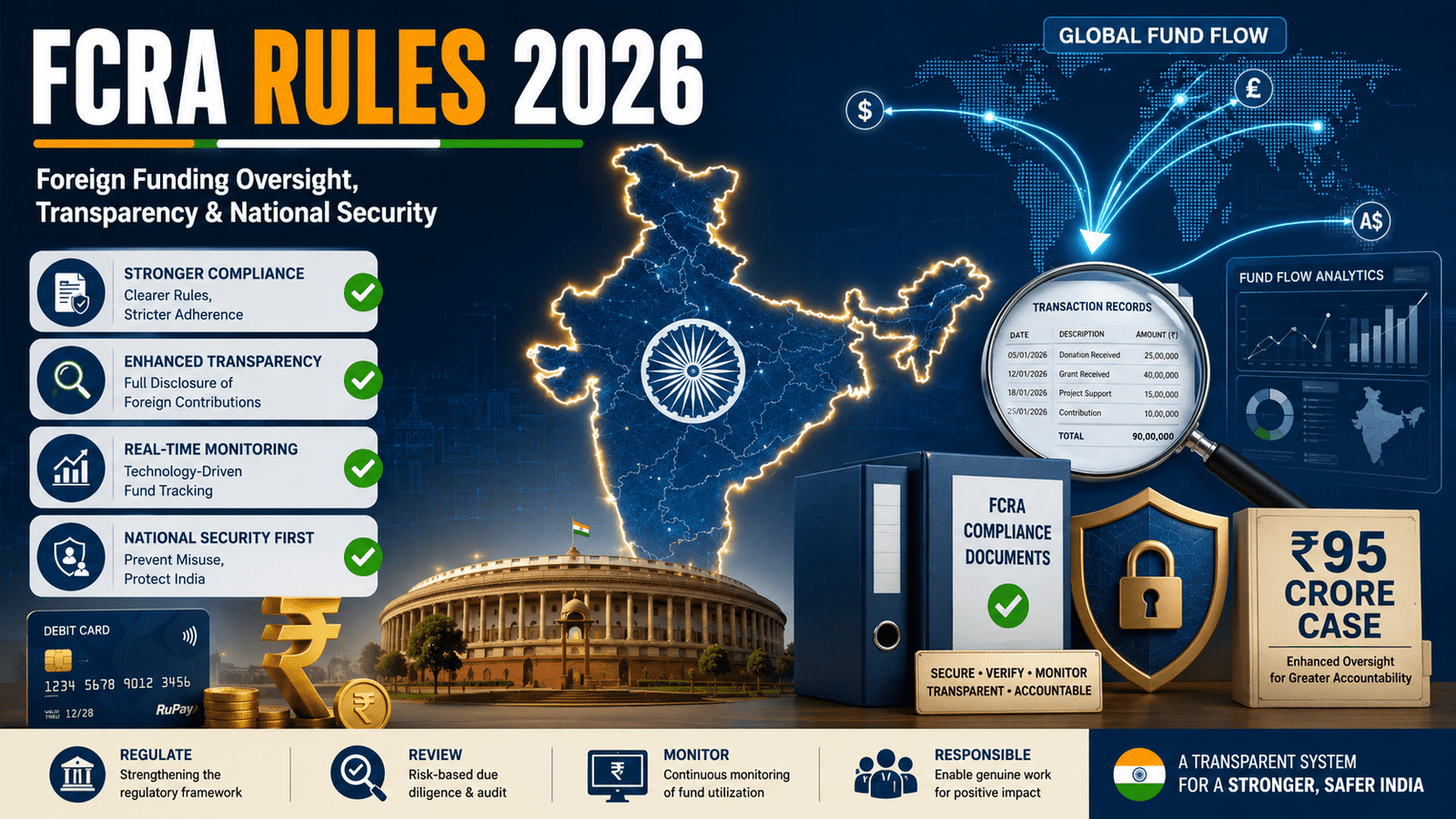
New FCRA Rules 2026: Why India Is Tightening Foreign Funding Oversight for National Security

India has tightened its foreign funding rules under the Foreign Contribution Regulation Act, better known as FCRA. The new FCRA framework is being seen as an important step to ensure that foreign donations entering India are used for genuine social, religious, educational and charitable work — not for unlawful activity, political manipulation, forced conversion or threats to national security.
Foreign funding itself is not wrong. Many NGOs, schools, hospitals, disaster-relief groups and religious institutions do valuable work with transparent donations. But when foreign money is routed through unclear channels, withdrawn in cash and used outside the approved purpose, it becomes a serious national security concern.
That is why the new FCRA rules matter.
What Is FCRA and Why Does It Matter?
The Foreign Contribution Regulation Act regulates how individuals, associations, NGOs and companies receive and use foreign contributions in India. Its core purpose is to ensure that foreign money is not used in a way that harms India’s national interest, public order or security.
In simple words, FCRA is not against charity. It is against hidden influence.
India is a large, diverse and sensitive country. Foreign funds can support hospitals, education, disaster relief and community service. But if misused, the same money can be diverted into illegal religious conversion networks, unlawful political activity, extremist ecosystems, personal enrichment or social unrest.
That is why transparency is essential.
What Are the New FCRA Rules?
The Ministry of Home Affairs has notified the Foreign Contribution Regulation Amendment Rules, 2026, introducing clearer rules for organisations receiving foreign funds under the “religious” category.
The new rules define what qualifies as permissible religious activity. These include construction, renovation and maintenance of places of worship such as temples, mosques, churches, gurudwaras, monasteries, synagogues and other religious places.
They also allow activities such as preservation of sacred scriptures, religious education, moral instruction, satsangs, discourses, meditation retreats, pilgrim amenities, community kitchens, langars, annadans and documentation of indigenous and tribal faith practices.
But the key point is this: activities involving proselytisation are excluded.
This means foreign funds cannot be used as a tool for religious conversion campaigns under the cover of charity or social service.
Why the Government Is Tightening Compliance
The new rules also expand accountability by introducing the term “key functionary.” This includes directors, partners, trustees, office-bearers and anyone responsible for the management or control of an organisation.
Registration certificates must now clearly specify the exact purpose and geographical area of operation. Organisations must declare the states or Union Territories where they will work and choose their objectives from the prescribed schedule.
This is important because foreign funds should not enter India for one purpose and then be used for something else.
For example, if an organisation receives foreign funds for education, the money should not be used for political mobilisation or religious conversion. If it receives funds for religious maintenance, it should not be used for unlawful outreach activities.
Purpose-based transparency is the foundation of trust.
The ₹95 Crore Foreign Debit Card Case
The importance of stricter FCRA rules became clearer after a recent investigation involving The Timothy Initiative, a U.S.-based Christian missionary organisation.
According to reports, the Enforcement Directorate alleged that foreign debit cards linked to a U.S. bank were brought into India and used for repeated ATM cash withdrawals. The ED said 25 foreign debit cards, ₹40 lakh in cash and digital devices were seized during searches.
Investigators alleged that around ₹92.5 crore to ₹95 crore was channelled and used through foreign debit card transactions between November 2025 and April 2026. Reports also said more than 1,000 foreign-issued debit cards were allegedly distributed across India.
The case became even more serious because investigators said cash withdrawals were made in Left Wing Extremism-affected areas such as Bastar and Dhamtari in Chhattisgarh. Authorities are reportedly examining whether the funds were diverted toward Naxal-linked activity, unlawful conversion activity and other illegal purposes.
It is important to note that these are allegations under investigation. Courts will decide guilt or innocence. But even at the investigation stage, the case shows why foreign funding cannot be treated casually.
Why Debit Card Withdrawals Raise Red Flags
Foreign donations are supposed to enter India through regulated banking channels and approved FCRA accounts. This allows authorities to track the source, amount, purpose and utilisation of funds.
But when money is allegedly moved through foreign debit cards and withdrawn in cash, it becomes harder to monitor. Cash transactions reduce transparency. They can hide the final beneficiary. They can also make it difficult to verify whether funds were used for lawful charity or for unlawful influence networks.
That is why the debit card case has become a major example in the FCRA debate.
If foreign contributions are genuine, there should be no fear of transparent banking, proper accounting, audited records and legal compliance.
Foreign Funds, Religious Conversion and Demographic Concerns
India’s Constitution protects freedom of religion. Every individual has the right to follow, practice and peacefully propagate their faith within the limits of law. Genuine religious charity by any community should be respected.
However, forced conversion, fraudulent conversion or conversion through financial inducement is a serious concern. When foreign funds are allegedly used to target poor, tribal or vulnerable communities through dependency, pressure or material benefits, the issue is no longer only religious. It becomes a question of social harmony, local identity and national security.
This does not mean every Christian, Muslim, Hindu, Sikh, Buddhist or other religious organisation is guilty of wrongdoing. Many faith-based institutions do genuine social work. The concern is with illegal funding patterns, unregistered operations and alleged misuse of charity for conversion or extremist activity.
India must protect both religious freedom and national security. The two are not contradictory.
Why FCRA Reform Is Important for India
Stronger FCRA rules help India in several ways.
First, they protect national security by ensuring that foreign money is not used to influence internal affairs.
Second, they protect genuine NGOs. Honest organisations benefit when illegal operators are exposed because public trust improves.
Third, they protect vulnerable communities from coercion, manipulation or inducement-based conversion.
Fourth, they improve accountability by linking foreign funds to declared purposes and declared locations.
Fifth, they prevent foreign donors from indirectly shaping India’s politics, society or local conflicts through hidden funding networks.
The Balance India Must Maintain
India must be firm, but fair.
The government should act strongly against illegal foreign funding, fake charity, forced conversion, extremist financing and personal enrichment. At the same time, genuine NGOs working in health, education, disaster relief, poverty reduction and community service should not be unfairly targeted.
The solution is not to block all foreign donations. The solution is to make every rupee traceable, every project auditable and every organisation accountable.
Foreign money should serve India’s people, not foreign agendas.
Final Thoughts
The new FCRA rules are a major step toward transparency, accountability and national security. The ₹95 crore foreign debit card case shows why India needs strict monitoring of foreign-funded organisations, especially when money is allegedly routed outside normal banking channels and withdrawn in cash in sensitive regions.
India welcomes genuine charity. India respects lawful religious freedom. But India cannot allow foreign funds to be misused for illegal conversion networks, social destabilisation, extremist influence or demographic manipulation.
In the modern world, national security is not only about borders. It is also about money, influence, ideology and information.
The message of the new FCRA rules is clear: foreign donations are welcome when they are transparent, lawful and used for the declared public good. But hidden funding, unlawful activity and misuse of charity will face stricter scrutiny.
Disclaimer: This article is for informational and educational purposes only. It does not target any religion, community or lawful charitable organisation. Allegations mentioned in the article are based on publicly reported investigations and should be treated as allegations unless proven in cour