


























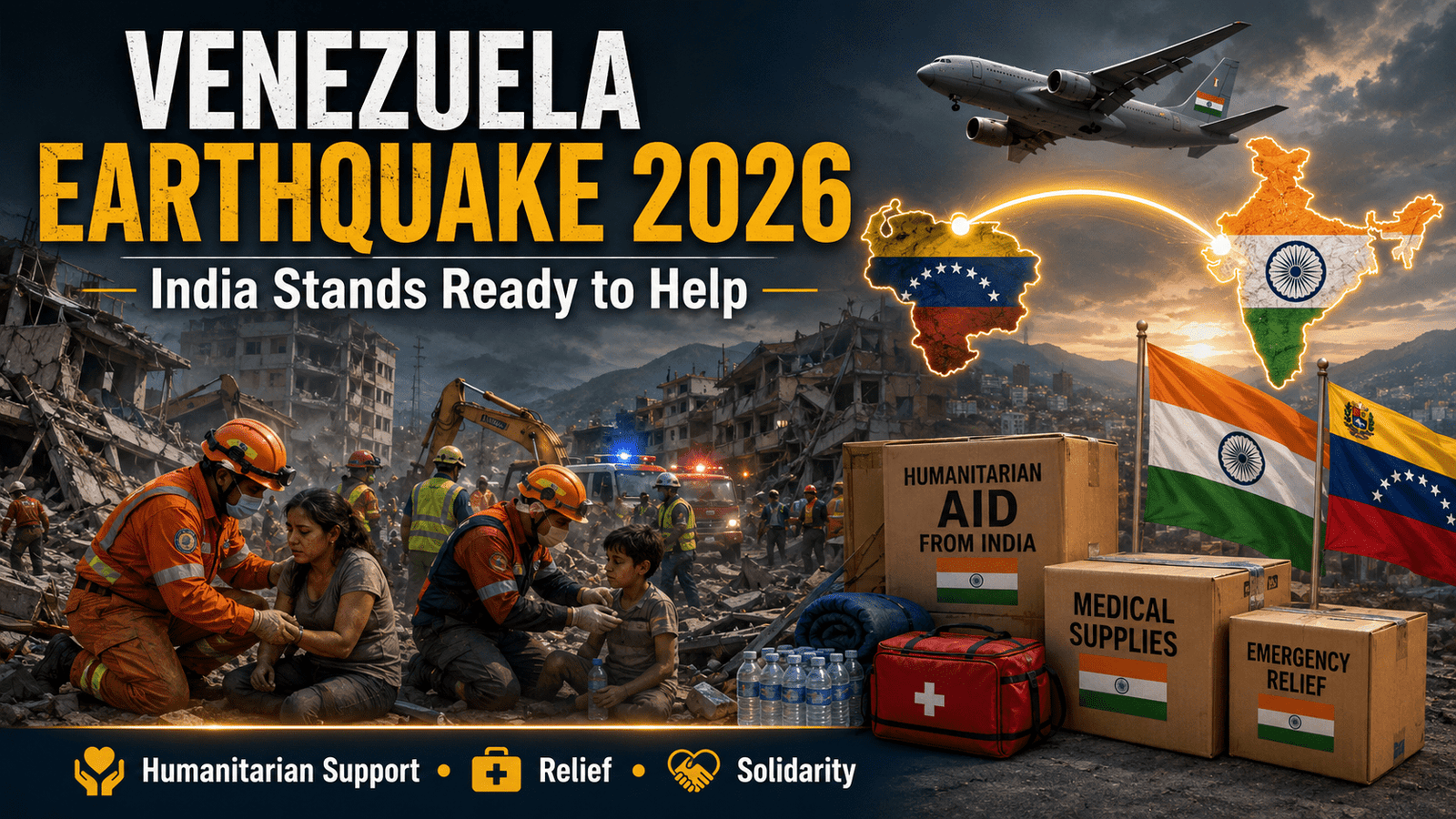
Venezuela Earthquake 2026: India Stands Ready to Help as Humanitarian Crisis Deepens

A powerful earthquake disaster in Venezuela has shaken the world, leaving families devastated, buildings damaged and rescue teams racing against time. As the crisis unfolds, India has once again stepped forward with a message of solidarity and support.
Prime Minister Narendra Modi expressed deep sadness over the severe earthquakes in Venezuela and offered condolences on behalf of the people of India. He also said that India stands ready to extend all possible assistance during this difficult time.
This response reflects a larger truth: India is no longer just a regional power. India is increasingly becoming a global humanitarian responder — a country that helps during disasters, even when political relations are complex.
What Happened in Venezuela?
Venezuela was hit by two powerful earthquakes near Caracas, causing major damage in several areas. Rescue operations are ongoing, and authorities fear that the number of casualties and displaced families may rise as more information comes from affected regions.
Buildings have collapsed, hospitals have been affected, and thousands of families are facing uncertainty. In such situations, the first 72 hours are extremely important. Search-and-rescue teams, emergency medical care, temporary shelters, food, water and medicines can save many lives.
That is why international support matters.
India’s Message: Humanity Comes First
PM Modi’s message was clear: India stands with Venezuela in this hour of grief. His statement was not just diplomatic language. It reflected India’s long-standing belief that humanitarian support should rise above politics.
India’s approach to global crises is rooted in the idea of Vasudhaiva Kutumbakam — the world is one family. When a natural disaster strikes, the first duty is to save lives, support the injured and help families recover.
India’s offer of assistance to Venezuela fits into this larger humanitarian philosophy.
What Kind of Help Can India Provide?
If Venezuela formally requests assistance, India can support in multiple ways depending on the needs on the ground.
India has experience in sending:
- emergency medicines
- tents and blankets
- food supplies
- rescue equipment
- field hospitals
- medical teams
- disaster-response specialists
- relief material through Air Force aircraft or naval assets
India’s National Disaster Response Force, Armed Forces, medical teams and diplomatic network have previously handled large-scale emergency operations abroad. This makes India capable of responding quickly when partner countries need help.
India’s Track Record: From Nepal to Turkey
India’s response to Venezuela is not an isolated case. Over the years, India has repeatedly helped countries during earthquakes, floods, wars, evacuations and health emergencies.
Nepal Earthquake: Operation Maitri
When Nepal was hit by a devastating earthquake in 2015, India launched Operation Maitri. India sent aircraft, relief supplies, NDRF teams, medical support and rescue teams within hours. Thousands were rescued, and India later supported Nepal’s long-term reconstruction.
This showed India’s role as a natural first responder in South Asia.
Turkey and Syria Earthquake: Operation Dost
In 2023, after the devastating Turkey-Syria earthquake, India launched Operation Dost. Indian aircraft carried rescue teams, medical staff, equipment and relief material. An Indian Army field hospital was set up in Turkey to treat injured civilians.
This was significant because India helped Turkey despite political disagreements. Turkey has often taken positions on India-related issues that many Indians strongly disagree with. But when disaster struck, India did not respond with bitterness. India responded with humanity.
That is the difference between narrow politics and civilizational confidence.
India Helps Even When Politics Is Complicated
India’s humanitarian diplomacy is unique because it does not wait for perfect political alignment. Whether it is Nepal, Turkey, Syria, Myanmar, Maldives, Sri Lanka or other crisis-hit regions, India has shown that people’s lives come first.
This is important for the world to understand.
A country can disagree politically and still help during a disaster. A country can defend its national interest and still show compassion. India does both.
That is why India’s global image is changing. India is not only seen as an economic power or a defence power. It is increasingly seen as a responsible power.
Why Humanitarian Assistance Builds India’s Global Respect
Humanitarian aid is not just charity. It is also soft power, trust-building and responsible leadership.
When India sends doctors, rescue workers, medicines and relief supplies, it builds goodwill among ordinary people. It shows that India’s rise is not selfish. India wants to contribute to global stability and human dignity.
This matters especially in the Global South, where many countries face climate disasters, earthquakes, floods, food insecurity and health emergencies.
India understands these challenges because it has faced them itself. That gives India’s response a sense of empathy.
Venezuela Crisis and India’s Global Role
The Venezuela earthquake has again shown why the world needs quick humanitarian coordination. Disasters do not respect borders. A tragedy in Latin America can become a global concern when thousands of people need help.
India’s offer to assist Venezuela sends a powerful message: distance does not reduce responsibility.
Even though Venezuela is geographically far from India, the humanitarian principle remains the same. If people are suffering, help should come.
A Responsible Power in a Divided World
Today’s world is divided by wars, sanctions, rivalries and geopolitical tensions. But disasters remind us that humanity is bigger than politics.
India’s response to Venezuela fits the image of a country that wants to be a bridge-builder. It does not see humanitarian aid as a bargaining tool. It sees it as a moral duty.
This is why India’s crisis-response model deserves attention. It combines speed, professionalism, compassion and strategic responsibility.
Final Thoughts
The Venezuela earthquake is a tragedy that needs urgent global attention. Families need rescue, medical help, shelter and emotional support. India’s message of solidarity shows that New Delhi is ready to stand with the Venezuelan people.
From Nepal to Turkey, from Syria to Myanmar, India has repeatedly shown that it can act quickly in times of crisis. Even when countries have political disagreements with India, India does not turn away from human suffering.
That is the real strength of a rising India.
India’s message to the world is simple: in times of disaster, humanity must come first.
Disclaimer: This article is for informational and educational purposes only. Disaster updates can change quickly. Readers should follow official government and humanitarian agency updates for the latest information.