














































Data Centers in Space: The Next Big Leap in AI Infrastructure — Is India Ready?

The world is running out of easy answers for the AI infrastructure boom. Artificial intelligence needs massive computing power, and that computing power needs data centers. But data centers on Earth require huge amounts of electricity, land, cooling systems, water and grid capacity.
This is why a futuristic idea is suddenly becoming serious: data centers in space.
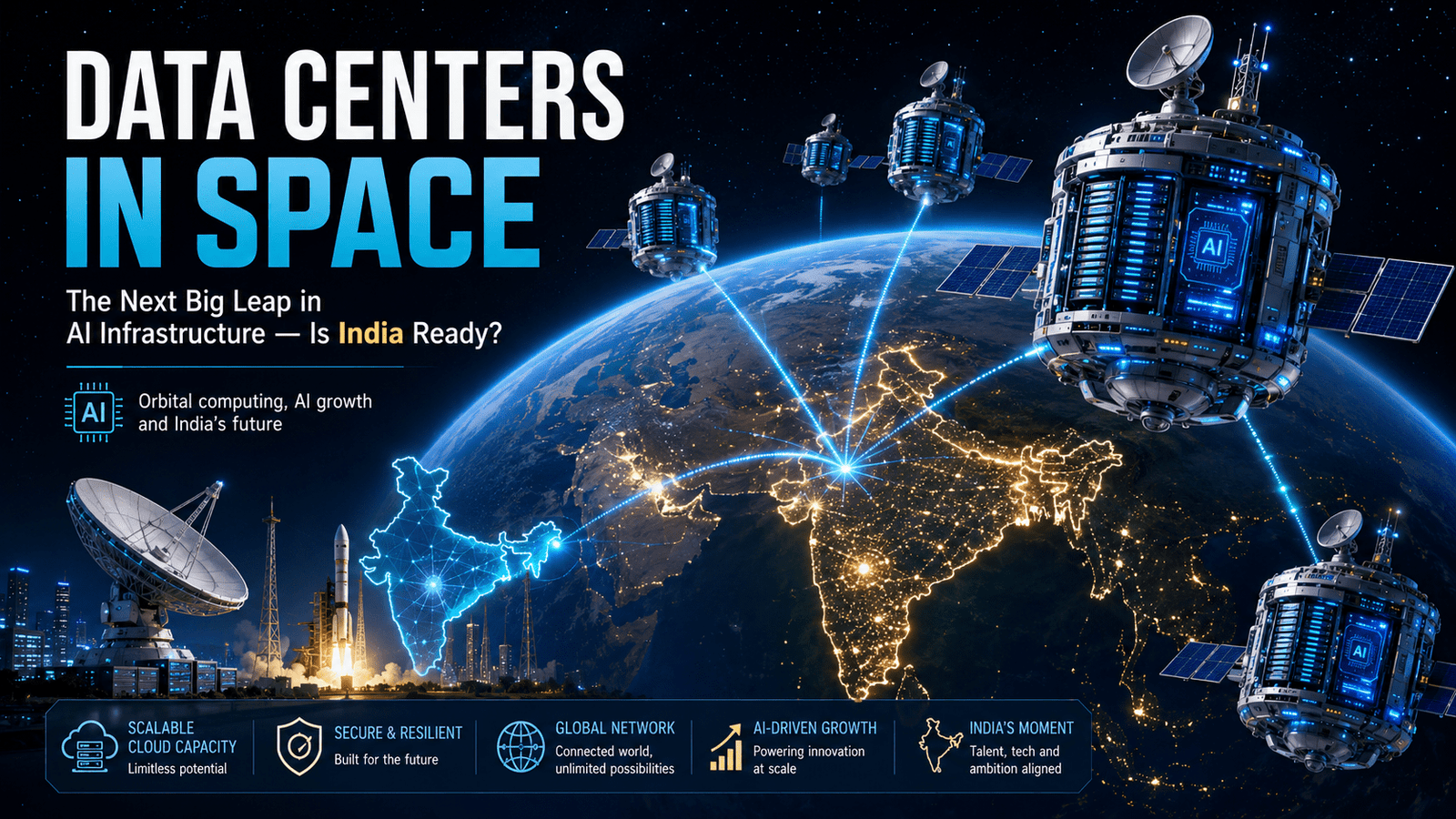
It sounds like science fiction, but some of the world’s biggest technology and space companies are already exploring it. The idea is simple but bold: instead of building all AI data centers on Earth, place powerful computing systems in orbit, powered by solar energy, cooled by space conditions and connected to Earth through laser communication links.
If successful, space-based data centers could become one of the biggest infrastructure shifts of the AI age.
What Is a Space Data Center?
A space data center is a satellite or satellite cluster that can process, store and transmit data from orbit. Instead of sending all raw data back to Earth for processing, satellites can perform computing directly in space.
This is especially useful for Earth observation, defence monitoring, disaster response, climate tracking, satellite imagery, maritime surveillance and AI inference.
For example, a satellite may capture thousands of images of Earth. Instead of sending every image to a ground station, an onboard AI system can process the images in orbit and send only useful results. This reduces bandwidth, saves time and improves real-time decision-making.
In the future, larger orbital data centers may even support AI workloads, cloud services and space-based computing networks.
Why Are Companies Looking at Space?
The biggest reason is energy.
AI data centers on Earth are power-hungry. As AI models become larger, the demand for GPUs, TPUs, cooling and electricity is increasing rapidly. Many countries are already facing pressure on power grids because of data center expansion.
Space offers one major advantage: almost continuous solar energy in certain orbits.
A satellite-based data center can directly use solar power without depending on local electricity grids. Space also removes land constraints. No city approvals, no real-estate pressure and no direct competition with agricultural or residential land.
Another advantage is proximity to space-generated data. Satellites already produce enormous amounts of information. Processing that data in orbit may be faster and more efficient than sending everything to Earth first.
Google’s Project Suncatcher
Google is one of the most serious players in this field. Its Project Suncatcher is exploring solar-powered satellite constellations equipped with Tensor Processing Units, or TPUs, for machine learning compute in space.
The goal is not to replace Earth data centers immediately. The goal is to test whether AI chips can survive and operate efficiently in orbit, where radiation, temperature swings and communication challenges are very different from Earth.
Google is reportedly working with Planet Labs to test prototype satellites by early 2027. If successful, this could become one of the first major steps toward large-scale orbital AI infrastructure.
SpaceX and the Orbital AI Race
SpaceX is also being linked to the idea of AI data centers in space. Reports suggest that Elon Musk’s companies are exploring satellite-based AI computing systems that could eventually combine launch capability, satellite networks, AI hardware and space infrastructure.
This gives SpaceX a unique advantage. It already has rockets, Starlink experience and satellite deployment capability. If orbital computing becomes practical, SpaceX could become one of the strongest players because it controls much of the launch pipeline.
However, many details remain unconfirmed. The technology is still early, and the economics are far from settled.
Europe’s ASCEND Project
Europe is also thinking seriously about space data centers. The ASCEND project, led by Thales Alenia Space for the European Commission, studied whether large-capacity data centers could be placed in space with lower environmental impact.
The study found that the idea may be technically feasible, but there is a major condition: launch systems must become much cleaner. If rockets remain highly emission-intensive, the environmental benefit of space data centers becomes weaker.
This is an important point. Space data centers are not automatically “green.” Their environmental value depends on launch cost, launcher emissions, satellite life, orbital debris management and replacement cycles.
China’s Space Computing Push
China is also entering the race. Recent reports say China has launched a space computing industry initiative to bring together satellite firms, chip companies, AI developers and launch providers.
China’s approach appears more state-coordinated than the private-sector-led models seen in the United States. This matters because space computing is not just a commercial opportunity. It is also linked to national security, communication networks, satellite intelligence and future military technology.
If China moves quickly, space-based AI infrastructure could become another area of strategic competition.
Starcloud and the Startup Race
Startups are also trying to build this market early. Starcloud, formerly linked with Lumen Orbit, is positioning itself as a company focused on building data centers in space. Its pitch is based on solar power, lower electricity costs and the future needs of AI.
Such companies may not immediately compete with Google or SpaceX at hyperscale, but they can test early business models, smaller orbital compute nodes and satellite-to-satellite services.
In technology revolutions, startups often move faster than large institutions. Space data centers may follow the same pattern.
Is India Thinking in This Direction?
Yes, India is beginning to move in this direction — but still at an early stage.
India has not yet announced a Google-scale national orbital data center program. But Indian startups are already experimenting with orbital AI and space-based computing.
Hyderabad-based TakeMe2Space developed the MOI-TD payload, described by ISRO as an AI lab in space. It demonstrated real-time data processing for Earth observation, including uplinking machine learning models, running in-orbit computation and downlinking inferences.
This is important because it proves that India is not completely outside the race. Indian startups are already testing the building blocks of orbital computing.
Another major development is the partnership between Agnikul Cosmos and NeevCloud, which aims to build India’s first privately led AI data center in space. Their pilot is expected to focus on low-Earth orbit AI inference, not massive training workloads.
This is the right first step. India does not need to immediately build a giant space cloud. It should begin with practical orbital edge computing, satellite image processing, disaster monitoring, defence applications, agriculture intelligence and maritime surveillance.
Why India Should Care
India wants to become a leader in artificial intelligence, space technology and digital infrastructure. Space data centers connect all three.
For India, the opportunity is not only commercial. It is strategic.
Space-based computing can help India in:
- real-time satellite image analysis
- border and maritime surveillance
- disaster response
- cyclone and flood monitoring
- agriculture mapping
- climate research
- defence intelligence
- secure sovereign AI infrastructure
- satellite communication networks
India has already proven itself through ISRO’s low-cost launch capability, Chandrayaan, Mars Orbiter Mission, Aditya-L1 and private space reforms. The next step is to combine space capability with AI capability.
That is where orbital data centers become important.
The Big Challenges
Space data centers are exciting, but they are not easy.
The first challenge is cost. Launching hardware into orbit is still expensive, even though launch costs have fallen.
The second challenge is cooling. Space is cold, but cooling electronics in a vacuum is difficult because there is no air to carry heat away. Systems must use radiators and careful thermal design.
The third challenge is communication. AI workloads require huge data movement. Ground data centers can move massive data internally through fiber networks. Space systems must depend on laser links, satellite relays and limited ground station windows.
The fourth challenge is maintenance. If a data center fails on Earth, engineers can repair it. If a satellite data center fails in orbit, repair is much harder.
The fifth challenge is orbital debris. More satellites mean more responsibility. Space infrastructure must not create long-term debris risks.
Will Space Data Centers Replace Earth Data Centers?
Not soon.
For the next several years, space data centers will likely complement Earth data centers rather than replace them. The best early use cases will be satellite data processing, AI inference in orbit, defence monitoring, space-to-space services and specific low-latency applications.
Large-scale AI model training will probably remain on Earth for now because it needs massive hardware, maintenance, cooling, networking and physical upgrades.
But the direction is clear: the future digital infrastructure may not be only terrestrial. It may become a hybrid system — Earth data centers, edge devices, satellites and orbital compute working together.
Final Thoughts
Data centers in space are no longer just a fantasy. Google, SpaceX, China, Europe and startups are all exploring the idea because AI is pushing Earth-based infrastructure to its limits.
India should not ignore this race.
The country is already building data centers on Earth, expanding AI capability and growing its private space ecosystem. But the future may require a new ambition: combining ISRO’s space experience, Indian startup innovation and sovereign AI infrastructure into a long-term orbital computing strategy.
India does not need to copy the West blindly. It should build practical, affordable and mission-driven space computing systems for Indian needs first.
The future of AI may not only be in Silicon Valley data centers. Some of it may be above Earth, powered by the Sun, orbiting the planet and processing intelligence from space.
If India wants to lead the next technology era, it must look beyond land, beyond cloud and beyond old limits.
The next data center may not be built in a city. It may be launched into orbit.
FAQs
What is a data center in space?
A data center in space is a satellite or satellite network that can process, store and transmit data from orbit. It can reduce the need to send all raw satellite data back to Earth.
Why are companies interested in orbital data centers?
Companies are interested because space offers solar energy, no land constraints and the ability to process satellite data closer to where it is generated.
Is India working on space data centers?
India is at an early stage. Startups like TakeMe2Space, Agnikul Cosmos and NeevCloud are exploring orbital AI computing and space-based data center concepts.
Will space data centers replace Earth data centers?
Not soon. They will likely complement Earth data centers, especially for satellite data processing, defence, disaster monitoring and AI inference in orbit.
What are the biggest challenges?
The main challenges are launch cost, cooling, communication bandwidth, maintenance, radiation, reliability and orbital debris management.
Disclaimer: This article is for informational and educational purposes only. It should not be considered investment, technical, defence or policy advice. Space-based data center technology is still emerging and commercial viability remains uncertain.