





























Operation Amistad Underway: India Dispatches Relief and Medical Aid to Earthquake-Hit Venezuela

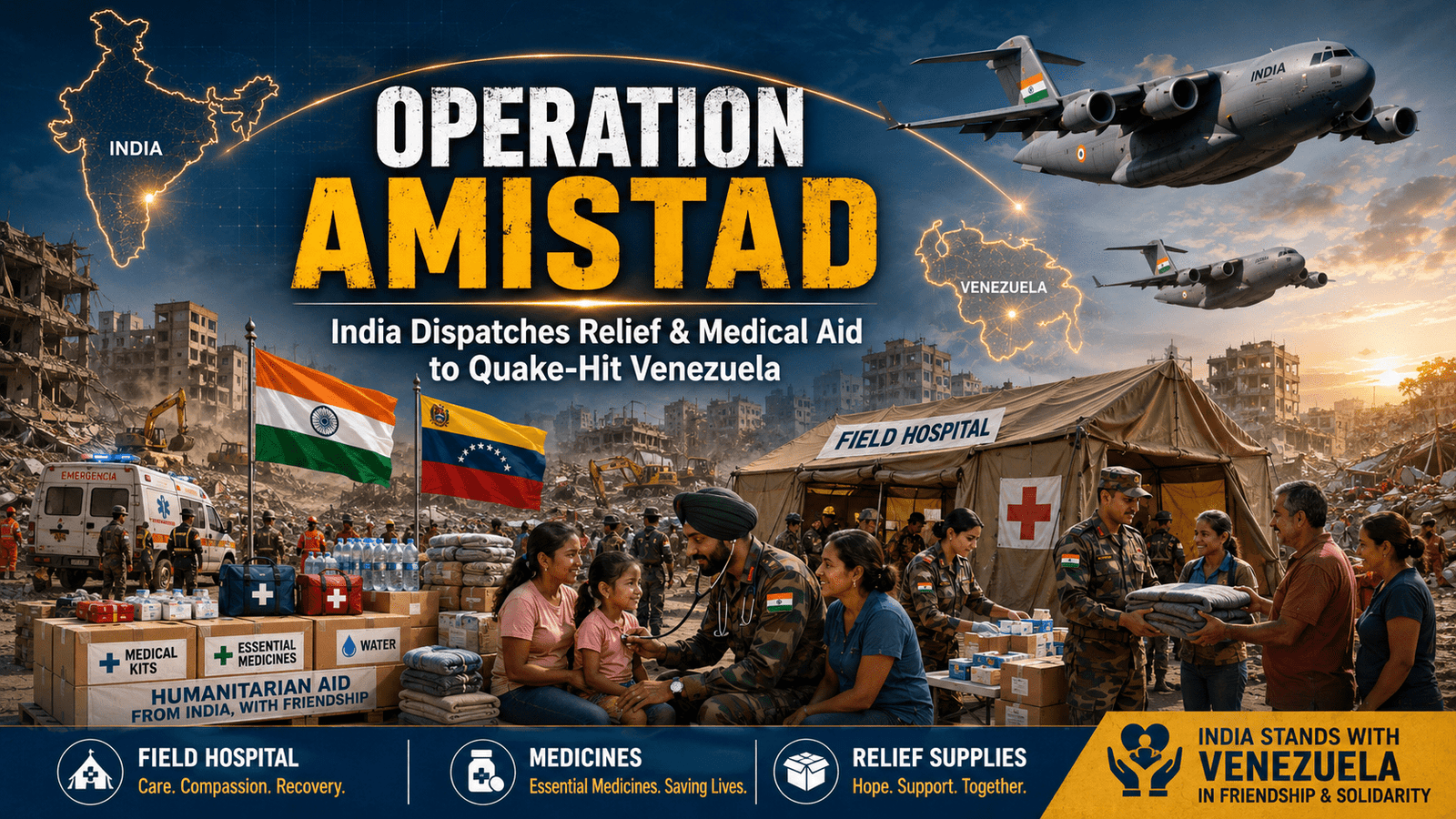
India has once again shown why it is becoming one of the world’s most trusted humanitarian responders. After devastating twin earthquakes struck Venezuela, India launched Operation Amistad to send urgent medical and relief assistance to the disaster-hit country.
The word Amistad means friendship in Spanish, and the name itself carries a powerful message: when people are suffering, humanity must come before politics, distance or ideology.
Under this mission, two Indian Air Force C-17 aircraft have taken off for Venezuela with an Indian Army Field Hospital Unit, medical supplies, emergency equipment and more than 35 tonnes of humanitarian relief material.
For Venezuela, this aid comes at a critical moment. For India, it is another example of a rising power that does not only speak about global responsibility but acts when disaster strikes.
What Happened in Venezuela?
Venezuela was hit by two powerful earthquakes within a very short time, causing large-scale destruction across northern regions, including areas around Caracas and La Guaira. Buildings collapsed, hospitals were overwhelmed, families were displaced and rescue teams began searching through rubble for survivors.
Casualty numbers have been changing rapidly as rescue operations continue. Early reports cited hundreds of deaths and thousands of injuries, while later international updates suggested the toll may rise further as more bodies are recovered and missing people are traced.
In such disasters, the first few days are extremely important. Medical teams, trauma care, emergency surgeries, clean water, shelter, medicines and rescue coordination can save many lives.
That is why India’s rapid response matters.
What Is Operation Amistad?
Operation Amistad is India’s humanitarian relief mission for earthquake-hit Venezuela. External Affairs Minister Dr S. Jaishankar announced that two Indian Air Force C-17 aircraft had taken off with urgent assistance to support Venezuela’s post-earthquake relief efforts.
The assistance includes:
- Indian Army Field Hospital Unit
- more than 35 tonnes of relief supplies
- medicines and medical equipment
- specialised medical personnel
- emergency treatment capability
- two BHISHM Cubes for rapid medical support
The mission is being carried out by the Indian Army in coordination with the Indian Air Force and the Ministry of External Affairs.
Why the C-17 Aircraft Matter
The Indian Air Force C-17 Globemaster is a heavy-lift transport aircraft used for long-distance military and humanitarian missions. It allows India to move large quantities of relief material, medical teams and emergency equipment quickly across continents.
This is important because Venezuela is geographically far from India. Yet India has shown that distance is not a barrier when humanitarian assistance is needed.
A country that can rapidly deploy medical aid across the world has more than diplomatic influence. It has real crisis-response capability.
Indian Army Field Hospital: Saving Lives on the Ground
One of the most important parts of Operation Amistad is the Indian Army Field Hospital Unit. In a disaster zone, local hospitals may be damaged, overcrowded or short of supplies. A field hospital can provide emergency care where normal medical infrastructure is struggling.
The Indian medical contingent is expected to provide trauma care, emergency surgeries, life-saving treatment, wound management and urgent medical support for earthquake victims.
This is not symbolic aid. This is practical, life-saving assistance.
India has used similar medical capabilities in previous international disaster missions, including during the Turkey-Syria earthquake response under Operation Dost.
BHISHM Cubes: India’s Indigenous Emergency Medical Innovation
Operation Amistad also includes BHISHM Cubes, India’s portable emergency medical facilities developed under the Aarogya Maitri Project.
These modular medical units are designed for rapid deployment during disasters, wars and humanitarian emergencies. They can be transported quickly, set up in difficult conditions and used to provide critical medical care.
The BHISHM Cube reflects India’s growing ability to combine humanitarian diplomacy with indigenous technology. India is not only sending aid; it is sending advanced Indian-made emergency medical capability.
India’s Message: Humanity Comes First
Prime Minister Narendra Modi had earlier expressed condolences to the people of Venezuela and said India stands ready to extend all possible assistance.
That statement has now turned into action through Operation Amistad.
India’s response shows a clear foreign policy principle: when disaster strikes, humanity comes first. Whether the country is near or far, whether relations are simple or complicated, India has repeatedly stepped forward during humanitarian crises.
This is the spirit of Vasudhaiva Kutumbakam — the world is one family.
India’s Track Record as a First Responder
Operation Amistad is not an isolated event. It is part of India’s growing record in Humanitarian Assistance and Disaster Relief.
Operation Maitri: Nepal Earthquake
In 2015, after the devastating Nepal earthquake, India launched Operation Maitri. Indian rescue teams, aircraft, medical units and relief supplies reached Nepal quickly. India helped with evacuation, rescue, food, medical care and reconstruction support.
This showed India’s role as a natural first responder in South Asia.
Operation Dost: Turkey and Syria Earthquake
In 2023, after the powerful Turkey-Syria earthquake, India launched Operation Dost. India sent NDRF teams, medical specialists, relief supplies and an Indian Army field hospital to help victims.
This was especially important because India and Turkey have had political differences, particularly over issues related to India’s internal matters. But India did not allow political disagreement to block humanitarian support.
That is the strength of India’s civilizational approach: national interest and humanity can exist together.
Other Humanitarian Missions
India has also helped countries during floods, cyclones, earthquakes, wars, evacuations and health emergencies. From neighbourhood-first relief operations to global emergency assistance, India has built a reputation for fast and reliable response.
Why Operation Amistad Matters for India’s Global Image
Humanitarian missions create trust that cannot be built through speeches alone.
When Indian aircraft land with doctors, medicines and relief supplies, ordinary people remember India as a friend. This strengthens India’s soft power, diplomatic credibility and leadership image in the Global South.
Operation Amistad also shows that India’s military capability is not only for defence. It is also used for compassion, rescue and global responsibility.
A strong country protects itself. A responsible country helps others.
India is trying to be both.
A New India on the World Stage
India’s humanitarian role is growing at a time when the world is divided by wars, sanctions, ideological conflicts and geopolitical rivalries. In such a world, disaster relief becomes a powerful test of character.
Operation Amistad sends a clear message: India is willing to help where help is needed.
It also shows the coordination between Indian diplomacy, the Air Force, the Army and indigenous emergency medical technology. This is the kind of capability that makes India more than a regional power.
It makes India a global responder.
Final Thoughts
Operation Amistad is more than a relief mission. It is a symbol of India’s rising humanitarian leadership.
As Venezuela struggles with one of its worst natural disasters, India has sent aircraft, medical teams, field hospital capability, medicines and relief supplies. The mission reflects friendship, compassion and responsibility.
From Nepal to Turkey, from Syria to Venezuela, India has repeatedly shown that it does not remain silent when people are suffering.
The world often measures power through weapons, money and influence. But real power is also measured by how quickly a country helps others in their darkest hour.
With Operation Amistad, India has once again shown that it stands for humanity.
Disclaimer: This article is for informational and educational purposes only. Disaster figures and relief updates may change as official information is revised. Readers should follow official government and humanitarian agency updates for the latest details.