















































Kitakyushu Eco Model: How Telangana Plans to Build India’s Japan-Inspired Green City

India’s cities are growing fast, but so are their problems: garbage, pollution, water stress, traffic, industrial waste and rising carbon emissions. Telangana now wants to try a different model — a cleaner, smarter and more sustainable city inspired by Japan’s famous Kitakyushu Eco-Town.
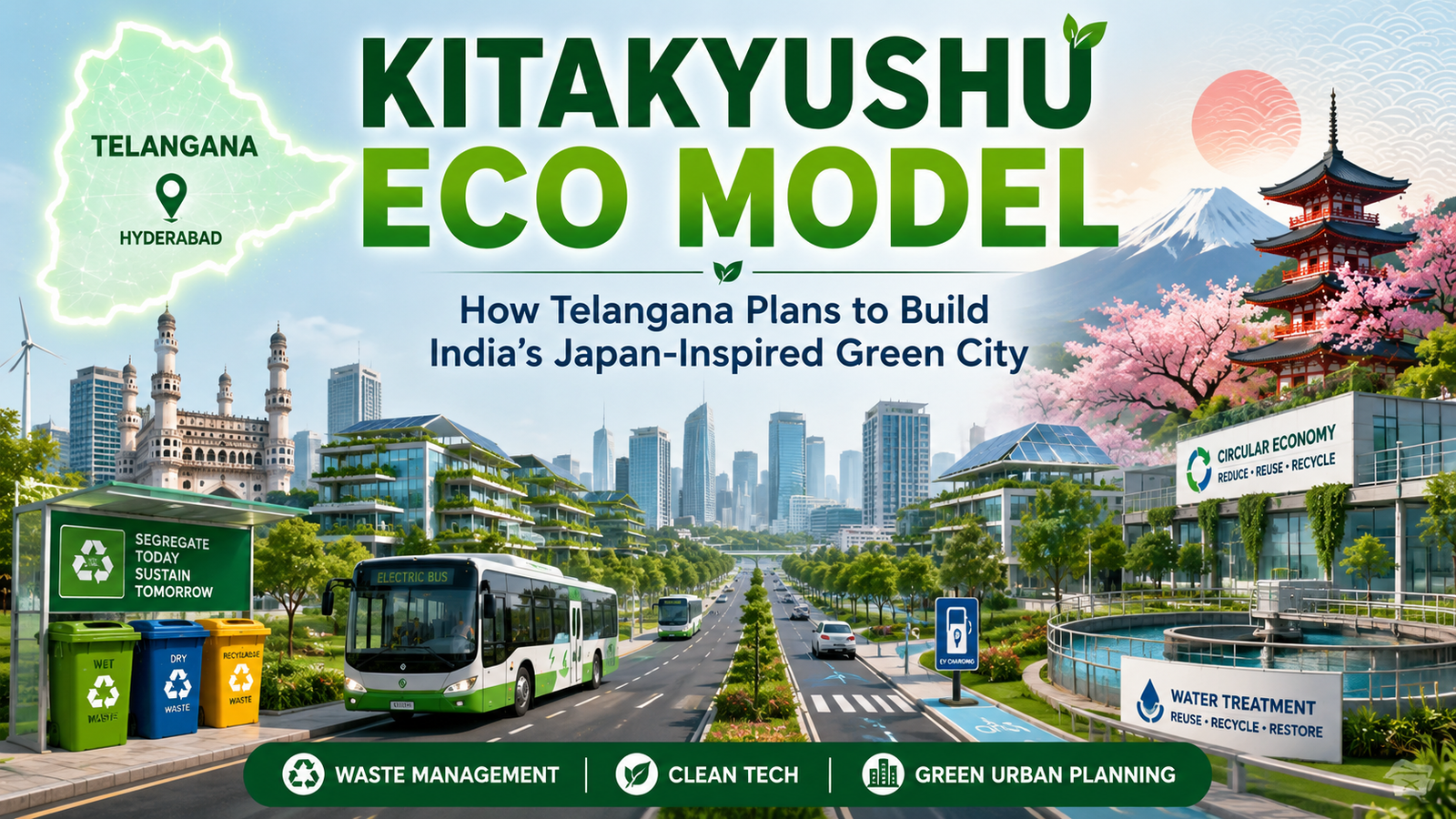
The Telangana government has announced plans to develop an 80-acre eco-town near Hyderabad, based on the Japanese city of Kitakyushu. The project is expected to focus on sustainable development, clean technologies, circular economy, Net Zero targets and urban innovation.
If executed properly, this could become one of India’s most important green-city experiments over the next decade.
What Is the Kitakyushu Eco Model?
Kitakyushu was once one of Japan’s most polluted industrial cities. Heavy industries such as steel and manufacturing helped the city grow, but they also created serious air and water pollution.
Instead of shutting down industry completely, Kitakyushu changed its development model.
The city brought together government, companies, researchers and citizens to clean the environment while keeping economic growth alive. The result was the Kitakyushu Eco-Town, a model where waste is not treated as useless garbage but as a resource.
In simple words, one company’s waste can become another company’s raw material.
For example, plastic, metals, electronics, construction waste, household appliances and industrial by-products can be recycled, reused or converted into energy. This reduces landfill pressure and creates green jobs.
Why Telangana Is Looking at Kitakyushu
Telangana wants to build a future-ready eco-town that can support growth without repeating the mistakes of polluted urbanisation.
State IT and Industries Minister D. Sridhar Babu said the proposed eco-town is inspired by Kitakyushu and will focus on sustainable development. The idea comes after cooperation between Telangana and Kitakyushu, including plans around Net Zero goals, circular economy practices, clean technologies, riverfront development and digital innovation.
Chief Minister Revanth Reddy has also said that Kitakyushu’s eco-town model inspired Telangana to develop a similar model in Hyderabad.
This is important because Hyderabad is expanding rapidly. A green industrial and urban model can help the city manage waste, attract Japanese investment and create new jobs in clean technology.
What Can This Eco-Town Include?
The Telangana eco-town can include recycling plants, waste-to-energy systems, clean-tech industries, research centres, green buildings, water treatment systems, solar power, pollution monitoring and skill-development facilities.
The goal should not be only to build a township with greenery. The real goal should be to create a working ecosystem where industry, environment and people can grow together.
A true eco-town should have:
- proper waste segregation
- recycling industries
- clean energy systems
- water recycling
- low-emission transport
- green jobs
- public awareness programs
- transparent pollution monitoring
This is how Telangana can turn the project from a real-estate idea into a real environmental model.
Why This Matters for India
India produces huge amounts of urban and industrial waste every year. Most cities struggle with landfills, untreated sewage, polluted lakes and weak recycling systems.
If Telangana successfully builds a Kitakyushu-style eco-town, other Indian states may follow the model.
This can help India in three major ways.
First, it can reduce waste and pollution. Second, it can create green jobs and attract investment. Third, it can support India’s climate and Net Zero goals.
The project also fits India’s bigger need: cities must grow, but they must grow responsibly.
The Biggest Challenge: Execution
The idea is excellent, but execution will decide success.
India has seen many smart-city and green-city announcements, but many fail because of weak planning, poor maintenance and lack of public participation.
Kitakyushu worked because citizens, companies and local government worked together. Telangana must do the same.
Waste must be separated at source. Industries must follow strict standards. Pollution data must be public. Residents must be educated. Green technology must be practical, not just decorative.
If the eco-town becomes only a branding project, it will fail. If it becomes a working circular economy hub, it can become a national example.
Final Thoughts
Telangana’s plan to build an eco-town inspired by Japan’s Kitakyushu model is a bold and timely idea.
India needs cities that are not only bigger, but smarter and cleaner. The future of urban development cannot be based only on concrete, malls and highways. It must include recycling, clean energy, water conservation, green jobs and environmental responsibility.
Kitakyushu proved that an industrial city can transform into a green city. Telangana now has a chance to prove that India can do the same.
The next decade will show whether this becomes just another urban announcement or a real model for India’s sustainable future.
Disclaimer: This article is for informational and educational purposes only. Project details may change as official planning, approvals and implementation progress.