
































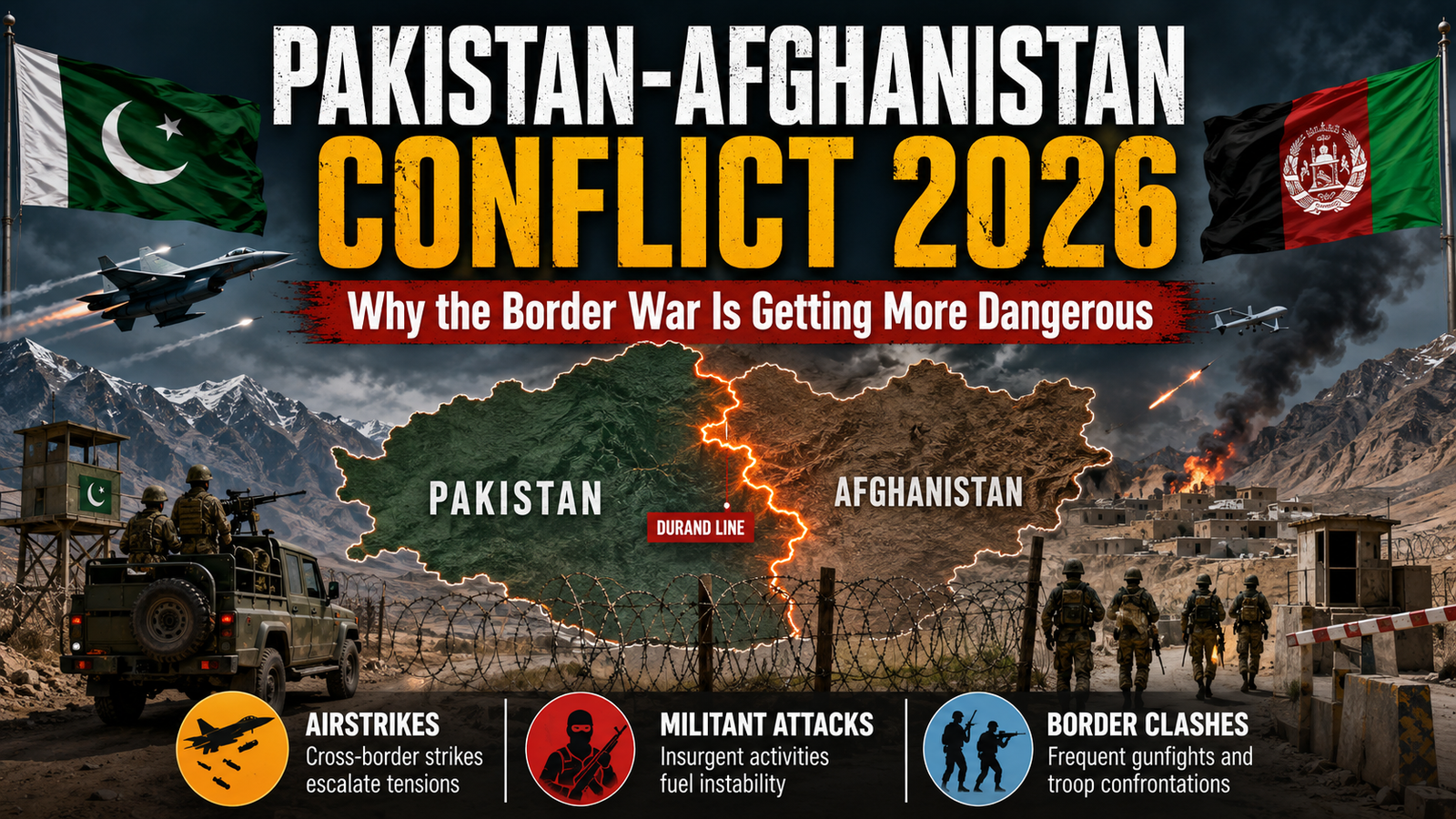
Pakistan-Afghanistan Conflict 2026: Why the Border War Is Getting More Dangerous

The conflict between Pakistan and Afghanistan has entered another dangerous phase after Pakistani airstrikes hit targets inside Afghanistan’s eastern provinces. The strikes have deepened tensions between Islamabad and the Taliban-led government in Kabul, raising fears of a wider border war.
Pakistan says its operations targeted militant hideouts linked to the Tehreek-e-Taliban Pakistan, or TTP, after a deadly attack in Karachi. Afghanistan’s Taliban government, however, says civilians were killed and has condemned the strikes as aggression.
This is no longer just a border dispute. It is a serious regional crisis.
What Happened Recently?
Pakistan carried out air and ground operations near the Afghanistan border, targeting suspected militant facilities in Paktia, Paktika and Kunar provinces.
The United Nations Assistance Mission in Afghanistan confirmed that at least 28 civilians were killed and 49 injured in the strikes. Afghan officials have claimed higher casualty numbers, including women and children.
Pakistan says it killed militants and destroyed weapons caches. Kabul denies allowing militants to use Afghan territory against Pakistan and has warned of retaliation.
The result is a dangerous cycle: Pakistan blames Afghanistan for sheltering militants, Afghanistan accuses Pakistan of violating its sovereignty, and civilians are trapped in the middle.
Why Pakistan and Afghanistan Are Fighting
The main issue is the TTP.
The TTP is a Pakistan-focused militant group that has carried out attacks inside Pakistan. Islamabad believes many TTP fighters operate from Afghan territory after the Taliban returned to power in Kabul in 2021.
Pakistan expected the Afghan Taliban to control or expel these groups. But that has not happened. Instead, attacks inside Pakistan have increased, especially against security forces.
Afghanistan’s Taliban government rejects Pakistan’s accusations and says Pakistan’s security problems are its internal matter.
This disagreement has turned into repeated border clashes, airstrikes and diplomatic breakdowns.
Border Closures Are Hurting Ordinary People
The Pakistan-Afghanistan border is not only a military line. It is also a lifeline for trade, families, workers and transport.
Repeated closures of crossings such as Torkham and Chaman have hurt traders, truck drivers, farmers and ordinary families on both sides. Afghan exports suffer, Pakistani border markets lose business, and prices rise.
When borders close, poor people suffer first.
Why This Conflict Matters for India
India must watch this conflict closely because instability in Afghanistan and Pakistan affects the entire region.
A prolonged Pakistan-Afghanistan war can increase terrorism, refugee pressure, drug trafficking, arms smuggling and regional instability. It can also weaken trade routes and create new opportunities for extremist groups.
For India, the situation also exposes Pakistan’s long-term strategic mistake. For decades, Pakistan supported militant networks as tools of influence. Today, some of those same forces are creating instability inside Pakistan itself.
This is a classic example of strategic blowback.
China and Regional Powers Are Worried
China, Saudi Arabia and other countries have tried to support dialogue between Pakistan and Afghanistan, but a stable solution remains difficult.
China is especially concerned because instability can affect its investments, regional connectivity projects and security interests. A border war between Pakistan and Afghanistan also complicates Beijing’s wider plans in Central and South Asia.
What Happens Next?
There are three possible paths.
First, both sides may return to talks and reduce tensions. This is the best outcome, but it requires trust, which is currently weak.
Second, Pakistan may continue limited airstrikes and border operations. This could keep pressure on militants but also increase civilian casualties and Taliban retaliation.
Third, the conflict may expand into a wider border war. That would be dangerous for the entire region.
Final Thoughts
The latest Pakistan-Afghanistan fighting shows how unstable the region remains after the Taliban’s return to power.
Pakistan wants Kabul to act against the TTP. Afghanistan denies sheltering militants and accuses Pakistan of attacking civilians. Meanwhile, ordinary Afghans and Pakistanis are paying the price through deaths, fear, border closures and economic disruption.
This conflict is a warning for South Asia: using militant groups as strategic tools can create long-term consequences that no border can fully contain.
Peace will require more than airstrikes. It will require honest dialogue, border security, action against militant networks and protection of civilians.
Until then, the Pakistan-Afghanistan border will remain one of the most dangerous flashpoints in Asia.
Disclaimer: This article is for informational and educational purposes only. Conflict details and casualty figures may change as new official updates emerge. Readers should follow verified news sources and official statements for the latest developments.