
















































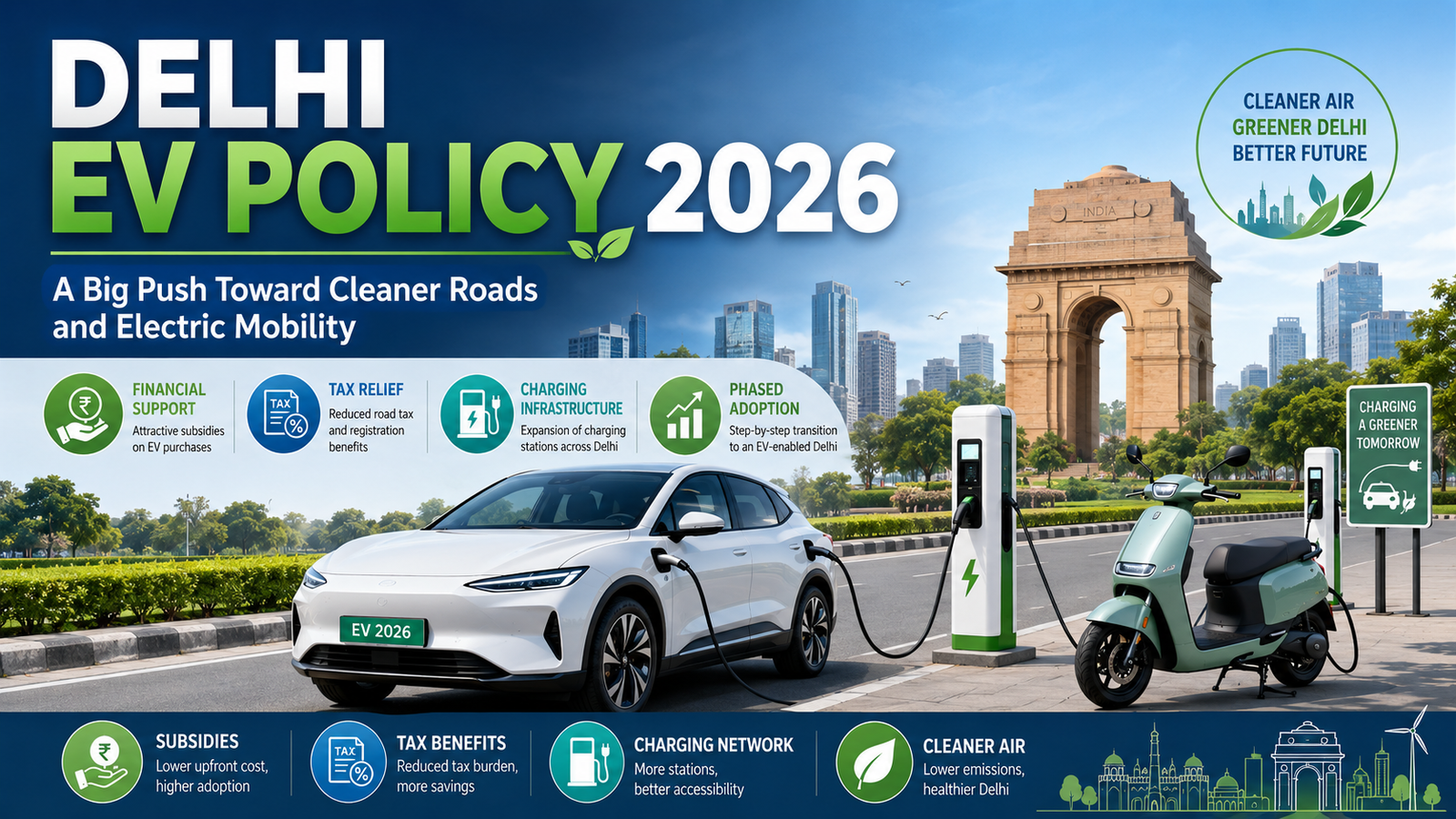
Delhi EV Policy 2026: A Big Push Toward Cleaner Roads and Electric Mobility

Delhi has taken a major step toward cleaner mobility with the launch of the Delhi Electric Vehicle Policy 2026. The new policy came into effect on July 1, 2026, and will remain valid until March 31, 2030.
The goal is simple but ambitious: reduce pollution, promote electric vehicles, expand charging infrastructure and make Delhi one of India’s leading EV cities.
For a city that regularly struggles with toxic air, traffic congestion and rising fuel costs, this policy could become a turning point.
What Is Delhi EV Policy 2026?
Delhi EV Policy 2026 is a roadmap to shift more vehicles from petrol, diesel and CNG to electric power.
The policy focuses on electric two-wheelers, three-wheelers, electric cars, goods carriers, charging stations and vehicle scrapping incentives. It also introduces deadlines after which some vehicle categories will move toward electric-only registration.
In simple language, Delhi wants more people to buy EVs and fewer new fossil-fuel vehicles on the road.
Big Subsidies for EV Buyers
One of the biggest attractions of the new policy is financial support.
Electric two-wheeler buyers can get subsidies up to ₹30,000 in the first year, followed by lower incentives in the second and third years.
Electric three-wheeler buyers can get up to ₹50,000 in the first year. This is important for auto drivers, delivery workers and small transport operators.
N1 category electric goods carriers can get incentives up to ₹1 lakh, which can help small businesses shift toward cleaner logistics.
This matters because EVs often have a higher upfront cost. Subsidies can make them more affordable for middle-class families, gig workers and commercial users.
Electric Cars Get Tax Relief
The policy offers 100% exemption on road tax and registration fees for electric cars with an ex-showroom price up to ₹30 lakh.
This can make EV cars more attractive for urban buyers who are already considering electric options but are worried about cost.
There is also a ₹1 lakh scrapping incentive for people who scrap old BS-IV or older four-wheelers and buy a new electric car within the required time period.
This is a smart move because old vehicles are a major source of pollution.
EV-Only Registration Deadlines
The policy also sets clear deadlines for some categories.
From January 1, 2027, only electric passenger and goods three-wheelers will be registered in Delhi.
From April 1, 2028, only electric two-wheelers will be eligible for new registration in the capital.
This is one of the strongest parts of the policy. Two-wheelers and three-wheelers form a huge part of Delhi’s traffic. If these segments shift to electric, the city can reduce fuel emissions significantly.
Charging Infrastructure Gets a Big Push
One of the biggest concerns for EV buyers is charging. People often ask: where will I charge my vehicle?
The Delhi government plans to install more than 30,000 EV charging points across the city. The policy also supports a single-window clearance system to make setting up charging stations easier.
EV dealerships, housing societies, private companies and public spaces are expected to play a larger role in expanding charging access.
This is critical because EV adoption cannot grow without reliable charging.
No Hybrid Subsidy: Delhi Chooses Full EV Path
The final policy does not include incentives for hybrid vehicles. Earlier discussions had considered benefits for strong hybrids, but the government has decided to focus on battery electric vehicles.
This shows that Delhi wants a direct transition toward zero-tailpipe-emission vehicles rather than a half-step approach.
Supporters say this will speed up the EV shift. Critics may argue that hybrids could have helped during the transition. But Delhi’s policy direction is now clear: full electric mobility is the priority.
Why This Policy Matters for Delhi’s Air Pollution
Delhi’s air pollution is one of India’s biggest urban challenges. Vehicles are not the only source of pollution, but they are a major contributor.
Electric vehicles can reduce tailpipe emissions, especially in crowded urban areas. Cleaner buses, autos, scooters and delivery vehicles can improve air quality where people live, work and travel every day.
However, EVs alone will not solve Delhi’s pollution crisis. The city also needs better public transport, cleaner construction, dust control, industrial regulation and regional coordination.
Still, EV adoption is an important part of the solution.
Challenges Ahead
The policy is ambitious, but implementation will decide success.
Delhi must ensure charging stations actually work, subsidies are paid on time, drivers are not burdened financially and low-income transport workers are supported during the transition.
Battery safety, recycling, electricity supply and repair infrastructure will also be important.
If the policy is implemented poorly, people may see EVs as expensive and inconvenient. If implemented well, Delhi can become a national model for clean mobility.
Final Thoughts
Delhi EV Policy 2026 is one of the strongest electric mobility pushes in India. It offers subsidies, tax exemptions, scrapping incentives, charging expansion and clear timelines for EV-only registration in key categories.
The policy sends a powerful message: the future of urban transport is electric.
For buyers, this may be a good time to seriously consider EVs. For businesses, it is a signal to prepare for electric logistics. For policymakers, it is a test of execution.
Delhi’s air cannot improve through slogans alone. It needs bold policies, clean technology and public participation.
The new EV policy is a big step. Now Delhi must prove that it can turn policy into real change on the road.
FAQs
When did Delhi EV Policy 2026 start?
Delhi EV Policy 2026 came into effect on July 1, 2026, and is valid until March 31, 2030.
Will electric two-wheelers get subsidies?
Yes. Electric two-wheeler buyers can receive subsidies up to ₹30,000 in the first year, with reduced incentives in later years.
Are hybrid cars included in Delhi EV Policy 2026?
No. The final policy focuses on battery electric vehicles and does not provide incentives for hybrids.
When will only electric two-wheelers be registered in Delhi?
From April 1, 2028, only electric two-wheelers will be eligible for new registration in Delhi.
How many charging points are planned?
Delhi plans to install more than 30,000 EV charging points across the city.
Disclaimer: This article is for informational and educational purposes only. Policy benefits, eligibility rules and timelines may change. Buyers should check official Delhi government notifications before making vehicle-purchase decisions.