



































Pakistan’s Demolished Sikh Gurdwara: Why Minority Rights Are Again Under Question

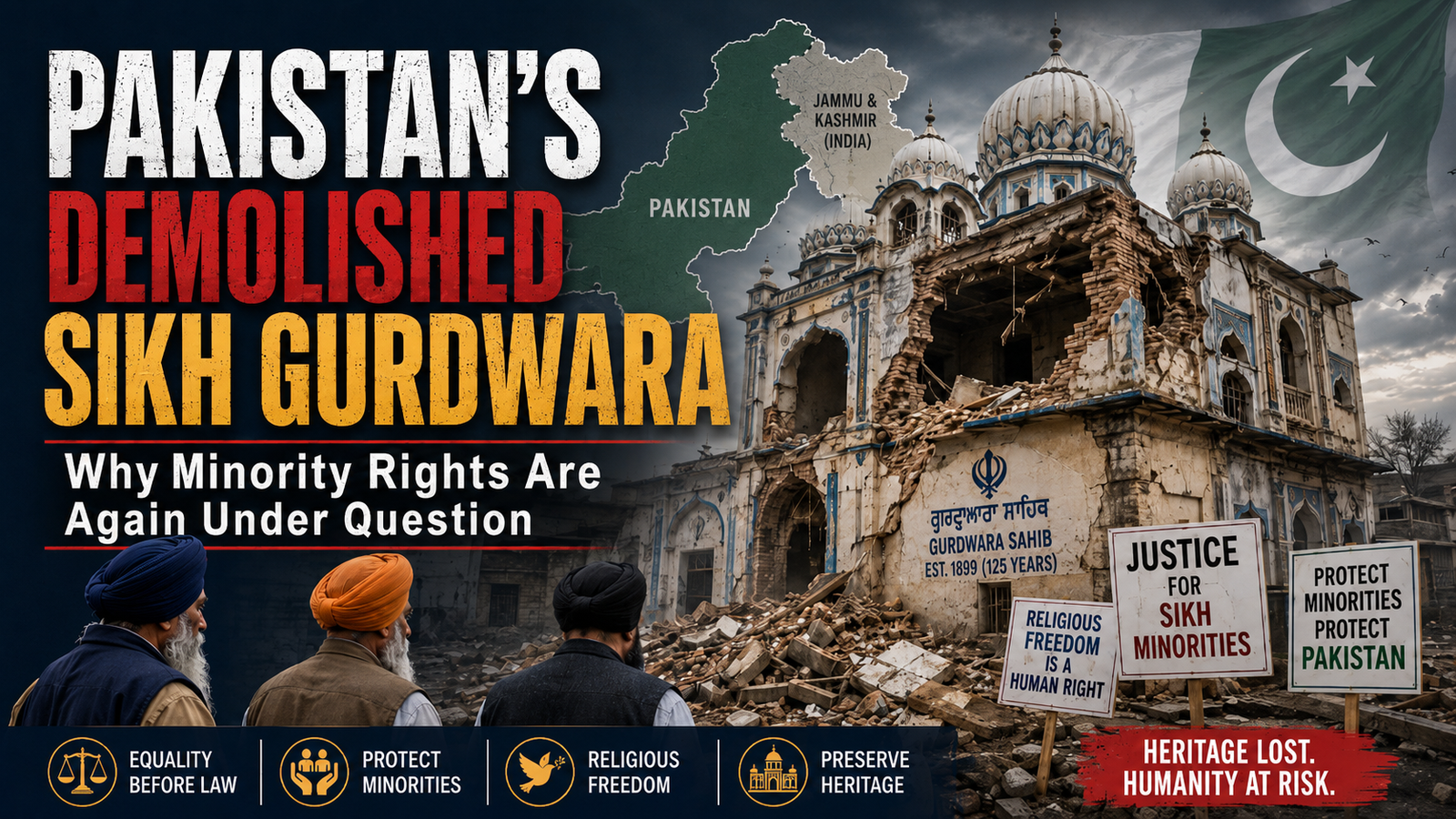
The reported demolition of a 125-year-old Sikh gurdwara in Pakistan has once again raised serious questions about the safety of religious minorities in the country.
The historic Gurdwara Sri Guru Singh Sabha Sahib in Farooqabad, around 70 km from Lahore, was reportedly demolished in late June 2026. India strongly condemned the incident and called it a “targeted act of vandalism.” Sikh organisations have demanded accountability, restoration of the shrine and stronger protection for minority religious heritage in Pakistan.
This incident is not just about one building. It is about history, faith, identity and the shrinking space for minorities in Pakistan.
What Happened in Farooqabad?
According to reports, the 125-year-old gurdwara was demolished bywara was demolished by local elements, with some reports naming a local businessman. Pakistan’s Punjab minority affairs minister later acknowledged that a portion of the historic shrine had been demolished and promised reconstruction.
But the larger question remains: how can a 125-year-old religious site be demolished so easily?
A gurdwara is not just a structure. For Sikhs, it is a place of worship, memory and community. For the subcontinent, it is part of shared civilisational heritage.
When such a site is destroyed, it sends a chilling message to minorities: your history is not safe.
A Pattern of Minority Insecurity
Pakistan’s minorities — Hindus, Sikhs, Christians, Ahmadis and others — have long complained of discrimination, forced conversions, blasphemy-related violence, attacks on places of worship and weak legal protection.
Hindus in Sindh have repeatedly raised concerns over forced conversions and underage marriages of minority girls. Christians have faced mob violence and church attacks after blasphemy allegations. Ahmadis face legal restrictions and social hostility because Pakistan’s constitution and laws deny their self-identification as Muslims. Sikh heritage sites often depend on state protection, but many remain vulnerable.
This does not mean every Pakistani citizen supports persecution. Many Pakistanis also speak for peace, minority rights and interfaith harmony. But the problem is that extremist pressure, weak law enforcement and politicised religion have created an environment where minorities often feel unsafe.
The Demographic Question Since 1947
The decline of minorities in Pakistan is often discussed with emotional figures. Some claims say non-Muslims were around 20–23% of Pakistan’s population in 1947 and are now only around 3–4%.
This comparison needs context because pre-1971 Pakistan included East Pakistan, which is now Bangladesh and had a large Hindu population. After Bangladesh separated, Pakistan’s demographic profile changed sharply.
But even with that context, today’s numbers are striking.
According to Pakistan’s 2023 census data, Muslims make up more than 96% of the population. Hindus are around 2.17%, Christians around 1.37%, Ahmadis around 0.07%, and Sikhs around 0.01%.
That means Pakistan’s religious minorities are now extremely small in national terms. This makes their protection even more important, not less.
A confident country protects its smallest communities. A weak system allows them to disappear from public life.
Why Global Silence Looks Selective
India condemned the gurdwara demolition quickly and demanded restoration and accountability. But there has been no similarly strong global reaction from major Western capitals or the United Nations visible in public headlines at the same level.
This selective silence raises a difficult question.
Why do international institutions speak loudly on some religious-freedom issues but remain quiet when Sikh, Hindu or Christian minorities face pressure in Pakistan?
Human rights should not depend on geopolitics. A demolished gurdwara deserves the same moral attention as any attacked mosque, church, temple or synagogue anywhere in the world.
If religious freedom is universal, then condemnation must also be universal.
Radicalisation and the Role of the State
Pakistan’s minority crisis cannot be understood without discussing radicalisation.
Over decades, extremist narratives have entered parts of society, education, politics and street mobilisation. Blasphemy accusations can trigger mob violence. Religious identity is often weaponised. Politicians and police sometimes hesitate to confront extremist groups because of fear, pressure or political calculation.
This creates a dangerous cycle.
First, minorities are targeted. Then the state reacts slowly. Then extremists feel stronger. Then minorities become more afraid to speak.
The issue is not that all Pakistanis are intolerant. The issue is that intolerant groups have too often been allowed to dominate public pressure.
Why Heritage Protection Matters
Pakistan’s Sikh heritage is not only important for Sikhs. It is important for the entire Indian subcontinent.
Punjab’s history cannot be separated by modern borders. Gurdwaras, temples, shrines, forts and old neighbourhoods are part of a shared past.
Destroying a historic gurdwara is not only a religious loss. It is a cultural loss.
Pakistan often promotes religious tourism around Kartarpur Sahib and other Sikh sites. But religious tourism cannot be only for optics. If Pakistan wants global trust, it must protect every minority heritage site — famous or forgotten.
What Pakistan Must Do Now
Pakistan should immediately conduct a transparent investigation into the Farooqabad gurdwara demolition.
Those responsible should face legal action. The gurdwara should be restored with Sikh community involvement. All minority religious sites should be mapped, legally protected and monitored.
Pakistan also needs stronger laws against forced conversions, better protection for minority girls, reform of blasphemy-law misuse, and faster police action against mob violence.
Minority rights cannot remain a speech topic. They must become enforceable reality.
What the World Should Demand
The United States, Europe, the United Nations and global human-rights organisations should speak clearly.
They should ask Pakistan to protect Sikh, Hindu, Christian, Ahmadi and other minority communities. They should demand protection of religious heritage sites and accountability for attacks.
Silence only encourages the next incident.
The world must stop treating minority suffering in Pakistan as a secondary issue.
Final Thoughts
The demolition of a 125-year-old Sikh gurdwara in Pakistan is not an isolated story. It is part of a larger question: can minorities live with dignity and security in Pakistan?
A nation is judged not by how it treats its majority, but by how it protects its smallest communities.
Pakistan must decide whether it wants to preserve its shared heritage or allow extremist pressure and weak governance to erase it piece by piece.
For Sikhs, Hindus, Christians, Ahmadis and other minorities, protection is not a favour. It is a basic human right.
The world must speak. Pakistan must act. And the demolished gurdwara must be restored — not only in brick and stone, but in justice and dignity.
FAQs
Which gurdwara was demolished in Pakistan?
Reports say the 125-year-old Gurdwara Sri Guru Singh Sabha Sahib in Farooqabad, Punjab, Pakistan, was demolished in late June 2026.
Did India condemn the demolition?
Yes. India’s Ministry of External Affairs condemned the incident and called it a targeted act of vandalism.
Are minorities declining in Pakistan?
Pakistan’s 2023 census shows religious minorities form a very small share of the population: Hindus around 2.17%, Christians around 1.37%, Ahmadis around 0.07%, and Sikhs around 0.01%.
What problems do minorities face in Pakistan?
Reported issues include forced conversions, blasphemy-law misuse, mob violence, attacks on places of worship, discrimination and weak protection of heritage sites.
What should Pakistan do?
Pakistan should investigate the demolition, restore the gurdwara, punish those responsible and strengthen legal protection for all minority communities.
Disclaimer: This article is for informational and human-rights analysis purposes only. It does not target ordinary citizens of any country or religion. It discusses reported incidents, official reactions and documented concerns around minority rights and heritage protection.