
















































PM Modi’s Semiconductor Push: How India Is Building the Foundation of the Future AI Economy

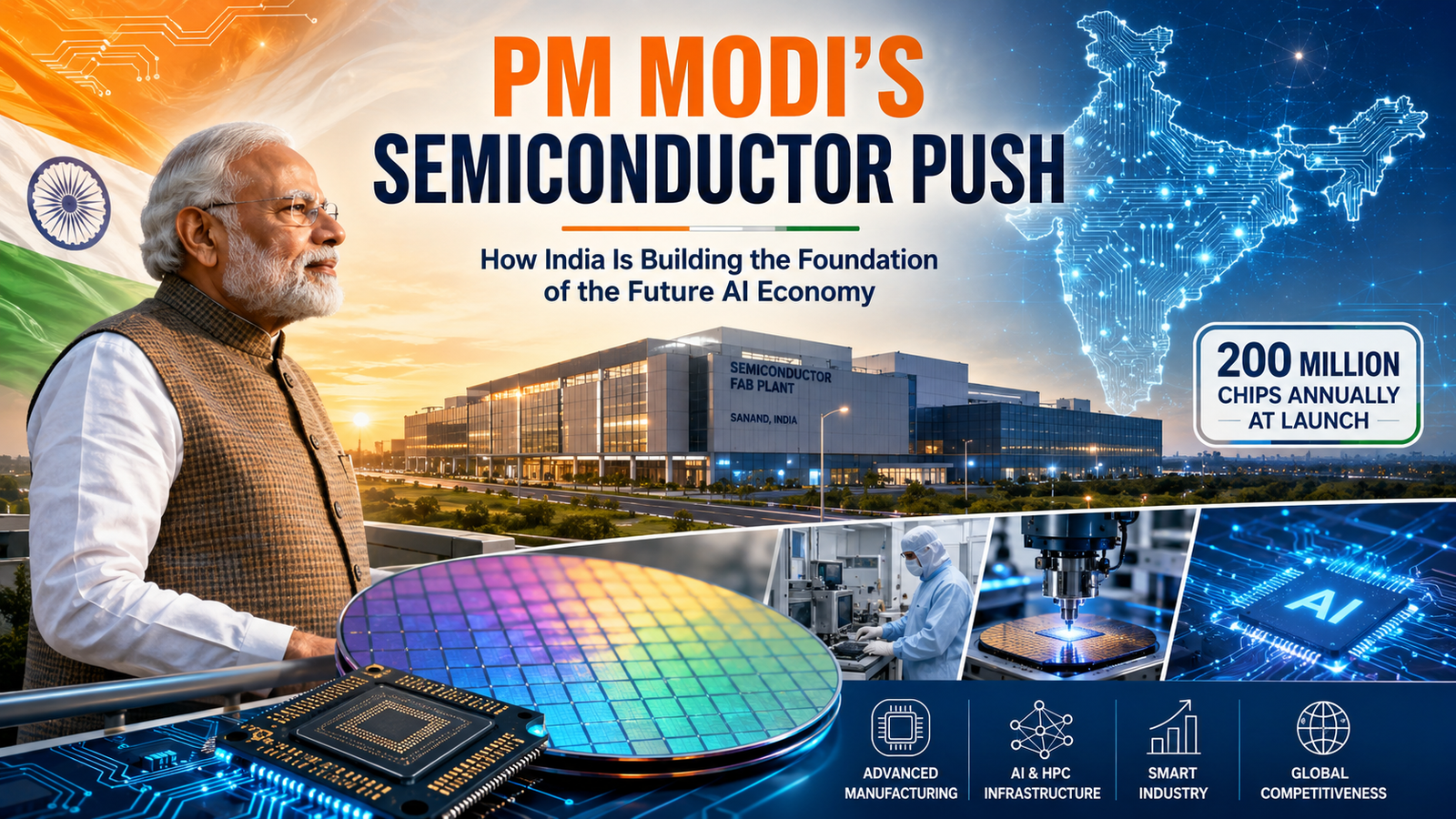
India has taken another major step toward becoming a global semiconductor power. Prime Minister Narendra Modi recently inaugurated the CG Semi Outsourced Semiconductor Assembly and Test facility in Sanand, Gujarat — a plant that will initially produce around 200 million chips annually.
This is not just another factory inauguration. This is a strategic moment for India.
Semiconductors are the brain of the modern world. They power smartphones, cars, satellites, defence systems, data centres, robotics, electric vehicles and artificial intelligence. Whoever controls semiconductor supply chains will control the future digital economy.
For decades, India was a large consumer of electronics. Now India wants to become a serious producer.
What Is the CG Semi Plant?
The Sanand facility is an OSAT plant, which stands for Outsourced Semiconductor Assembly and Test.
In simple language, chipmaking has many stages. First, chips are designed. Then wafers are fabricated. After that, chips must be packaged, assembled and tested before they can be used in real products.
That packaging and testing stage is what OSAT plants do.
Many people think only wafer fabrication matters. That is wrong. Packaging and testing are critical parts of the semiconductor supply chain. Without them, chips cannot enter cars, phones, industrial equipment or AI systems.
The CG Semi plant is expected to support automotive, industrial, consumer and next-generation technology sectors. Chips from this facility are also expected to be exported to advanced markets such as Japan, America and Europe.
200 Million Chips Annually: Why This Number Matters
At launch, the plant is expected to produce around 20 crore chips per year, or 200 million chips annually. PM Modi also highlighted an ambitious future target of scaling production to 500 crore chips per year.
This matters because India cannot build an AI economy only by importing chips.
AI models need data centres. Data centres need chips. Electric vehicles need chips. Defence systems need chips. Smart cities need chips. Even ordinary appliances now need chips.
If India wants to lead the future AI economy, it must build chip capacity inside the country.
This plant is one more step in that direction.
India Is Moving From Consumer to Creator
For many years, India was known as a market where foreign companies sold electronics. Phones, laptops, chips, servers and components were mostly imported or assembled with foreign dependence.
That model is changing.
India is now the world’s second-largest mobile phone manufacturer. The next step is to build the full electronics value chain — products, components, semiconductors, chip design, packaging and eventually advanced fabrication.
This is why PM Modi’s semiconductor roadmap matters.
It is not only about one plant. It is about creating an ecosystem.
Why Semiconductors Are Important for AI
Artificial intelligence is not magic. It runs on hardware.
Behind every chatbot, defence AI system, autonomous vehicle, medical AI tool or cloud platform, there are chips doing the heavy computation.
The global AI race is also a chip race. Countries that control semiconductor manufacturing will have more economic power, strategic autonomy and bargaining strength.
This is why the United States, China, Taiwan, Japan, South Korea and Europe are all investing billions into semiconductors.
India cannot afford to stay behind.
If India builds its own chip supply chain, it can support AI startups, defence technology, space missions, electric vehicles, telecom, robotics and digital public infrastructure.
The Lost Opportunity: Why India Could Have Been Earlier
India’s semiconductor dream is not new.
India began semiconductor manufacturing in the 1980s through the Semiconductor Complex Limited in Mohali, years before Taiwan’s TSMC became the global giant it is today.
But India lost momentum.
A major fire in 1989 damaged the Mohali facility. But the deeper problem was not only one fire. The bigger issue was decades of policy delay, weak follow-through, limited private-sector freedom, shortage of sustained investment and the old Licence Raj mindset.
This is where Gen Z must understand history.
India did not lose the semiconductor race because Indians lacked talent. India lost time because the system did not allow talent, capital and technology to move fast enough.
The Licence Raj Problem
For decades after independence, India’s economy was controlled by permissions, quotas, licences and government approvals. Private industry was restricted. Foreign investment was viewed with suspicion. Import controls were heavy. Bureaucracy became more powerful than enterprise.
This created a culture where business growth depended more on government permission than innovation.
In the 1970s, policies such as FERA pushed major foreign technology companies like IBM out of India. At a time when the computer and semiconductor revolution was beginning globally, India made itself less attractive for high-tech investment.
That mistake cost India heavily.
Countries like Taiwan built focused technology ecosystems. India got trapped in red tape, slow decision-making and political hesitation.
Congress-Era Policy Failure Must Be Discussed Honestly
It is important to discuss this without sugarcoating.
For many decades, Congress-dominated economic policy created a system where private enterprise, global technology partnerships and large-scale manufacturing were not encouraged in the way they should have been.
The result was that India became strong in software services but remained weak in hardware manufacturing.
This is one of the biggest economic mistakes of modern India.
Gen Z should know that today’s semiconductor push did not appear from nowhere. It is also an attempt to correct decades of missed opportunity.
At the same time, history should be understood fairly. Some reforms began in the 1980s and the 1991 liberalisation opened India further. But those reforms came late and often under crisis, not because India had a long-term semiconductor strategy like Taiwan.
Why Today Is Different
The difference today is scale, urgency and execution.
The India Semiconductor Mission has approved multiple semiconductor projects with investments crossing lakh-crore levels. The government is supporting chip design, fabrication, packaging, testing, talent development and supply-chain resilience.
This is exactly what India needed decades ago.
Instead of only talking about self-reliance, India is now creating factories, partnerships and production capacity.
The CG Semi plant, Micron’s Sanand facility, Kaynes Semicon, Tata’s Dholera fab and other approved projects together show that India’s semiconductor story is finally moving from announcement to production.
Can India Become Like Taiwan?
India can become a major semiconductor player, but it must be realistic.
Taiwan did not become a chip superpower overnight. It took decades of focus, talent, manufacturing discipline, government support and private-sector execution.
India has the population, engineering talent, market size and geopolitical importance. But India must build reliability, speed, quality, clean infrastructure, water security, power stability and deep supplier networks.
India should not try to copy Taiwan blindly. India should build its own model: design strength, packaging scale, mature-node manufacturing, power chips, automotive chips, AI infrastructure and eventually advanced fabs.
What This Means for Jobs
The semiconductor industry can create high-quality jobs for engineers, technicians, operators, researchers, logistics experts and material suppliers.
It can also support hundreds of smaller companies in chemicals, gases, clean rooms, precision equipment, testing tools, packaging material and electronics manufacturing.
This is why semiconductor manufacturing is not just a technology issue. It is also a jobs issue.
For India’s youth, this could become one of the most important career sectors of the next decade.
Final Thoughts
PM Modi’s inauguration of the CG Semi plant in Sanand is a major milestone in India’s journey toward semiconductor self-reliance.
The plant’s initial capacity of 200 million chips annually may be only the beginning, but it sends a powerful message: India is no longer satisfied with being only a consumer of technology.
India wants to build the chips that power the future.
This is about AI, defence, electric vehicles, robotics, data centres, smartphones and national security.
India lost decades because old policy thinking slowed down private enterprise and high-tech manufacturing. Gen Z must understand that history clearly. Countries that respect innovation move ahead. Countries trapped in red tape fall behind.
Today, India has a second chance.
If execution stays strong, this semiconductor push can become one of the biggest foundations of Viksit Bharat and India’s future AI economy.
FAQs
Which semiconductor plant did PM Modi inaugurate?
PM Modi inaugurated CG Semi’s Outsourced Semiconductor Assembly and Test facility in Sanand, Gujarat.
How many chips will the plant produce?
The facility is expected to initially produce around 200 million chips annually, with a much larger future scale-up target.
Why are semiconductors important for AI?
AI systems depend on chips for computing power. Without semiconductor capacity, countries remain dependent on foreign hardware for AI growth.
Can India become a semiconductor leader like Taiwan?
India can become a major semiconductor player if it continues investing in design, packaging, fabs, talent, infrastructure and supply-chain depth.
Why did India lose the semiconductor race earlier?
India had early capability, but policy delays, Licence Raj restrictions, limited private-sector freedom, weak investment and the 1989 SCL fire slowed momentum.
Disclaimer: This article is for informational and opinion-based analysis only. It discusses public policy, economic history and semiconductor development based on publicly available reports. It does not target any individual citizen or community.