












































Australia Gives India Strategic Access to Cocos Islands: Why It Matters for the Indian Ocean

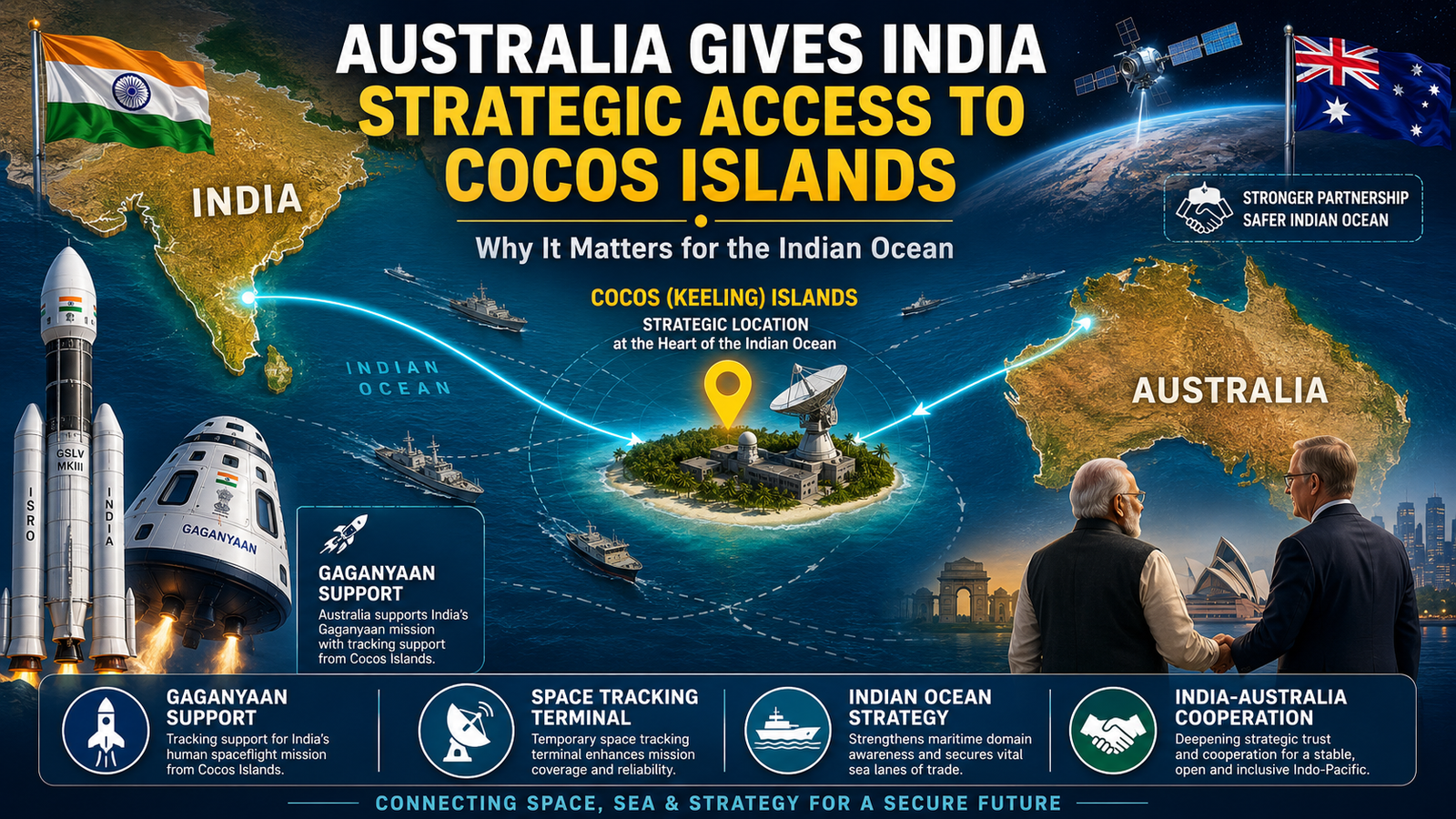
Prime Minister Narendra Modi’s visit to Australia has delivered an important strategic outcome: Australia has commissioned a temporary space tracking terminal on the Cocos (Keeling) Islands to support India’s Gaganyaan Human Spaceflight Program.
According to the official India-Australia joint statement, both leaders welcomed Australia’s continued support for Gaganyaan, including the commissioning of a temporary space tracking terminal on Cocos Keeling Islands, while expressing hope for deeper cooperation between ISRO and the Australian Space Agency.
This may sound like a space cooperation announcement, but its strategic importance goes far beyond space.
Why Cocos Islands Matter
The Cocos (Keeling) Islands are Australian territories located in the Indian Ocean, far from mainland Australia but very close to some of the world’s most important sea routes. Their location gives Australia and its partners a valuable position for space tracking, maritime monitoring, communication and regional surveillance.
The Australian Space Agency said the newly commissioned terminal is now operational and will provide mission-critical tracking support for four planned ISRO-led Gaganyaan missions.
This means India’s first human spaceflight mission will receive important support from a location that sits deep inside the Indian Ocean region.
Not Just Space: A Strategic Indian Ocean Signal
Officially, this is a space tracking facility. It is not a permanent Indian military base. However, the strategic message is clear: India and Australia are building trust in sensitive technology, mission support and Indian Ocean cooperation.
Cocos is important because of its geography. Reuters reported that the islands are close to an Indian Ocean chokepoint for Chinese oil shipments and are considered important for maritime surveillance as Chinese submarine activity increases in the region.
For India, this matters because the Indian Ocean is no longer just a trade route. It has become a major strategic theatre where China, the United States, Australia, India and other powers are increasing their presence.
Countering China’s Growing Indian Ocean Footprint
China has expanded its presence across the Indian Ocean through ports, naval deployments, dual-use infrastructure and submarine activity. Indian strategists often describe this pressure as part of China’s wider “String of Pearls” strategy.
India’s response is not to copy China blindly. Instead, India is building trusted partnerships with countries like Australia, Indonesia, France, Japan and the United States.
The Cocos cooperation fits into this strategy. It strengthens India’s reach in the eastern Indian Ocean and improves coordination with Australia, a key Quad partner.
Link With Andaman and Nicobar Strategy
Cocos Islands also matter because they sit in the wider maritime arc that connects Australia, Southeast Asia and India’s Andaman and Nicobar Islands. India’s Andaman and Nicobar Command already gives New Delhi a strong position near the Malacca Strait, one of the world’s busiest maritime chokepoints.
Better India-Australia coordination can improve maritime domain awareness, search-and-rescue capability, space mission tracking and future defence interoperability.
Australia’s Defence Department had earlier noted that India deployed a P-8I maritime patrol aircraft to Darwin in 2022 for coordinated exercises with Australia’s P-8A Poseidon aircraft, calling it a landmark step in maritime surveillance and anti-submarine warfare cooperation.
This shows that India-Australia cooperation is moving from symbolic diplomacy to practical operational coordination.
Why This Is a Win for India
For India, access to support infrastructure on Cocos Islands is a big diplomatic and strategic achievement.
First, it helps India’s Gaganyaan mission, which aims to make India one of the few countries capable of sending humans into space through its own national program.
Second, it builds trust with Australia in high-technology cooperation.
Third, it gives India a stronger role in the Indian Ocean strategic map.
Fourth, it sends a message that India is no longer operating only from its own coastline. India is now building a wider network with trusted partners.
Australia Also Gains
This is not one-sided. Australia also benefits from deeper cooperation with India.
The official joint statement said India and Australia agreed to enhance maritime cooperation through the India-Australia Maritime Security Collaboration Roadmap, including information sharing, capability development, capacity building and operational coordination.
For Australia, India is a major democratic partner with growing naval, space and economic power. Working with India strengthens Australia’s role in the Indian Ocean and supports a stable Indo-Pacific.
Final Thoughts
Australia’s decision to support India’s Gaganyaan mission through Cocos Islands may look like a space announcement, but strategically it is much bigger.
It reflects growing India-Australia trust, India’s rising space power, and a deeper alignment in the Indian Ocean at a time when China’s maritime activity is increasing.
Cocos Islands may be small on the map, but in the new Indo-Pacific power game, their importance is huge.
For India, this is another step toward becoming a stronger maritime, space and strategic power in the Indian Ocean.
FAQs
Did Australia give India a military base on Cocos Islands?
No. Official statements mention a temporary space tracking terminal for India’s Gaganyaan mission, not a permanent Indian military base.
Why are Cocos Islands important for India?
Cocos Islands are strategically located in the Indian Ocean near important sea routes and can support space tracking, maritime awareness and India-Australia strategic cooperation.
What is Gaganyaan?
Gaganyaan is India’s human spaceflight program led by ISRO. It aims to send Indian astronauts into low Earth orbit.
How does this help India in the Indian Ocean?
It improves India’s cooperation with Australia, strengthens regional trust, and supports India’s wider maritime and space presence in the Indo-Pacific.
Disclaimer: This article is for informational and educational purposes only. It is based on official statements and credible media reports available at the time of writing. It should not be treated as defence, diplomatic or investment advice.