














































Bollywood’s Soft Propaganda: How Hindi Cinema Shaped Attitudes Toward Hindu Culture and Women

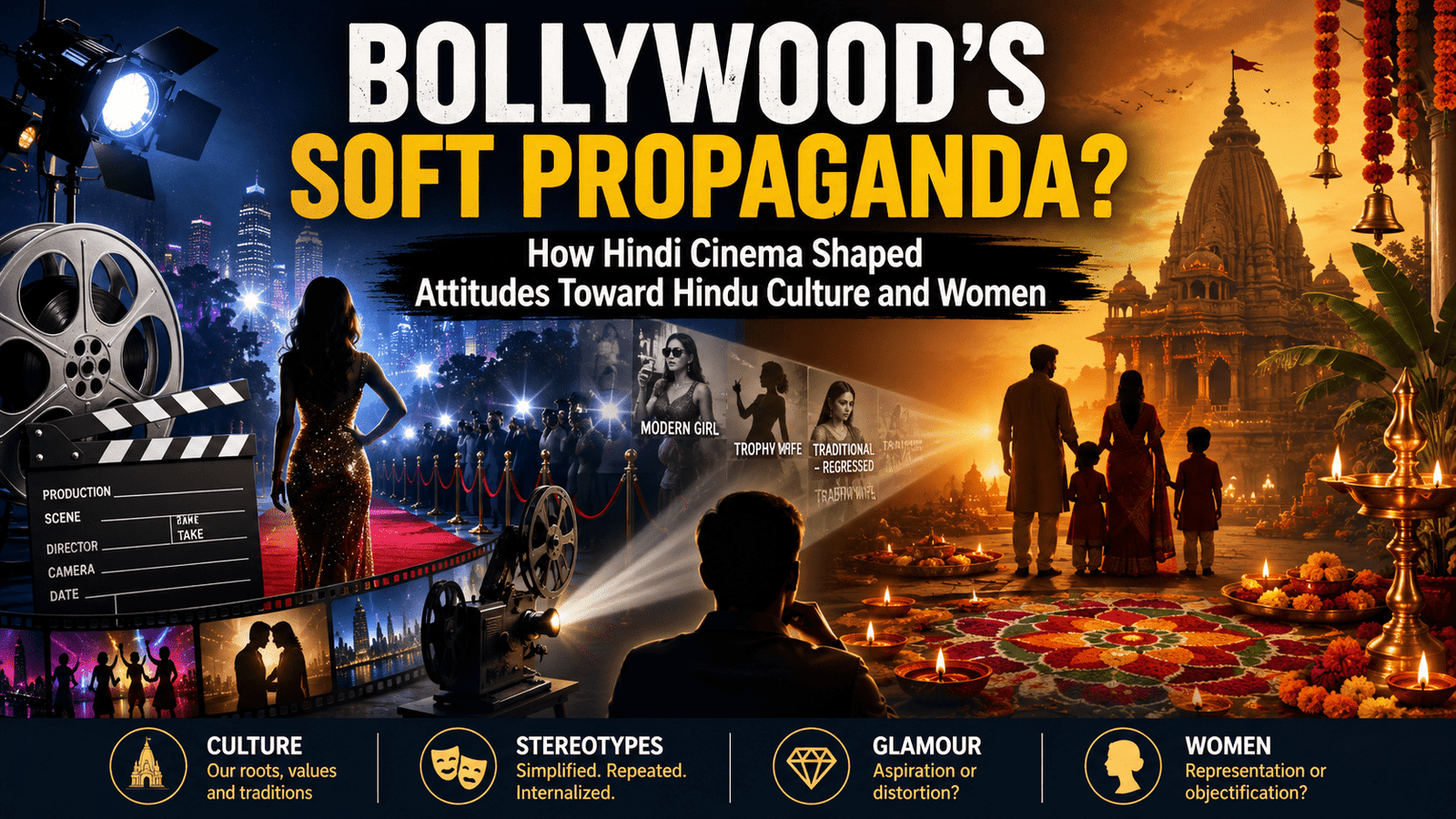
Bollywood is not just entertainment. For decades, Hindi cinema has shaped how Indians think, dress, speak, love, celebrate and even view their own culture. A film may last three hours, but its impact can last for generations.
This is why many viewers today are asking a serious question: did Bollywood use soft propaganda against Indian culture and Hinduism?
The answer is not simple. Bollywood has produced patriotic films, devotional songs, family dramas and movies that celebrated Indian values. But critics argue that a long pattern also existed where Hindu traditions were mocked, priests were shown as greedy, rituals were treated as backward, western lifestyles were glamorized, and women were often reduced to glamour objects.
Over time, this may have created a quiet cultural inferiority complex among many Indians — especially urban Hindus who were repeatedly taught that being modern meant being disconnected from their roots.
What Is Soft Propaganda in Cinema?
Soft propaganda does not always look like open political messaging. It works slowly through repeated images, jokes, characters and storylines.
When a tradition is shown again and again as outdated, the viewer starts feeling embarrassed by it. When western clothing, English-speaking elites and nightclub culture are shown as symbols of success, young audiences may begin to associate their own traditions with backwardness.
This is how cinema shapes the mind without giving a lecture.
How Hindu Symbols Were Often Used Negatively
For many years, Bollywood often used Hindu visuals in predictable ways. The corrupt priest, the superstitious family elder, the oppressive ritual, the helpless woman trapped by tradition, or the villain standing near a religious festival became familiar images.
This does not mean every film was anti-Hindu. Many films used temples, bhajans and festivals beautifully. But critics argue that when negative portrayals become more common than respectful ones, audiences begin to internalize shame.
A Hindu ritual was often shown as blind faith, while a westernized character was shown as rational and progressive. A mother wearing traditional clothes was often emotional and helpless, while the modern character was shown as free and intelligent. This repeated contrast slowly created the idea that modernity and Hindu identity cannot exist together.
That is a false idea.
India’s civilization has always evolved. Hindu culture is not against science, progress, education or women’s freedom. But Bollywood often failed to show that balance.
The Inferiority Complex Problem
One of the biggest impacts of this pattern was psychological. Many Indians grew up laughing at their own traditions before understanding them.
Young people learned to say “it is just superstition” without knowing the philosophy behind rituals. Many felt embarrassed by Sanskrit, temples, tilak, traditional clothing or family customs because cinema often associated them with outdated thinking.
This is where cultural inferiority begins. A society does not lose confidence overnight. It loses confidence when its own stories repeatedly tell it that its roots are inferior.
Bollywood had huge power because it entered homes, songs, weddings, festivals and everyday conversation. When such a powerful industry repeatedly presents foreign aesthetics as aspirational and Indian traditions as comic or regressive, it changes social behavior.
Women and the Bollywood Male Gaze
Another major criticism of Bollywood is the oversexualization of women.
For decades, item songs, camera angles, lyrics and dance sequences often presented women as objects of desire rather than complete human beings. Many songs became popular not because they moved the story forward, but because they sold glamour, body display and male fantasy.
This had a social cost.
When women are repeatedly shown through the male gaze, audiences may begin to normalize objectification. The heroine becomes valuable for beauty, youth and desirability, while her thoughts, ambitions and moral strength receive less attention.
Even strong actresses often had to perform songs that existed mainly for visual appeal. This created a contradiction: Bollywood spoke about women’s empowerment in dialogues, but often objectified women in songs and promotional material.
A culture that worships Devi, Durga, Lakshmi and Saraswati should not reduce women to item numbers.
Westernization Was Sold as Modernity
Bollywood also played a major role in selling westernized lifestyles as superior. English-speaking characters, foreign locations, alcohol-centered parties and casual disrespect for family systems were often presented as cool and aspirational.
There is nothing wrong with modern clothing, global exposure or personal freedom. The problem begins when Indian traditions are shown as obstacles to freedom rather than sources of identity and strength.
A confident society can wear jeans and still respect its temples. It can use technology and still value Sanskrit. It can support women’s rights and still celebrate Indian family values.
Modernity does not require self-hate.
Why Audiences Are Pushing Back Today
The rise of social media has changed everything. Earlier, audiences could only watch and accept. Now they can question films, expose patterns and debate cultural messaging online.
This is one reason why many viewers began demanding better representation of Hindu culture. They want stories where temples are not only backdrops for superstition, where priests are not always villains, where festivals are shown with dignity, and where Indian women are written with depth instead of being used only for glamour.
The success of many regional films has also shown that audiences still connect deeply with cultural confidence. Films that respect Indian civilization, family values, dharma, devotion and local identity often receive strong public support.
Not All Bollywood Is the Same
It is important to be fair. Bollywood is not one person or one ideology. It includes thousands of writers, actors, directors, technicians and musicians. Many films have celebrated Indian culture beautifully. Many artists have created devotional songs, patriotic stories and powerful female characters.
The problem is not Bollywood as an art form. The problem is the repeated pattern of selective mockery, cultural embarrassment and gender objectification.
Cinema should question society, but it should not condition people to hate their own civilization.
What Bollywood Should Do Now
Bollywood does not need censorship. It needs responsibility.
It should create stories that are modern but rooted, progressive but respectful, entertaining but not insulting. Hindu culture can be shown with nuance. Women can be shown as strong characters, not just visual attractions. Indian identity can be global without becoming self-rejecting.
The future audience is smarter. It wants authenticity.
Final Thoughts
Bollywood shaped India’s imagination for decades. It gave us music, emotion, romance and unforgettable stories. But it also influenced how Indians viewed their own traditions and women.
For too long, parts of Hindi cinema treated Hindu customs as backward, westernization as superior and female bodies as marketing tools. That cultural messaging cannot be ignored.
India does not need films that create shame. It needs films that inspire confidence.
A modern India should not hate its roots. It should understand them, reform what needs reform, celebrate what deserves celebration and tell its own stories with dignity.
Disclaimer: This article is for informational and opinion-based cultural analysis only. It does not target any individual, religion, artist or community. It discusses film trends, media representation and audience criticism based on publicly available information.