















































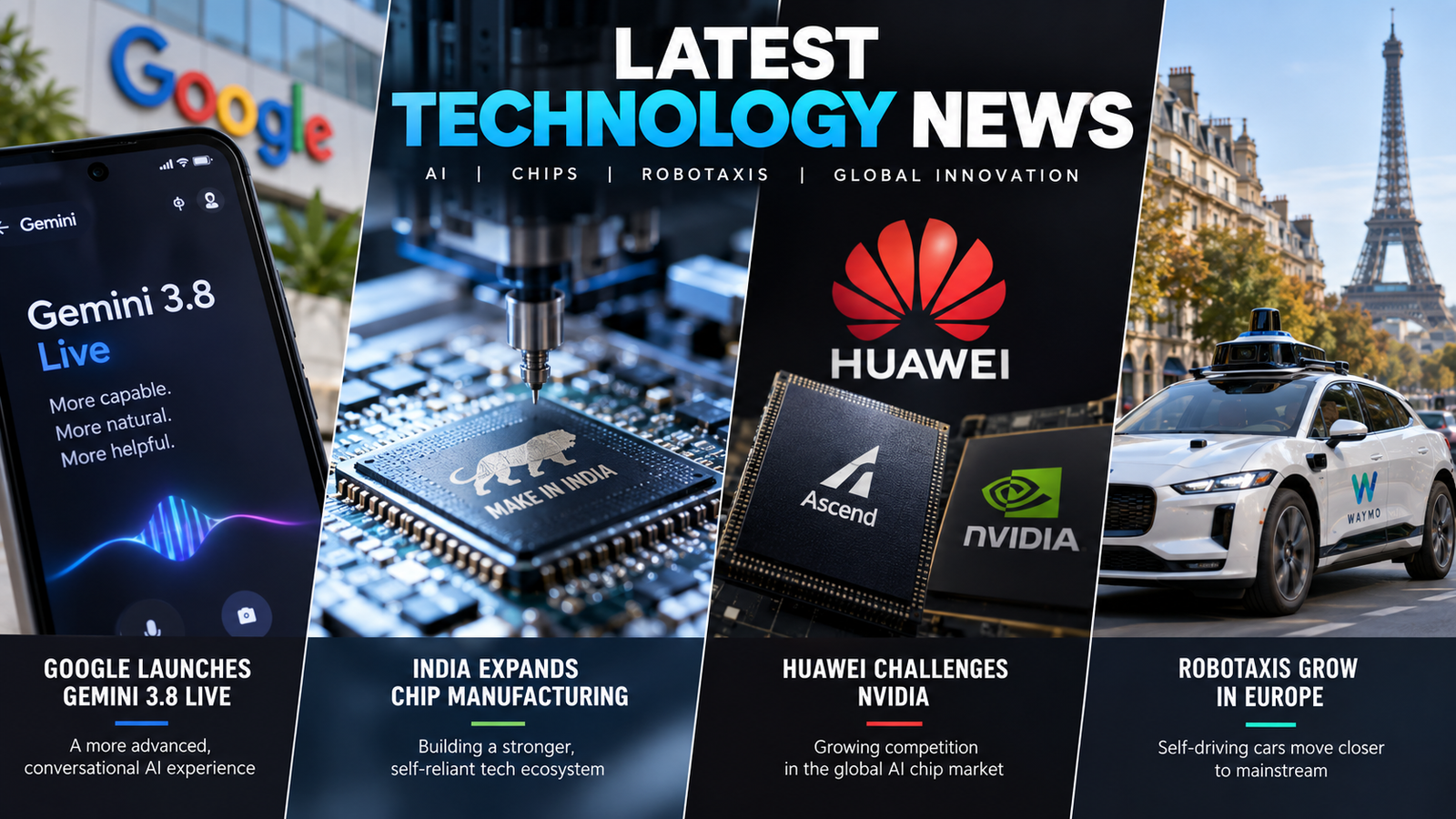
Latest Technology News: Gemini 3.8, India’s Chip Push and European Robotaxis

The latest technology news shows that innovation is moving beyond experimental products and into real-world infrastructure. Artificial intelligence is becoming more conversational, countries are strengthening domestic semiconductor production, and autonomous vehicles are preparing for wider commercial deployment.
From Google’s new Gemini models to a major Indian semiconductor partnership, here are the most important technology developments making headlines.
Google Introduces Gemini 3.8 Live
Google has introduced Gemini 3.8 Live and Gemini 3.8 Live Extended Thinking, two artificial-intelligence models designed for different types of tasks.
Gemini 3.8 Live focuses on natural conversations, visual understanding and cost-efficient performance. The Extended Thinking version is intended for more complicated problems that require multiple reasoning steps.
According to Google’s official announcement, the technology can process visual information in near real time and switch between 97 supported languages during a conversation.
Google also says the models can continue talking to users while certain tools and application programming interface calls operate in the background. This could make AI assistants more useful for workplace productivity, customer support, education and accessibility.
However, performance figures published by Google should be treated as company claims until they are independently tested across different use cases.
Tata and Nexperia Strengthen India’s Semiconductor Ambitions
One of the most important developments for India is a partnership between Tata Electronics and Dutch chipmaker Nexperia.
Under the agreement, Nexperia’s power-management chips are expected to be manufactured at Tata Electronics’ semiconductor facility in Dholera, Gujarat. Testing and assembly will reportedly take place at Tata’s packaging facility in Jagiroad, Assam.
The partnership also creates opportunities for future technology development between the two companies, although its financial terms have not been disclosed. Reuters reported that these chips are widely used in automobiles and consumer electronics.
The deal is important because India has traditionally depended heavily on imported semiconductors. Building manufacturing, testing and packaging capabilities within the country could improve supply-chain security and create skilled employment.
India is still developing its position in the global semiconductor industry, but partnerships with experienced international manufacturers could help it become an important alternative production hub.
Huawei Accelerates Its Challenge to Nvidia
Huawei is preparing additional Ascend artificial-intelligence chips as China works to reduce its dependence on foreign semiconductor technology.
The company plans to introduce the Ascend 960DT in early 2027, followed by the 960PR later in the year. Huawei is also developing an architecture called Peerium, which it says could eventually connect extremely large numbers of processors.
However, Huawei has acknowledged that it cannot currently produce enough AI computing equipment to meet demand within China. That shortage limits the company’s ability to expand internationally.
Huawei’s new hardware could strengthen China’s domestic AI industry, but Nvidia continues to hold a major advantage through its CUDA software ecosystem. Developers have spent years building applications around Nvidia’s platform, making it difficult for competitors to replace.
The result could be a more divided global AI-chip market, with different hardware and software ecosystems developing in China and Western countries. More details are available in Reuters’ report on Huawei’s chip plans.
Lucid and Bolt Plan 25,000 Robotaxis in Europe
Electric-vehicle manufacturer Lucid and mobility company Bolt have announced plans to deploy 25,000 autonomous vehicles across major European cities.
The robotaxis will be based on Lucid’s upcoming midsize vehicle platform and use Nvidia’s Hyperion autonomous-driving technology. They are being designed for SAE Level 4 operation, meaning they could drive without human control within approved locations and operating conditions.
The project supports Bolt’s broader ambition of operating 100,000 autonomous vehicles by 2035. However, the companies have not announced an exact starting date for the 25,000-vehicle deployment.
Regulatory approval, road testing, insurance rules and public confidence will determine how quickly the service can expand. Nevertheless, the scale of the plan suggests that Europe’s robotaxi industry is beginning to move from limited trials toward commercial operations.
Read the Reuters report on the Lucid–Bolt partnership.
OpenAI Expands into Legal Technology
OpenAI has launched Astra for Law, an AI platform designed to assist lawyers with legal research, drafting and the creation of specialised applications.
The platform combines OpenAI’s Astra model with an index of US laws, regulations and court decisions. Technology providers including Harvey and Legora are expected to build products using the platform, while integrations have been announced with companies such as Clio, Relativity and Thomson Reuters.
Selected law firms are receiving initial access, with OpenAI promising additional protections for confidential client information.
Astra for Law demonstrates how AI companies are moving from general-purpose chatbots toward specialised industry platforms. Legal professionals will still need to verify AI-generated research and advice because errors or missing context could have serious consequences.
The launch was covered in detail by Reuters.
France Advances Hybrid Quantum Computing
France’s Atomic Energy Commission and quantum-computing company Alice & Bob are working on software that connects quantum processors with conventional supercomputers.
Their work will improve the open-source Qaptiva platform, allowing quantum computers to handle selected parts of a problem while traditional systems process the remaining workload.
This hybrid approach could be more practical than attempting to replace conventional supercomputers entirely. It could also reduce dependence on a single technology provider as competition develops between open platforms and systems such as Nvidia’s CUDA-Q.
According to Reuters, Alice & Bob hardware is expected to be added to the French programme in 2027.
What These Technology Developments Mean
The latest technology news reveals three major trends.
First, AI is becoming more specialised. Companies are developing separate systems for live conversations, legal work, scientific research and other professional tasks.
Second, control over semiconductor production is becoming a strategic priority. India, China, Europe and the United States all want stronger domestic technology supply chains.
Third, technologies such as robotaxis and hybrid quantum computing are gradually moving from laboratories into practical applications. Their success will depend on reliability, affordability, regulation and public trust—not simply impressive demonstrations.
Conclusion
Technology competition is no longer limited to faster smartphones or more powerful computers. It now involves national semiconductor strategies, specialised AI platforms, autonomous transportation and the infrastructure needed to support future industries.
Google’s Gemini expansion, India’s semiconductor partnership, Huawei’s AI-chip plans and Europe’s robotaxi ambitions all point in the same direction: technological capability is becoming a major source of economic and geopolitical influence.
Frequently Asked Questions
What is Gemini 3.8 Live?
It is Google’s conversational AI model designed for fluid dialogue, visual understanding and multilingual interaction.
Why is the Tata–Nexperia agreement important for India?
It could help India develop a more complete semiconductor ecosystem covering manufacturing, testing and packaging.
Is Huawei overtaking Nvidia in AI chips?
Not globally. Huawei is strengthening its position in China, but Nvidia retains substantial advantages in production scale, performance and software support.
Will 25,000 robotaxis begin operating immediately?
No exact deployment date has been announced. Operations will depend on testing and regulatory approval in individual European cities.
Disclaimer: This article is based on company announcements and publicly available news reports as of September 17, 2026. Product specifications, business plans and launch schedules may change. Company performance claims may not have been independently verified. This content is for general information only and should not be considered financial, legal or investment advice.
