














































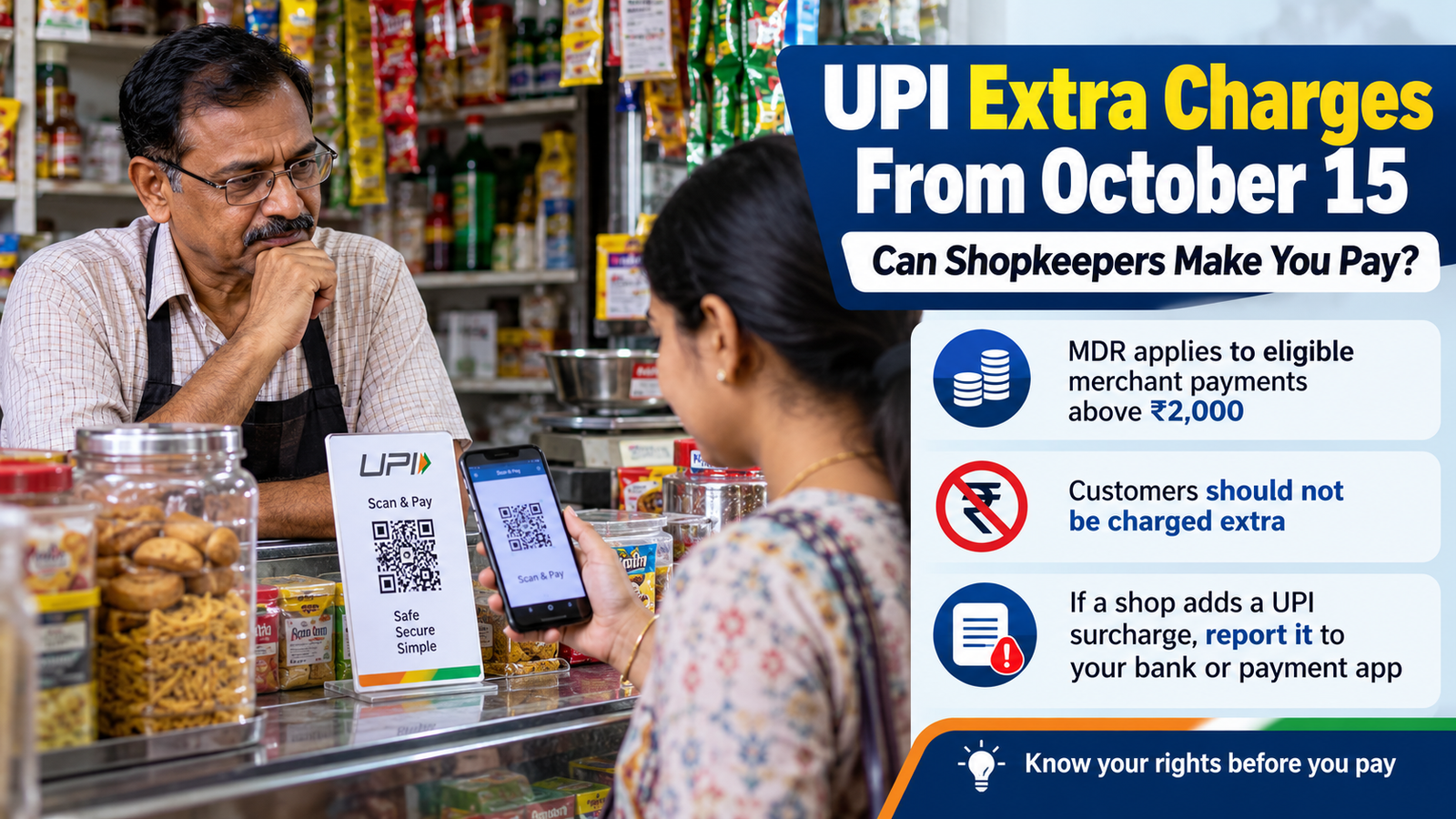

India’s new Merchant Discount Rate for certain UPI payments will take effect on October 15, 2026. Although customers are not supposed to pay this fee, many people are concerned that shops may add an extra charge to their bills.
The most important clarification is simple: the new UPI charge is intended to be paid by eligible merchants—not customers.
If a shopkeeper asks a customer to pay an additional amount solely for using UPI, the merchant would effectively be passing on the MDR. That would be contrary to the framework announced by the National Payments Corporation of India and clarified by the government.
What Changes From October 15?
Eligible person-to-merchant UPI payments exceeding ₹2,000 can attract a Merchant Discount Rate of up to 0.4%.
MDR is a payment-processing fee deducted from the amount settled with the merchant. It helps compensate the banks, payment applications and other companies operating the UPI infrastructure.
For example:
| Customer’s bill | Maximum MDR | Customer should pay |
|---|---|---|
| ₹3,000 | ₹12 | ₹3,000 |
| ₹5,000 | ₹20 | ₹5,000 |
| ₹10,000 | ₹40 | ₹10,000 |
| ₹50,000 | ₹200 | ₹50,000 |
The merchant may receive the bill amount after the applicable MDR and taxes have been deducted. However, the customer should still pay only the original bill.
For a complete explanation of exemptions and merchant categories, read our guide: UPI Charges From October 15: Who Pays and Who Is Exempt?
Can a Shopkeeper Add a Separate UPI Fee?
Under the announced framework, customers will not be required to pay the new MDR.
Consider a customer purchasing a mobile phone for ₹10,000. If the retailer demands ₹10,040 because the customer selected UPI, that additional ₹40 is effectively a UPI surcharge.
The retailer should not label the following as customer charges:
- UPI handling fee
- QR-code charge
- Digital-payment fee
- MDR recovery fee
- Google Pay or PhonePe charge
- Bank settlement charge
The government has indicated that it will monitor whether businesses attempt to pass the MDR to customers after the rule takes effect.
What About Convenience and Platform Fees?
A convenience fee is not automatically the same as MDR.
Online platforms sometimes charge separately disclosed booking, delivery or service fees. Such charges may apply regardless of whether the customer pays through UPI, a card or another method.
The important distinction is why the additional amount is being collected.
If a business charges extra only because the customer selected UPI, it could be considered an attempt to pass on the payment-processing cost. If it is a general service charge applied transparently across payment methods, it may fall under a different pricing policy.
Customers should review the final payment page carefully before approving a transaction.
Which UPI Transactions Remain Free?
The new MDR does not turn every UPI payment into a paid transaction.
The following transactions remain outside the standard customer charge:
- Sending money to friends or family
- Transferring money between personal accounts
- Paying an eligible merchant ₹2,000 or less
- Eligible payments to protected small merchants
- UPI AutoPay and recurring mandates covered by the exemption
- Ordinary person-to-person UPI transfers
Individual users are not required to pay the MDR on personal transfers, regardless of whether the amount exceeds ₹2,000.
The ₹2,000 threshold applies to eligible merchant payments—not every UPI transaction.
What Should You Do If a Shop Demands an Extra UPI Charge?
Start by asking the merchant to remove the payment-method-specific charge. The business may be misunderstanding the new rule or assuming that it can recover the MDR directly from customers.
If the merchant refuses, take the following steps:
1. Ask for an Itemised Bill
Request a bill showing the original price and the additional UPI charge separately. A verbal demand is more difficult to prove later.
2. Keep Payment Evidence
Save:
- The invoice or receipt
- A screenshot of the payment page
- The UPI transaction ID
- The merchant’s name and UPI ID
- Any message mentioning an extra UPI fee
Do not share your UPI PIN, OTP or complete banking credentials while raising a complaint.
3. Complain to the Merchant or Platform
For an online transaction, contact the platform’s customer-support team and request a refund of the payment-method surcharge.
For a physical store, ask the owner or company’s customer-care department to review the charge.
4. Contact the National Consumer Helpline
A consumer grievance against a merchant can be registered through the government’s National Consumer Helpline.
Consumers can also call 1915 or 1800-11-4000. Supporting documents such as bills, screenshots and payment records can be attached to the complaint.
5. Escalate Incorrect Bank or UPI-App Deductions
If the additional fee was deducted by the bank or UPI application rather than collected by the merchant:
- Raise the complaint inside the UPI application.
- Contact the linked bank or payment-service provider.
- Register the transaction complaint through the NPCI complaint portal.
- If the regulated financial institution does not respond within the prescribed period or its resolution is unsatisfactory, use the RBI Complaint Management System.
NPCI advises users to raise UPI transaction complaints through the participating application or bank. RBI’s Ombudsman mechanism provides further escalation for unresolved complaints involving regulated financial institutions.
Can Merchants Refuse to Accept UPI?
The MDR announcement does not automatically require every merchant to accept every payment method.
A business may offer cash, cards, UPI or other options depending on its payment facilities and commercial arrangements. However, if it accepts UPI, the announced framework does not permit the MDR to be presented as a direct customer charge.
Merchants should check their classification with their acquiring bank or payment provider because exemptions and rates depend on transaction value, merchant category and payment type.
Why Customers Must Check Their Bills
Even a small surcharge can become significant when applied across millions of transactions.
A ₹20 or ₹40 charge may appear insignificant during a single purchase, but widespread pass-through would undermine the government’s assurance that individual UPI users remain protected.
Customers should therefore examine invoices and final payment screens—particularly for electronics, jewellery, travel bookings, insurance payments and other transactions commonly exceeding ₹2,000.
Conclusion
Customers should not have to pay extra simply because they scan a UPI QR code after October 15.
The new MDR applies to eligible merchants receiving certain payments above ₹2,000. It is not supposed to be deducted separately from the customer or added automatically to the bill.
If a business demands an additional UPI fee, ask for an itemised invoice, preserve the transaction evidence and raise a grievance through the merchant, platform or National Consumer Helpline.
The safest rule for customers is straightforward: always check the final amount before entering your UPI PIN.
Frequently Asked Questions
Can a shopkeeper charge 0.4% extra for UPI?
The MDR is intended to be paid by eligible merchants. Customers should not be asked to pay an additional 0.4% solely for choosing UPI.
Will sending ₹5,000 to a friend attract a charge?
No. Person-to-person UPI transfers remain free. The ₹2,000 threshold applies to eligible merchant transactions.
What if Google Pay or PhonePe deducts an unexpected fee?
Raise a complaint through the application and contact your linked bank. Keep the transaction ID and screenshot. Unresolved eligible complaints can be escalated through NPCI and RBI’s Complaint Management System.
Where can I report a shop charging extra for UPI?
You can first complain to the merchant or platform. If the matter is not resolved, register a grievance through the National Consumer Helpline website or call 1915.
Can a merchant offer a cash discount?
A genuine discount is not necessarily the same as adding a UPI surcharge. However, the pricing should be transparent and should not be used to disguise a payment-processing fee charged specifically to UPI users.
Disclaimer: This article is based on official clarifications and publicly available information as of September 24, 2026. UPI rules, merchant classifications and complaint procedures may be revised. This article is intended for general news and educational purposes and should not be treated as legal, tax or financial advice.
