
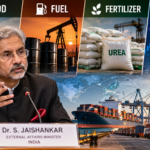










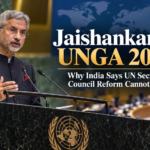





















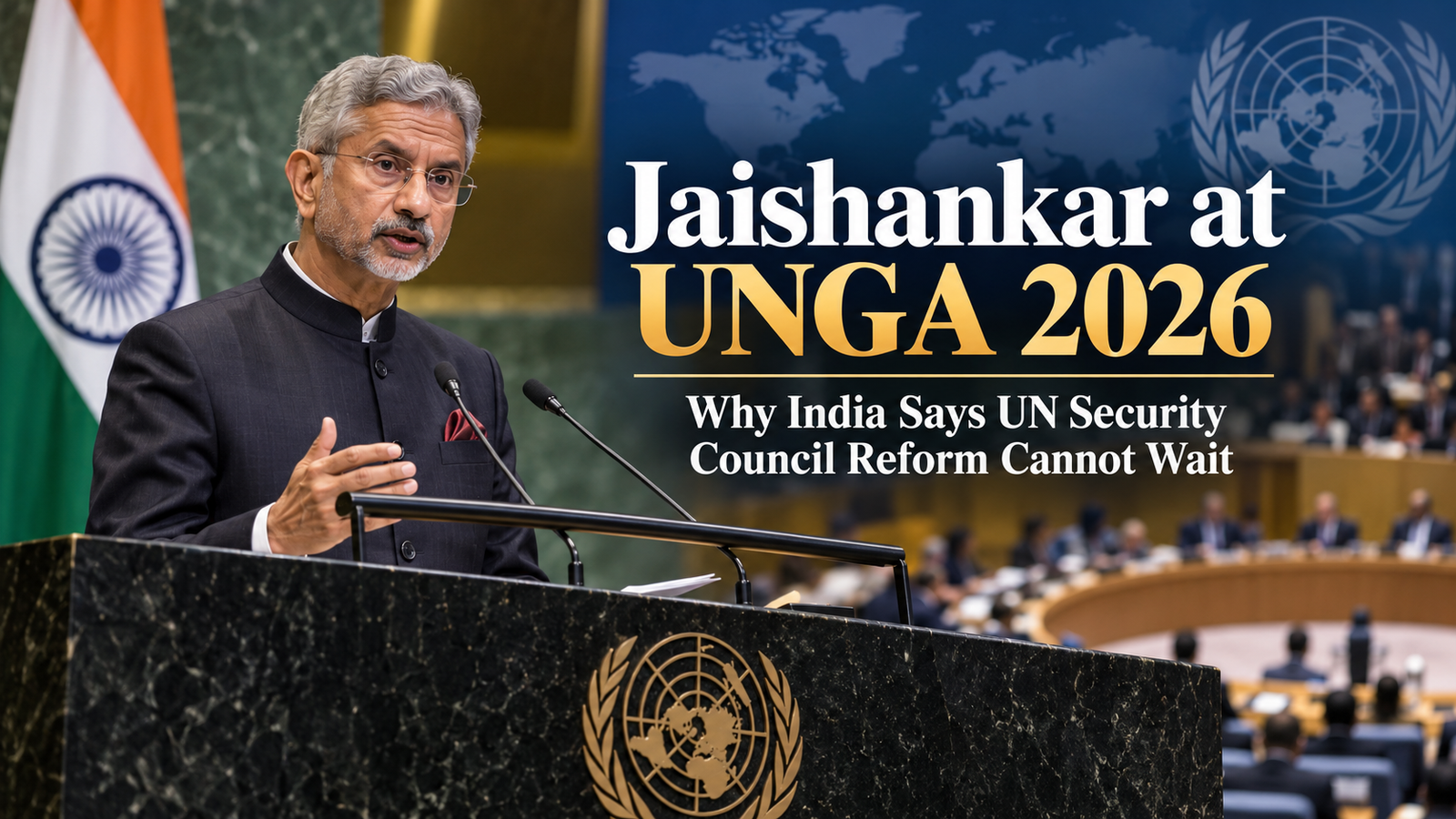

External Affairs Minister Dr. S. Jaishankar, addressing the 81st United Nations General Assembly in New York on September 26, delivered a message that went beyond India’s immediate foreign-policy concerns.
His broader argument was that the international system is struggling to respond to today’s conflicts while many countries affected by those crises have limited influence over the institutions making the most important decisions.
“Countries far from conflicts are being penalised for no fault of theirs,” Jaishankar said, adding that those most affected often have the least say.
That argument connects directly with one of India’s longest-running diplomatic priorities: reforming the United Nations Security Council and securing permanent representation for India.
What Did Jaishankar Say at the UN?
Jaishankar’s UNGA speech covered several major global challenges, including conflicts, terrorism, disruptions to trade and energy flows, and the pressure these crises place on developing countries.
Referring to continuing hostilities in the Gulf, he called for restraint, protection of civilians and the uninterrupted movement of energy and commerce.
He also placed terrorism prominently in India’s message to the UN, arguing that state-supported and cross-border terrorism remains a threat to the international order and reiterating India’s position that countries retain the right to defend themselves against terrorism.
But alongside these immediate security issues was a larger question: does the UN’s most powerful institution still represent the world it is supposed to govern?
The Security Council Still Reflects a Different Era
The UN Security Council has 15 members, but only five have permanent membership and veto power: the United States, China, Russia, France and the United Kingdom.
That structure is rooted in the international order created after the Second World War.
India argues that global political and economic realities have changed dramatically since then.
India is now one of the world’s most populous countries and a major economy, while countries across Africa, Latin America and large parts of Asia remain without permanent representation.
The criticism is therefore not only about India.
It is about whether an institution designed in the 1940s can remain representative in the 2020s.
Why India Is Making the Case for a Permanent Seat
Supporters of India’s candidacy point to several factors.
India has participated in UN peacekeeping since the organisation’s early decades. According to the United Nations, more than 275,000 Indian personnel have served under the UN flag, making India one of the largest cumulative contributors to peacekeeping operations.
India also presents itself as an important voice for developing countries and the Global South.
During this year’s UNGA meetings, that argument received additional support.
Foreign ministers from the Visegrád Group — Poland, Hungary, Slovakia and the Czech Republic — backed India’s permanent membership, saying India should have a place at the Security Council table.
India is also working with Brazil, Germany and Japan through the G4, whose foreign ministers said this week that Security Council reform has become increasingly necessary because of the changing geopolitical environment.
Jaishankar Wants Negotiations, Not Endless Discussion
One of Jaishankar’s strongest remarks during UNGA week came during a separate ministerial discussion on UN reform.
He argued that genuine reform requires text-based negotiations, saying that negotiations without an actual text risk becoming little more than a way of delaying decisions.
This has become a central Indian criticism of the reform process.
Countries have discussed Security Council reform for years, but disagreements remain over how many permanent seats should be created, which countries should receive them and whether new permanent members should receive veto powers.
The G4 says the Council should expand in both permanent and non-permanent categories and become more representative of Africa, Asia-Pacific and Latin America.
Why Reform Is So Difficult
Even widespread political support does not automatically produce a permanent seat.
Changing the Security Council requires amending the UN Charter.
Under Article 108, an amendment must receive support from two-thirds of the General Assembly and then be ratified by two-thirds of UN members — including all five existing permanent Security Council members.
That creates a major political hurdle.
Any reform effectively requires the approval of the countries whose existing privileges could be diluted by expansion.
There are also competing reform proposals. Some countries support adding new permanent members, while others prefer increasing elected or longer-term seats instead.
Is India’s Permanent Seat Becoming More Relevant?
The case made by India and its partners is essentially about representation.
Today’s major challenges — from wars and terrorism to energy security, artificial intelligence and climate change — affect countries far beyond the traditional centres of global power.
At the opening of this year’s General Assembly debate, UN officials themselves acknowledged that questions about the effectiveness and representativeness of the organisation have become increasingly difficult to ignore.
Whether India ultimately becomes a permanent member remains a matter for UN member states to negotiate.
But the debate is increasingly shifting from whether the Security Council needs reform to what that reform should look like and which countries should participate permanently in global decision-making.
Conclusion
Jaishankar’s UNGA address came at a time when wars, terrorism, disrupted shipping routes and economic pressures are testing international institutions.
India’s position is that the global system cannot claim to represent the modern world while its most powerful decision-making body continues to reflect the geopolitical balance of 1945.
A permanent Indian seat is one proposal within the much wider debate over UN Security Council reform.
The political obstacles remain substantial.
But as Jaishankar and other countries argued during UNGA 2026, the longer meaningful reform is postponed, the harder it may become for institutions such as the Security Council to maintain broad international confidence.
Frequently Asked Questions
Does India currently have a permanent seat on the UN Security Council?
No. India has served multiple terms as an elected non-permanent member but is not one of the five permanent members.
Which countries are permanent UNSC members?
China, France, Russia, the United Kingdom and the United States are the five permanent members.
Which countries support India’s permanent membership?
India has received support from a number of countries over the years. During UNGA 2026, the Visegrád countries — Poland, Hungary, Slovakia and the Czech Republic — publicly backed India’s permanent membership.
What is the G4?
The G4 consists of India, Brazil, Germany and Japan. The four countries work together in support of Security Council reform and expanded permanent representation.
