
















































For generations, one basic rule has shaped human life:
You work to earn money, and you need money to survive.
But what happens if machines can do much of that work?
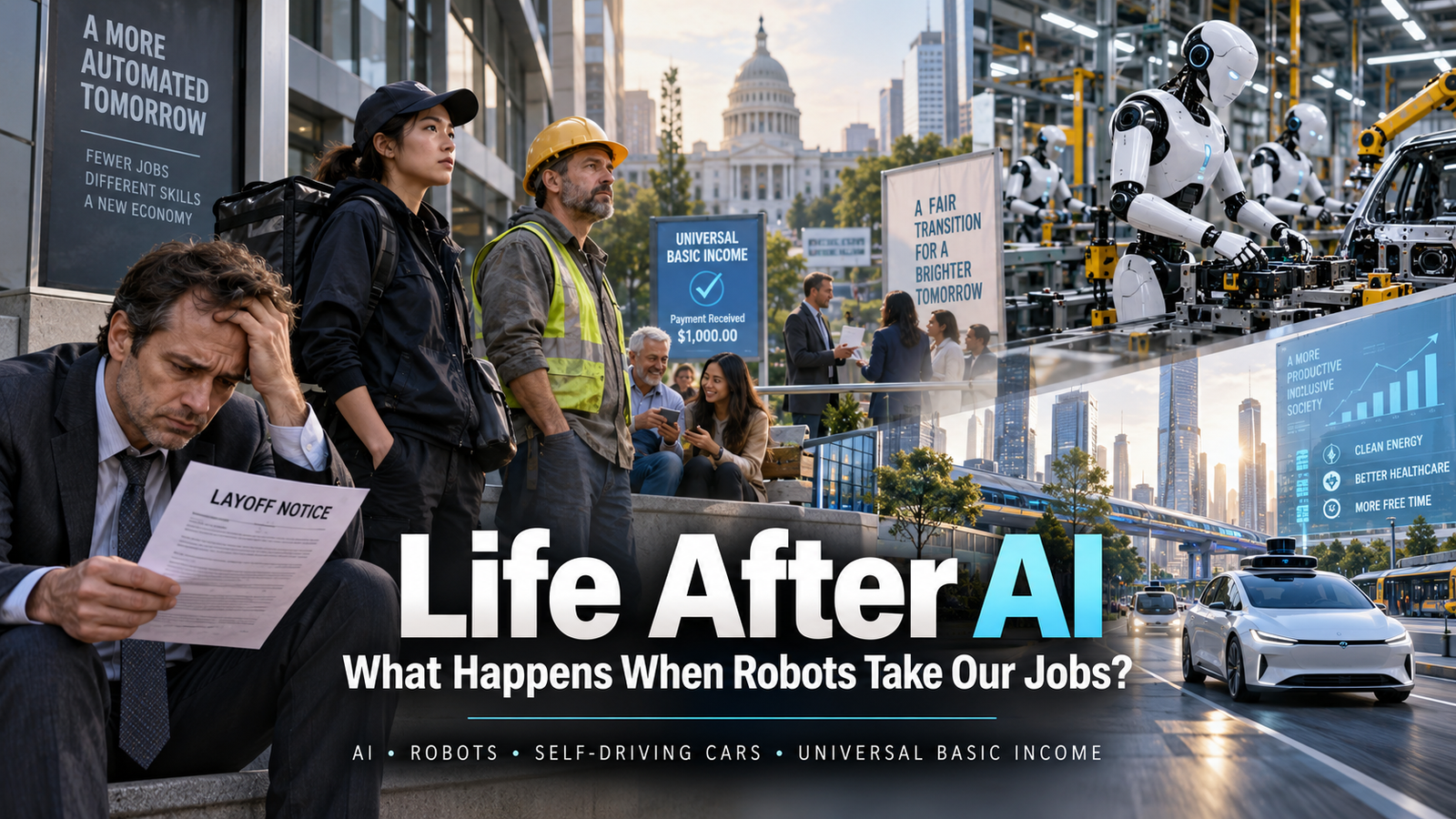
Imagine a world where trucks drive themselves, warehouses are operated by robots, AI handles accounting and customer service, factories need only a handful of human workers, and software can perform tasks that once required entire office departments.
This future is no longer purely science fiction.
Artificial intelligence and automation are already changing the workplace. The bigger question is what happens when the technology becomes good enough to replace not just individual tasks—but millions of jobs.
Will humans simply find new careers?
Will governments pay people a basic income?
Or will society eventually have to rethink the relationship between work, money and human purpose?
AI Probably Won’t Eliminate Every Job
The most dramatic prediction is that AI will make humans economically unnecessary.
Current research does not support that conclusion—at least not yet.
The International Labour Organization estimates that roughly one in four workers worldwide is employed in an occupation with some exposure to generative AI, but it says transformation of jobs is currently more likely than complete replacement.
The World Economic Forum’s Future of Jobs Report 2025 estimated that broader economic and technological changes could displace about 92 million jobs by 2030, while creating roughly 170 million new ones.
That means the near-term future may not be a world without jobs.
It may instead be a world where the jobs people do change extremely quickly.
But This Time Automation Is Different
Previous technological revolutions mainly automated physical labour.
Machines transformed agriculture.
Factories automated manufacturing.
Computers automated calculations and paperwork.
AI is unusual because it can increasingly perform cognitive work.
It can write.
Analyse documents.
Generate software.
Translate languages.
Create images.
Answer customers.
Summarise research.
And as AI becomes connected to robotics, automation can move from the computer screen into the physical world.
Imagine autonomous taxis replacing some drivers.
Robotic trucks handling long-distance freight.
Machines stocking warehouses.
Automated restaurants preparing meals.
AI agents performing routine administrative work.
The IMF estimates that nearly 40% of global employment is exposed to AI, with exposure reaching around 60% in advanced economies. Exposure does not mean all those jobs disappear, but it demonstrates how widely the technology could influence work.
What Happens If Machines Can Do Most Work?
This is where the economic problem becomes much bigger.
Suppose a company currently needs 10,000 employees.
Twenty years later, AI and robotics allow the same company to produce even more using only 1,000 workers.
For the company, productivity has increased enormously.
For society, however, a new question appears:
Who receives the economic benefits of that productivity?
If most of the gains flow to the owners of AI systems, robots, companies and capital, wealth could become increasingly concentrated.
The IMF has already warned that AI could increase inequality if high-income workers benefit disproportionately and returns to capital rise.
That could become one of the defining political and economic questions of the AI age.
How Will People Make Money Without Jobs?
If automation ever removes jobs faster than economies can create new ones, governments may have to rethink traditional social protection.
One idea is Universal Basic Income, or UBI.
Under a true UBI system, every eligible citizen would receive a regular payment from the government regardless of whether they are employed.
Imagine receiving enough each month to cover basic food, housing and essential expenses.
Working would still allow someone to earn additional money.
But survival would no longer depend entirely on having a conventional job.
Could Universal Basic Income Actually Work?
UBI has already been tested in limited forms.
Finland conducted a two-year basic-income experiment involving 2,000 unemployed people who received €560 per month without means testing.
Researchers found relatively small employment effects, but recipients reported greater financial security and improved wellbeing compared with the control group.
That does not prove that nationwide UBI would work.
Paying an entire population is very different from running a small experiment.
The OECD has also warned that a meaningful universal payment could require substantial tax increases or changes to existing benefits.
The central challenge would be:
Who pays for it?
Possible future proposals could involve taxes on income, consumption, corporate profits, capital or highly automated production.
But how an AI-era income system should work remains an unresolved policy question.
Would Humans Stop Working?
Probably not.
This is one of the biggest misconceptions about a post-work future.
People do not work only because they need food.
Humans also seek:
Status. Achievement. Competition. Purpose. Creativity. Community. Recognition.
Many wealthy people already have enough money to stop working, yet they continue building companies, creating art, conducting research or pursuing ambitious projects.
The difference in an AI-rich society might be that people have greater freedom to decide what kind of work is worth doing.
What Would Humans Do Instead?
A future with dramatically less compulsory labour could change everyday life.
Instead of spending 40 or 50 hours each week doing repetitive work, people might spend more time on:
Creative work. Art, filmmaking, music, writing and design could become accessible to far more people.
Care work. Raising children, supporting elderly parents and helping communities could receive greater social recognition.
Science and exploration. More people could participate in research, engineering and discovery.
Entrepreneurship. AI could allow one person to operate businesses that once required dozens of employees.
Education. Learning might become something people continually pursue rather than something that largely ends in their twenties.
Human experiences. Sports, travel, relationships, hobbies and community life may become more important when survival requires less labour.
Ironically, the age of intelligent machines could force humanity to rediscover what humans actually value.
The Bigger Risk Isn’t That AI Works
The more serious danger may be that AI works extremely well, while society fails to distribute its benefits.
Imagine robots producing enormous quantities of food, goods and services at very low cost.
Humanity could become extraordinarily productive.
But if a small number of organizations owned nearly all of those machines, society could still experience extreme inequality.
The critical question therefore may not be:
“Will AI take our jobs?”
It may be:
“Who will own the AI that does the work?”
We May Need a New Definition of Work
For centuries, productivity has been connected to human labour.
You worked because society needed your labour.
AI could gradually weaken that relationship.
If machines eventually become capable of producing much of what society needs, employment may become less central to survival.
That does not mean humans become useless.
It means economic value and human value would no longer be the same thing.
Being a good parent has value.
Creating music has value.
Helping a neighbour has value.
Learning has value.
Building relationships has value.
None necessarily requires a salary.
Conclusion
The future will probably not arrive with one dramatic morning when everyone suddenly loses their job.
Automation is more likely to spread unevenly.
Some careers will disappear.
Others will change.
Entirely new professions will emerge.
And humans will continue working alongside increasingly capable machines.
But if AI and robotics eventually become powerful enough to perform a large portion of economically necessary work, governments may have to reconsider taxation, income support, ownership and possibly concepts such as universal basic income.
For most of history, humanity faced one enormous problem:
We did not have enough productivity to give everyone a comfortable life.
Artificial intelligence could eventually create the opposite problem.
We may have extraordinary productive capacity—but need to figure out how everyone shares in it.
And perhaps the biggest question of the AI age will no longer be:
“What do you do for a living?”
It may become:
“What do you choose to do with your life?”
Frequently Asked Questions
Will AI take everyone’s job?
Current research suggests widespread job transformation is more likely than the disappearance of all employment. However, some occupations and tasks face considerably greater automation risk than others.
Which jobs could grow despite AI?
Technology, cybersecurity, healthcare, education, renewable energy and several frontline occupations are among areas the World Economic Forum expects to experience employment growth through 2030.
What is Universal Basic Income?
Universal Basic Income is a proposed system in which people receive a regular government payment regardless of employment status or, in its pure form, income.
Will UBI definitely happen because of AI?
No. UBI is one possible policy response. Governments could instead expand existing welfare systems, wage subsidies, retraining programmes, shorter working weeks or entirely different approaches.
Could people work fewer hours in the future?
Possibly. If AI produces significant productivity gains, societies could theoretically choose to convert some of those gains into shorter working weeks rather than only higher production. Whether that happens would depend on economic and political choices.
Disclaimer: This article discusses possible future economic and technological scenarios. Predictions about AI, robotics, employment and universal basic income are inherently uncertain and should not be interpreted as guaranteed outcomes.
