

















































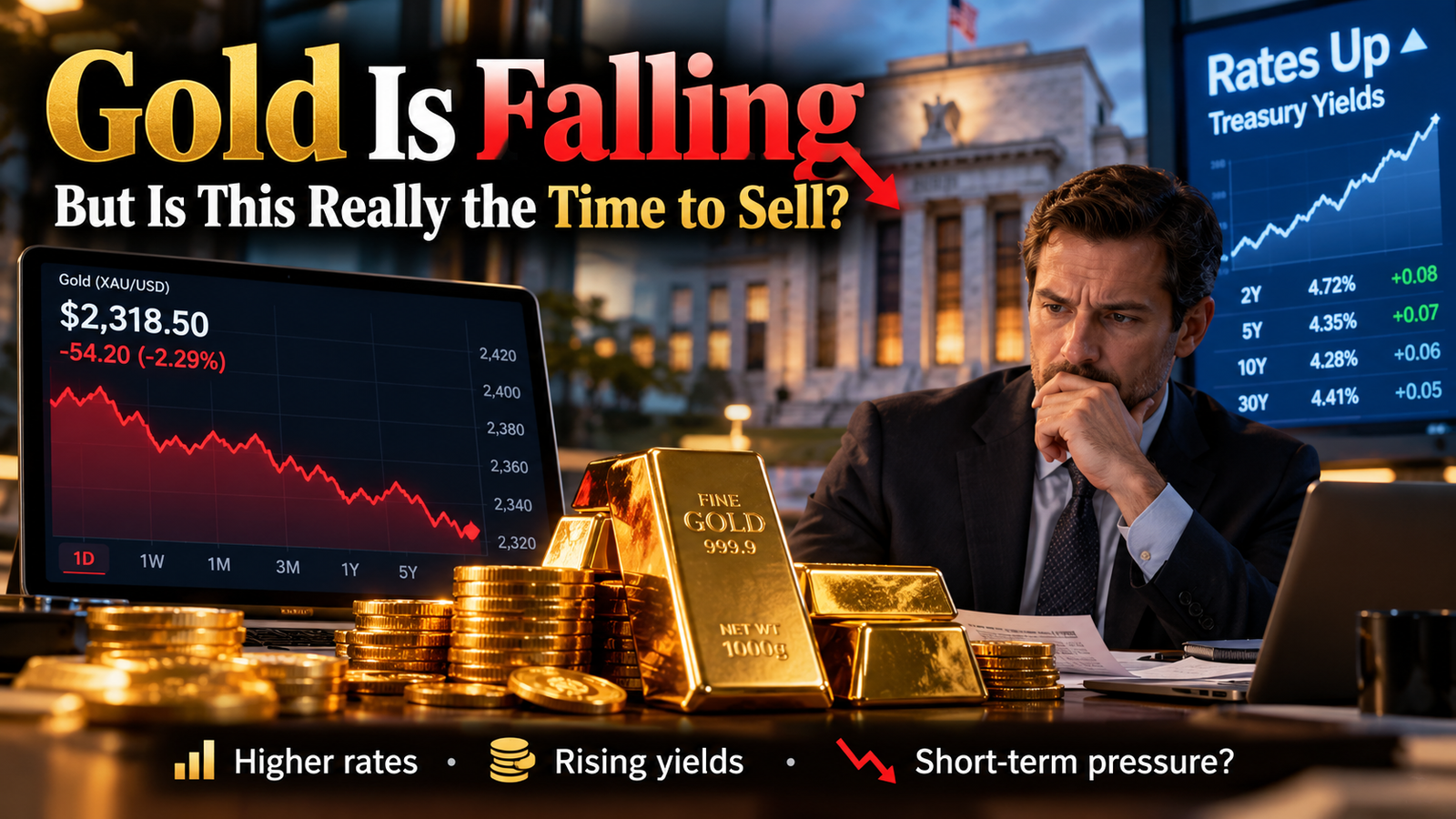

Gold has suddenly lost some of its shine.
After a powerful rally, the precious metal suffered a sharp correction this week, falling almost 4% in one session and briefly touching its lowest level in roughly seven weeks before recovering somewhat on September 29.
The obvious question for investors is:
Has the gold story changed—or is the market simply reacting to interest rates?
There are reasons to be cautious before assuming that a short-term fall in gold means the long-term case for the metal has disappeared.
Why Is Gold Falling?
The biggest pressure is coming from U.S. interest rates.
On September 16, the Federal Reserve raised its benchmark federal funds target range by 0.25 percentage point to 3.75%–4.00%, saying inflation remained elevated.
Higher interest rates usually create problems for gold because gold does not pay interest.
If investors can earn attractive yields by holding government bonds, some money naturally moves away from non-yielding assets such as gold.
That pressure has become especially noticeable in the Treasury market.
The U.S. 10-year Treasury yield reached about 5.29% on September 29—its highest level since 2007—while the 30-year yield briefly reached levels not seen since 2002.
That combination of higher yields and a stronger dollar has been one of the main forces pushing gold lower.
The 2007 Comparison Is Interesting—but Needs Caution
Seeing the 10-year Treasury yield return to levels last recorded in 2007 naturally brings uncomfortable memories.
The U.S. economy entered recession later that year, followed by the 2008 global financial crisis.
But today’s high yields do not automatically mean another 2008 crash is coming.
The circumstances are different.
The 2008 crisis was heavily connected to excessive mortgage lending, complex mortgage-backed securities, leverage inside the financial system and ultimately a collapse in housing-related credit.
Today’s risks include inflation, geopolitical tensions, expensive borrowing, stretched valuations in parts of financial markets and enormous investment in artificial intelligence infrastructure.
So the similarity in bond yields is worth watching.
It is not, by itself, a prediction of another financial crisis.
Something Doesn’t Quite Match the “Everything Is Fine” Narrative
The U.S. economy is giving conflicting signals.
On one side, economic activity has remained relatively strong. The Federal Reserve said in September that activity was expanding at a “solid pace,” with resilient domestic spending and strong capital investment.
But household sentiment tells a different story.
U.S. consumer confidence fell to 81.9 in September, near a 12½-year low, according to data reported by Reuters, as households expressed growing concern about employment prospects and the cost of living.
Inflation also remains above the Federal Reserve’s 2% target.
The U.S. Consumer Price Index increased 3.4% year over year in August, while prices rose 0.4% just during that month.
The Fed itself projects PCE inflation of around 3.7% for 2026, well above its long-run target.
So both statements can be true:
The broader economy can continue growing while many households still feel financially squeezed.
Are the Midterm Elections Affecting the Economic Narrative?
The November 2026 U.S. midterm elections inevitably put greater political attention on inflation, employment, fuel prices and household finances.
Republicans and Democrats have strong incentives to frame economic conditions in ways favourable to their electoral arguments.
But investors should separate campaign messaging from economic data.
It would be difficult to prove that gold’s current correction is being directly caused by the midterm elections.
The much clearer market explanation is the combination of higher Treasury yields, the stronger dollar and expectations that the Federal Reserve could raise interest rates again.
That does not make political narratives irrelevant.
It simply means markets should be analysed using economic indicators rather than campaign slogans from either side.
Why Higher Rates Hurt Gold in the Short Term
Imagine two choices.
Investment A pays you around 5% annually.
Investment B pays no interest.
When investors feel confident in financial markets, Investment A can suddenly look much more attractive.
That is essentially what higher Treasury yields do to gold.
But gold is rarely purchased only for income.
Investors also hold it as a potential hedge against inflation, currency weakness, geopolitical instability and financial-market stress.
That creates an interesting contradiction.
The same inflation pressures forcing interest rates higher can hurt gold today while strengthening some of the longer-term reasons investors own gold.
Central Banks Are Still an Important Part of the Story
Another factor separating today’s gold market from ordinary speculative trading is central-bank demand.
Reuters reports that central-bank purchases, including demand from China, continue to provide underlying support to the gold market even as higher interest rates create short-term pressure.
Central banks do not normally purchase gold because they expect to flip it for a quick profit next month.
Gold can serve as a reserve asset that is not simultaneously another country’s financial liability.
That long-term strategic role does not disappear because Treasury yields rise for several months.
Should Gold Investors Panic?
A falling price is uncomfortable.
But price movement alone does not tell you whether an investment thesis has changed.
Someone who purchased gold purely because they expected the price to rise every month may have a very different decision from someone holding it as part of a diversified long-term portfolio.
The useful question is therefore not:
“Gold fell. Should I sell?”
It is:
“Why did I own gold in the first place?”
If the original purpose was diversification or protection against longer-term monetary and geopolitical uncertainty, several weeks of higher bond yields may not fundamentally change that reasoning.
If someone’s financial circumstances, investment horizon or risk tolerance have changed, that is a different matter.
The Bigger Risk Could Be Chasing the Market
Markets routinely move between fear and enthusiasm.
When gold rises rapidly, people rush to buy.
When it corrects, some of the same investors rush to sell.
That behaviour can result in repeatedly buying after prices rise and selling after prices decline.
Gold has already demonstrated how quickly sentiment can reverse. After Monday’s sharp decline, it rebounded roughly 1% during Tuesday’s trading.
Nobody knows whether the next significant move will be higher or lower.
What investors can control is whether their decisions are driven by a long-term plan or short-term emotion.
Could High Bond Yields Become a Warning Sign?
This may be the more important question.
A 10-year Treasury yield above 5% means borrowing becomes expensive across the economy.
Mortgage rates rise.
Corporate financing becomes more expensive.
Government debt servicing costs increase.
Consumers pay more to borrow.
Eventually, persistently high rates can slow economic activity.
That does not guarantee a recession or financial crisis.
But investors should watch whether high borrowing costs begin producing stress in housing, corporate credit, employment or the banking system.
Gold’s behaviour could then change quickly.
If markets move from worrying about inflation toward worrying about recession or financial instability, investors may again view gold very differently.
Conclusion: Don’t Confuse a Correction With a Conclusion
Gold is under genuine short-term pressure.
The Federal Reserve has raised rates.
Treasury yields have surged.
The dollar has strengthened.
And a non-yielding asset naturally becomes less attractive when safe bonds offer substantial returns.
But none of that proves that gold’s longer-term role has disappeared.
Inflation remains above target.
Consumers are increasingly pessimistic.
Government borrowing remains enormous.
Geopolitical risks remain elevated.
And Treasury yields are now sitting around levels markets have not experienced since before the global financial crisis.
That does not mean another 2008 is inevitable.
It means investors should pay attention.
For people already holding gold as part of a diversified long-term strategy, a short-term correction is better treated as a reason to reassess the original investment thesis rather than automatically panic-sell.
Markets can move quickly.
Fundamentals usually move much more slowly.
Frequently Asked Questions
Why is gold falling right now?
Higher U.S. Treasury yields, a stronger dollar and expectations of additional Federal Reserve rate increases have reduced the short-term appeal of non-interest-bearing gold.
Did the Federal Reserve recently raise interest rates?
Yes. On September 16, 2026, the Fed increased its target range by 25 basis points to 3.75%–4.00%.
Are Treasury yields really back near 2007 levels?
Yes. The U.S. 10-year Treasury yield reached approximately 5.29% on September 29, its highest level since 2007.
Does this mean another 2008 crash is coming?
No. Similar bond yields do not mean the same economic outcome will follow. The financial system, economic conditions and sources of risk differ significantly from 2007–08.
Is U.S. inflation still high?
Inflation remains above the Federal Reserve’s target. Headline CPI was 3.4% year over year in August 2026.
Should investors sell gold because prices are falling?
There is no universal answer. Investors should consider why they own gold, their time horizon, diversification needs and financial circumstances rather than making decisions solely because of short-term price movement.
Disclaimer: This article is for informational and educational purposes only. It does not constitute investment, financial or trading advice. Gold and other investments can rise or fall substantially, and past market patterns do not guarantee future results.
