








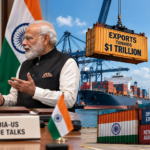






























India-US Trade Deal Hits a Plateau as India Pushes Export Diversification Toward $1 Trillion

The long-awaited India-US trade deal has entered a difficult phase.
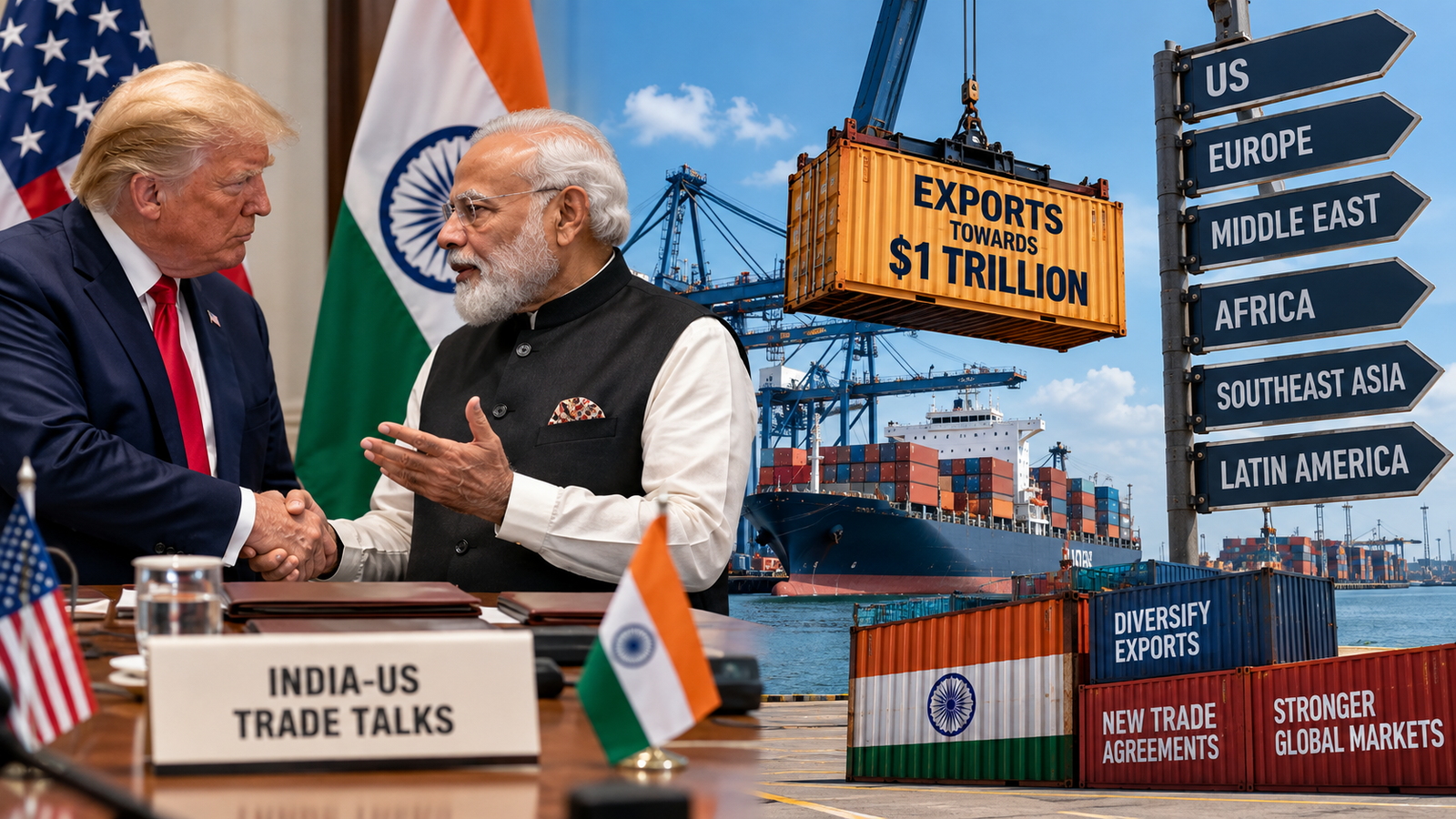
On October 5, Finance Minister Nirmala Sitharaman said negotiations between New Delhi and Washington had reached a “plateau”, suggesting that both sides have limited room left to make additional concessions.
The talks are still continuing, but a breakthrough does not appear imminent. U.S. Trade Representative Jamieson Greer also said last week that an agreement was not close.
At the same time, something else is happening quietly.
India is becoming less dependent on any single export market.
New free-trade agreements, rising services exports and stronger trade with countries such as the UAE, UK and Australia are helping India diversify its economic relationships.
And with total exports already above $860 billion annually, the long-discussed $1 trillion export milestone is beginning to look increasingly realistic.
Why Have India-US Trade Talks Stalled?
India and the United States have been negotiating a bilateral trade agreement since February 2025.
The objective was relatively straightforward:
expand market access, reduce trade barriers and deepen economic ties between two of the world’s largest economies.
But negotiations have become increasingly difficult.
According to Sitharaman, both sides have reached a point where giving substantially more would be “very, very difficult.”
One major issue is the trade imbalance.
India exports more goods to the United States than it imports from America, something Washington wants to address.
Tariffs have added another layer of tension.
Washington introduced a new 10% tariff on a large portion of Indian imports earlier this year, although products including smartphones, generic pharmaceuticals and certain metals received exemptions. India said roughly 45% of its exports to the US remained outside the additional tariff.
Another complication is India’s continued purchase of Russian energy, which remains politically sensitive in Washington.
So while negotiations are not dead, the easy compromises may already have been exhausted.
India Is Refusing to Rush Into a Weak Deal
This is an important change in India’s trade strategy.
Earlier this year, India resisted signing a quick agreement because Washington had not provided sufficient guarantees on some of New Delhi’s key demands, including protection from future tariff measures and competitive treatment relative to other Asian exporters.
That suggests India is willing to wait rather than sign an agreement primarily for political symbolism.
This approach becomes easier if exporters have alternative markets.
And that is exactly where India’s diversification strategy becomes important.
India Is Expanding Beyond the US Market
The United States remains one of India’s most important export destinations.
But India has been aggressively expanding its trade network elsewhere.
Recent trade agreements and partnerships include deeper commercial relationships with:
The United Arab Emirates
Australia
The United Kingdom
as well as ongoing discussions with other economies.
India’s Commerce Ministry says recent FTAs are beginning to produce a wider range of exports and stronger use of preferential market access by Indian companies.
India is also pursuing additional bilateral investment agreements.
Sitharaman said India could finalise agreements with at least three additional countries by December, while negotiations involving countries such as Canada and Russia are also moving forward.
The strategy is simple:
If one market becomes more protectionist, Indian exporters need more places to sell.
India’s Exports Have Already Reached a Record
The most significant development is the scale India has already achieved.
India’s total exports of goods and services reached a record $863.1 billion in FY2025-26, according to government data.
That included:
$441.8 billion in merchandise exports
and
$421.3 billion in services exports.
That represents substantial progress from the previous year.
Official estimates put total exports in FY2024-25 at approximately $825.3 billion.
So India is already more than 86% of the way to $1 trillion.
Recent Monthly Data Are Even More Encouraging
The latest trade figures show that export momentum has accelerated.
India’s combined merchandise and services exports reached an estimated $82.68 billion in August 2026, up 25.4% year over year.
If India were able to sustain an average export pace above roughly $83 billion per month, annual exports would mathematically approach the $1 trillion mark.
Of course, exports fluctuate significantly from month to month.
One strong month does not guarantee a trillion-dollar year.
But the latest data show that the target is no longer unrealistic.
Services Could Be India’s Biggest Advantage
India’s most powerful export engine may increasingly be services rather than physical goods.
Services exports reached $421.3 billion in FY2025-26, supported by areas such as:
IT services
business services
telecommunications
professional services
digital services.
The Commerce Ministry is already developing a roadmap aimed specifically at taking services exports alone toward $1 trillion over the longer term.
Its priority sectors include IT and IT-enabled services, professional services, digital healthcare, audiovisual services, maritime services and tourism.
That matters because services exports are less exposed to some of the traditional barriers affecting physical goods.
Software, consulting and digital services do not face shipping costs or customs duties in the same way textiles or manufactured goods do.
India’s FTA Strategy Is Becoming More Important
India’s broader export strategy increasingly resembles portfolio diversification.
Instead of relying excessively on one major buyer, the country is trying to create multiple trade corridors.
The UAE gives India stronger access to the Gulf.
Australia provides another developed-market partner.
The UK agreement can support sectors ranging from textiles and engineering to professional services.
Additional agreements could expand access to Europe, Africa and other parts of Asia.
This does not mean the United States becomes unimportant.
Far from it.
The US remains a huge consumer market and an important destination for Indian technology, pharmaceuticals, engineering goods, textiles and other exports.
But diversification gives New Delhi more negotiating flexibility.
Could India Reach $1 Trillion in Exports Soon?
The numbers suggest it is possible, although the exact timing remains uncertain.
India needs roughly another $137 billion beyond its FY2025-26 export level to cross $1 trillion.
That represents growth of roughly 16%.
If services exports continue expanding quickly and merchandise exports remain resilient, India could approach that threshold considerably sooner than many expected.
But there are risks.
A global recession could weaken demand.
High oil prices could raise India’s import bill.
Protectionist tariffs could affect labour-intensive sectors such as textiles.
Currency volatility could also create challenges for exporters.
So $1 trillion should be viewed as a milestone India is approaching—not a guaranteed number for the current financial year.
The Bigger Story Is Export Diversification
The most important development may not actually be the $1 trillion figure.
It is India’s attempt to reduce economic vulnerability.
For years, Indian exporters depended heavily on a relatively small number of major markets.
Now the strategy is shifting toward:
more FTAs
more services exports
more manufacturing exports
more markets
and less dependence on any single trading partner.
That could become especially important in an era where tariffs are increasingly being used as geopolitical tools.
Conclusion
The India-US trade deal has clearly lost momentum.
Finance Minister Nirmala Sitharaman’s description of negotiations reaching a “plateau” suggests that both countries believe they have already made substantial concessions and are reluctant to go much further.
But this does not mean India’s broader trade story is weakening.
In many ways, the opposite is happening.
Total exports have reached a record $863.1 billion.
Services exports continue expanding rapidly.
New trade agreements are opening additional markets.
And recent monthly export growth suggests the path toward $1 trillion in annual exports is becoming increasingly visible.
The US will remain an important economic partner.
But India’s emerging strategy appears to be broader:
negotiate with Washington, but do not depend entirely on Washington.
For India, the next phase of trade growth may come not from one giant agreement—but from building many export corridors across the world.
Frequently Asked Questions
Has the India-US trade deal failed?
No. Negotiations are still continuing, but both sides have acknowledged that an agreement is not imminent and that major sticking points remain.
Why have the negotiations reached a plateau?
Major disagreements remain over market access, tariffs, trade imbalances and the amount of additional concessions each side is willing to make.
How much does India currently export?
India’s total goods and services exports reached a record $863.1 billion in FY2025-26.
Are India’s exports growing quickly?
Yes. Combined exports for August 2026 were estimated at $82.68 billion, up 25.4% from August 2025.
Could India reach $1 trillion in exports?
It is increasingly plausible, but the timing is uncertain. Sustaining recent export growth would bring India close to the $1 trillion threshold, although global demand, tariffs and geopolitical risks could affect the timeline.
How is India diversifying exports?
India is expanding free-trade agreements, increasing services exports and building stronger commercial links with markets such as the UAE, UK, Australia and other emerging partners.
