

























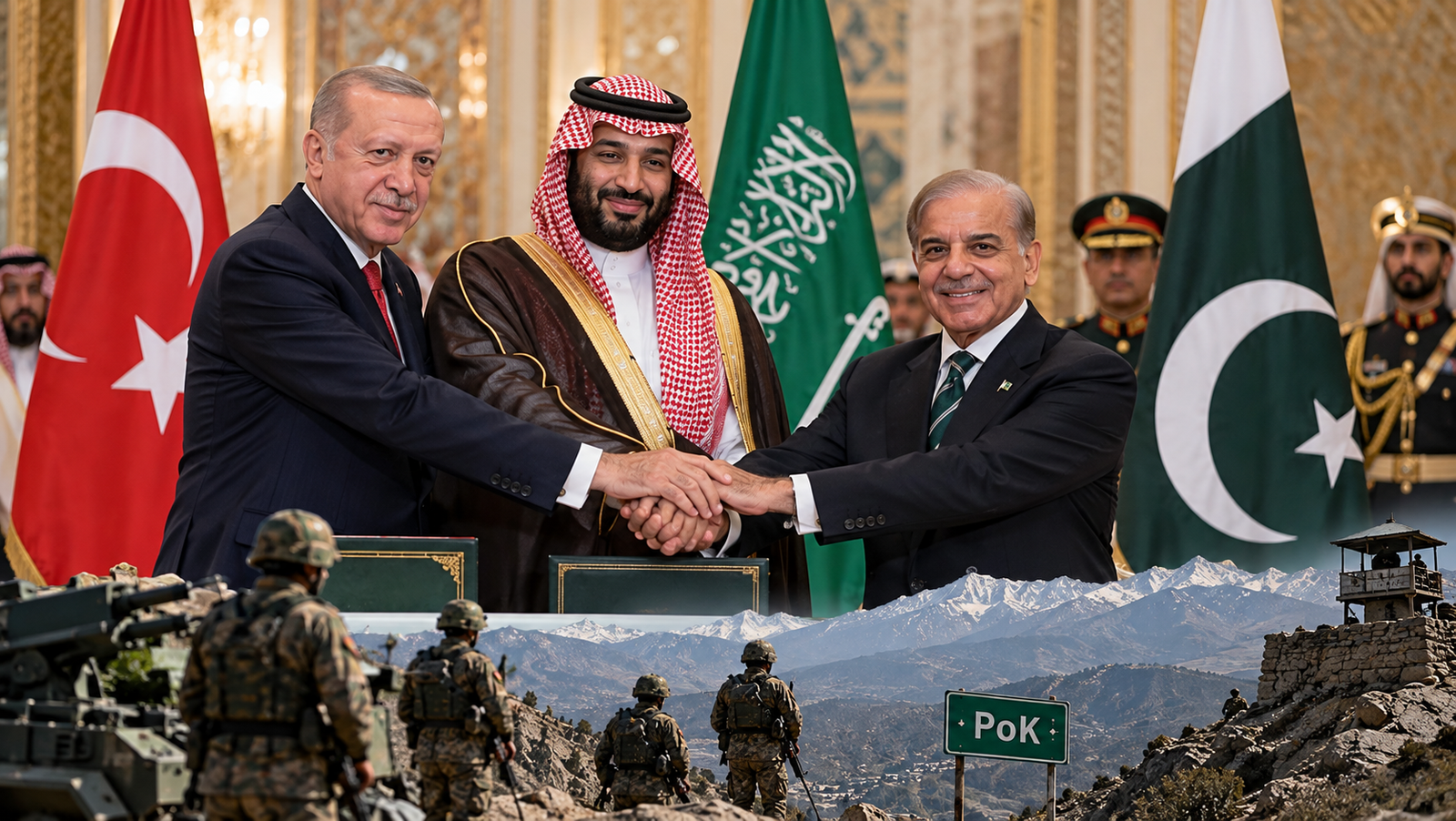
Makkah Defence Pact Activated: Could Pakistan’s Saudi Commitment Stretch Its Military—and What Does It Mean for PoK?

A major new security arrangement in the Middle East is beginning to move from paper to military planning.
On October 5, Saudi Arabia, Pakistan and Türkiye agreed to begin rapidly deploying agreed military forces and capabilities to Saudi Arabia under the Makkah Defence Alliance, following escalating Houthi attacks and instability around the Gulf.
The development immediately raises an important question for South Asia.
Pakistan already faces militant violence, political instability and security challenges along its western frontier. If Islamabad commits more troops, aircraft and military resources to defending Saudi Arabia, how much strategic capacity would it still have available at home?
And from India’s perspective, does that change the equation surrounding Pakistan-occupied Kashmir, or PoK?
The answer is more complicated than it may first appear.
What Exactly Is the Makkah Defence Pact?
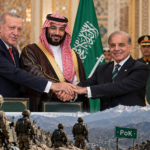
The Makkah Joint Defence Agreement was signed by Saudi Arabia, Pakistan and Türkiye on August 7, 2026.
Its central principle resembles NATO’s collective-defence concept: an attack against one member is treated as an attack against all three.
Initially, officials stressed that the alliance was defensive and still being institutionalised.
But events have moved quickly.
Following renewed attacks against Saudi territory and infrastructure, officials from the three countries met in Riyadh on October 5 and agreed to begin implementing collective-defence commitments, including the rapid deployment of agreed forces and military capabilities to the kingdom.
That is why it is reasonable to say the pact is now moving toward operational activation.
Pakistan Already Has Significant Forces in Saudi Arabia
Pakistan’s military involvement in Saudi Arabia did not begin with the Makkah agreement.
Reuters reported earlier this year that Islamabad had deployed approximately 8,000 troops, a fighter squadron, drone units and air-defence systems to Saudi Arabia during the Iran conflict.
Pakistan and Saudi Arabia also have decades of military cooperation involving training, advisers and security assistance.
The new alliance, however, potentially creates a much broader obligation.
If Saudi Arabia faces sustained missile, drone or cross-border attacks, Pakistan could be asked to provide additional personnel, air-defence assets, aircraft, intelligence support or logistical capabilities.
That raises an obvious strategic concern:
Can Pakistan increase its Middle Eastern commitments without weakening its ability to handle security pressures at home?
Pakistan Already Faces Serious Internal Security Challenges
Pakistan’s military is not operating in a quiet domestic environment.
Militant violence remains a major issue in Khyber Pakhtunkhwa and Balochistan, while tensions involving Afghanistan continue to complicate security along Pakistan’s western frontier.
Political instability is another factor.
Thousands of supporters of jailed former prime minister Imran Khan began another march toward Islamabad on October 5, while the federal government deployed extensive security around the capital.
Pakistan also faces severe fiscal constraints.
Its FY2026-27 budget increased defence spending by approximately 18% to 3 trillion Pakistani rupees, while development spending was cut as Islamabad attempted to remain within the conditions of its IMF programme.
That means Pakistan is simultaneously dealing with:
internal militancy
border security
political unrest
economic pressure
India-facing military requirements
and now potentially greater Gulf commitments.
That is a substantial burden.
Would Pakistan’s Military Become “Stretched”?
Possibly—but that should not be exaggerated.
Pakistan has one of the largest armed forces in the region, and not every deployment to Saudi Arabia requires withdrawing combat formations from the India-facing frontier.
The current Saudi-led operation against the Houthis also appears to rely heavily on Yemeni ground forces, with Pakistan and Türkiye contributing equipment, advisers and other support rather than necessarily providing the main combat force. Reuters reported on October 2 that Pakistani and Turkish forces were not then expected to lead direct ground combat in Yemen.
So the idea that Pakistan’s army will suddenly empty its eastern positions to defend Saudi Arabia is unrealistic.
The more significant issue is high-value military assets.
Air-defence batteries.
Fighter aircraft.
Drones.
Intelligence personnel.
Logistics.
Specialised troops.
These resources cannot be in several places at once.
A prolonged Gulf commitment could therefore reduce Pakistan’s flexibility even if it does not fundamentally remove its ability to defend its borders.
Does This Create an Opportunity for India Over PoK?
India’s official position has remained consistent for decades.
New Delhi states that the entire former princely state of Jammu and Kashmir—including territory currently administered by Pakistan—is an integral part of India.
The Ministry of External Affairs has also maintained that areas under Pakistani control are under what India considers illegal occupation.
Defence Minister Rajnath Singh reiterated that position in July 2026, saying that if India and Pakistan were to hold talks, the discussion would concern PoK.
But recognising a territorial claim and attempting to change control through military force are two completely different questions.
Why a Military Move Would Be Extremely Risky
Even if Pakistan diverted additional resources toward Saudi Arabia, several realities would remain.
Pakistan Would Still Retain Major Forces
Its eastern military posture is central to Pakistan’s national defence strategy.
Islamabad would be extremely unlikely to substantially weaken sensitive areas facing India simply because it had obligations in the Gulf.
Pakistan Is a Nuclear-Armed State
Any large conventional conflict between India and Pakistan carries escalation risks that do not exist in an ordinary territorial dispute.
What might begin as a limited operation could escalate rapidly if either side believed strategically important territory or forces were threatened.
That makes assumptions about a short, easily controlled conflict especially dangerous.
China Is Another Factor
China has major economic and strategic interests in Pakistan, including infrastructure connected to the China-Pakistan Economic Corridor.
India also disputes Chinese involvement in territory that New Delhi regards as part of Jammu and Kashmir and Ladakh.
A major India-Pakistan conflict would therefore have diplomatic and strategic consequences extending beyond the two countries.
India Would Risk Losing Diplomatic Ground
India has increasingly presented itself internationally as a major economic power focused on growth, trade, connectivity and stability.
Starting a major conflict could create economic consequences ranging from capital outflows and higher insurance costs to disruption of investment and trade.
Even a militarily successful operation could therefore carry enormous financial and diplomatic costs.
Pakistan’s Real Vulnerability May Be Strategic Overextension
The more interesting consequence of the Makkah alliance may therefore be not an immediate territorial opportunity, but long-term strategic overextension.
Pakistan must now balance commitments in multiple directions.
To the west, instability involving Afghanistan and militant groups remains serious.
Internally, Balochistan and Khyber Pakhtunkhwa require sustained security attention.
To the east, India remains Pakistan’s principal conventional military concern.
And in the Gulf, Pakistan is becoming increasingly tied to Saudi security.
Reuters has already described Pakistan as facing pressure to balance its Saudi defence commitments with its relationship with Iran while managing stretched military resources.
Managing all these commitments simultaneously could become increasingly difficult if the Gulf conflict continues for years.
India May Gain More Through Patience Than War
From India’s perspective, Pakistan becoming strategically overstretched can create leverage without requiring military action.
India can continue strengthening infrastructure and defensive capabilities along its borders.
It can expand diplomatic pressure over terrorism.
It can grow its economy and defence-industrial base.
And it can maintain its territorial position on PoK while avoiding an unpredictable large-scale conflict.
This distinction is important.
A rival becoming more stretched does not automatically mean “attack now.”
Sometimes the greater strategic advantage comes from allowing the rival to absorb the financial and military costs of its own commitments.
What Could Change the Calculation?
The situation would need to evolve much further before Pakistan’s Saudi commitments fundamentally altered South Asia’s military balance.
Important indicators to watch include:
How many additional Pakistani troops are actually deployed to Saudi Arabia.
Whether Pakistani combat aircraft and air-defence systems are moved in larger numbers.
Whether Pakistani forces become directly involved in Yemen.
Whether internal militancy continues increasing.
Whether Pakistan’s defence budget can sustain simultaneous commitments.
Until those numbers become clearer, claims that Pakistan’s India-facing defence has been significantly weakened remain speculative.
Conclusion
The Makkah Defence Pact has clearly entered a more serious phase.
Saudi Arabia, Pakistan and Türkiye are no longer discussing only political solidarity. They have agreed to move toward rapid military deployment and greater operational integration.
For Pakistan, that adds another responsibility to an already complicated security environment.
Islamabad must manage internal militancy, Afghanistan, political instability, economic constraints, its military balance with India and now a deeper commitment to Saudi defence.
That can create strategic overstretch.
But it does not mean Pakistan has suddenly become incapable of defending the Line of Control or that military action over PoK has become low-risk.
For India, the more consequential opportunity may be longer term.
If Pakistan spends increasing resources defending interests far from South Asia while India continues strengthening economically and militarily, the relative balance between the two countries could continue shifting.
PoK will remain a central political and territorial issue between India and Pakistan.
But in a region containing two nuclear-armed states, the difference between strategic opportunity and dangerous miscalculation can be extremely small.
The smartest question may therefore not be:
“Is this India’s moment to attack?”
It may be:
“Does Pakistan’s growing strategic burden strengthen India’s position without India needing to start another war?”
Frequently Asked Questions
What is the Makkah Defence Pact?
It is a collective-defence agreement signed by Saudi Arabia, Pakistan and Türkiye in August 2026. It treats an attack on one member as an attack on all three.
Has the Makkah pact been activated?
The alliance moved significantly toward operational activation on October 5, when the three members agreed to implement collective-defence measures and rapidly deploy agreed forces and military capabilities to Saudi Arabia.
Does Pakistan already have troops in Saudi Arabia?
Yes. Pakistan has maintained military personnel in Saudi Arabia for training and security cooperation, and Reuters reported a substantial deployment during the 2026 Iran conflict.
Will Pakistan have to remove troops from its border with India?
There is currently no evidence that Pakistan plans to significantly strip forces from its India-facing frontier. The impact will depend on the scale and duration of future Saudi deployments.
Does India claim PoK?
Yes. India’s official position is that the entire Union Territories of Jammu and Kashmir and Ladakh are integral parts of India and that Pakistan occupies portions of that territory illegally. Pakistan rejects India’s position.
Is this the right time for India to militarily take PoK?
Pakistan’s additional Gulf commitments may increase pressure on its military resources, but available evidence does not show that its eastern defences have collapsed. Any attempt to change control through force would also carry major conventional, nuclear, economic and diplomatic escalation risks.
Disclaimer: This article analyses publicly available information as of October 6, 2026. Military deployment details under the Makkah Defence Alliance remain partly confidential. Discussion of PoK reflects competing territorial positions and strategic analysis and should not be interpreted as advocating military action.
