







































America is officially a democracy.
Citizens vote.
Congress passes laws.
Courts review them.
Presidents come and go.
But there is another layer of power operating underneath the formal political system.
It is built on money.
Lobbyists.
Campaign donations.
Corporate lawyers.
Government contracts.
Regulatory influence.
And the revolving door between Washington and the industries Washington is supposed to regulate.
That is why the debate about whether America is becoming an oligarchy should not be dismissed as exaggeration.
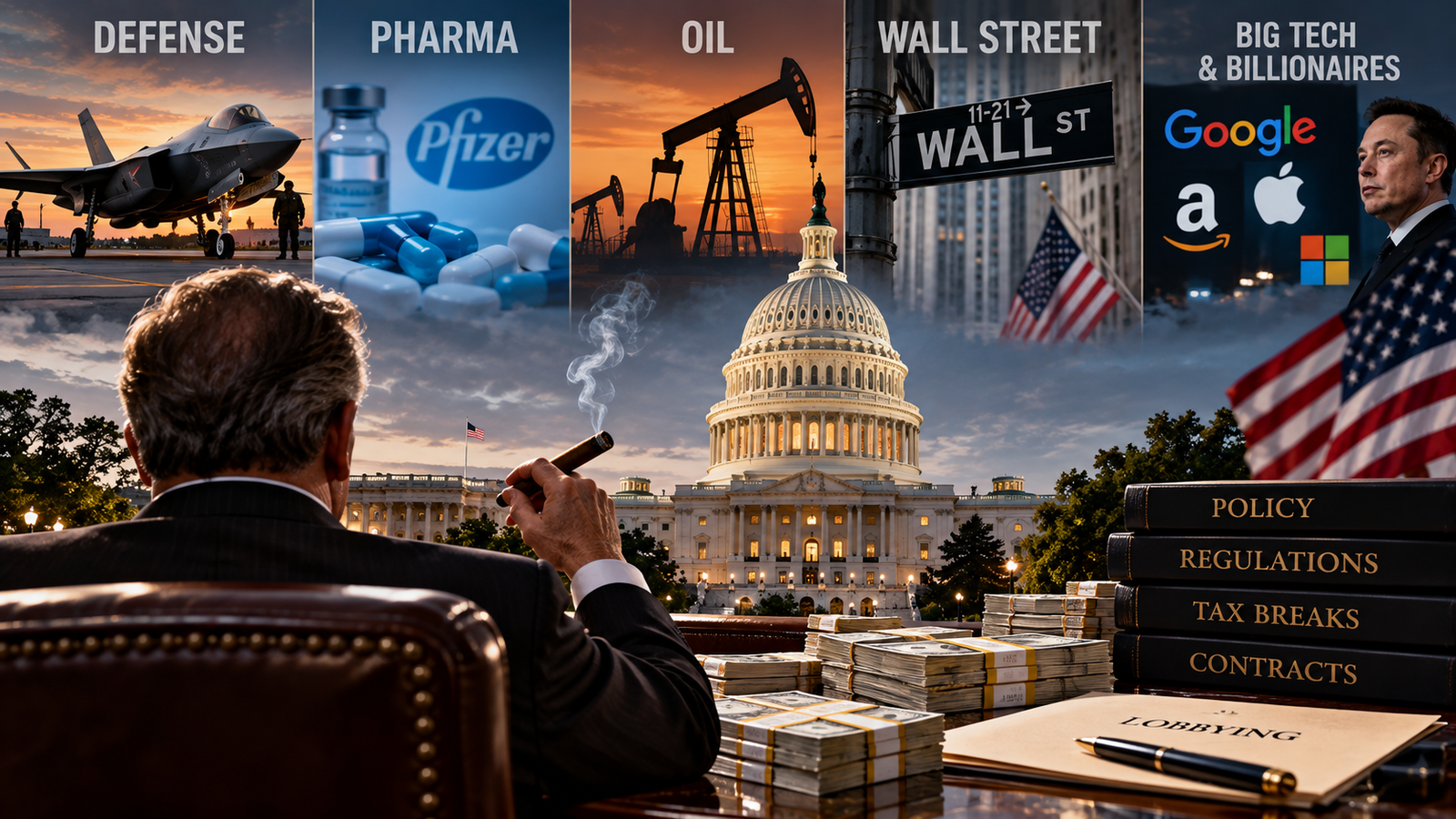
The question is not whether Elon Musk, JPMorgan, Pfizer, Exxon or Lockheed Martin literally sit in a room and issue orders to Congress.
The real question is simpler:
Who has the money, access and institutional power to shape the rules year after year?
Follow the Money
Corporate lobbying in Washington has become enormous.
OpenSecrets reported that corporate lobbying spending reached approximately $5.1 billion in 2025.
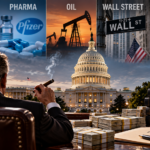
The pharmaceutical and health-products industry alone spent around $452 million, making it one of Washington’s most powerful lobbying forces.
That is not charity.
Companies do not spend hundreds of millions of dollars lobbying lawmakers because they enjoy political conversation.
They do it because government decisions affect:
drug prices,
patents,
taxes,
regulation,
contracts,
environmental rules,
banking requirements,
defense spending,
and billions of dollars in corporate profit.
That is political power expressed through money.
Big Pharma Shows How the System Works
Consider pharmaceuticals.
Americans routinely pay much more for many prescription drugs than patients in other wealthy countries.
At the same time, the industry maintains one of the strongest lobbying operations in Washington.
OpenSecrets reported that 17 pharmaceutical companies connected to the TrumpRx pricing initiative spent more than $130 million lobbying the federal government in 2025, a 23% increase as drug-pricing policy was being developed.
Now, in October 2026, PhRMA—the industry’s leading trade association—is suing the federal government over a Medicare policy designed to link some US drug prices to lower prices abroad.
That does not mean pharmaceutical companies always get everything they want.
They clearly do not.
But they possess something the average patient does not:
permanent professional representation inside Washington.
A patient may write one letter to a senator.
An industry can employ teams of lobbyists, lawyers, economists and former government officials for years.
That imbalance matters.
The Defense Industry Has an Even Deeper Relationship With Government
Defense companies occupy a unique position because the government is often their biggest customer.
Lockheed Martin.
RTX.
Northrop Grumman.
General Dynamics.
Boeing.
Their revenue depends heavily on decisions made in Washington.
In the 2024 cycle, the defense sector spent roughly $159 million lobbying the federal government, using more than 1,000 lobbyists.
OpenSecrets classified 619 of those lobbyists as “revolvers”—people who had moved between government and lobbying or related political work.
That revolving door is not imaginary.
The US Government Accountability Office examined 14 major defense contractors and found that they employed approximately 1,700 former senior Defense Department or acquisition officials in 2019.
That means people can spend years inside the Pentagon helping oversee weapons procurement, then later work for companies seeking Pentagon contracts.
There are ethics laws and restrictions.
But even the GAO warned that this system can create conflicts of interest and undermine public confidence.
This is one of the clearest examples of how institutional influence becomes self-reinforcing.
Government officials understand industry.
Industry hires former officials.
Former officials understand the government.
Then the cycle repeats.
And Defense Spending Keeps Expanding
The connection matters because defense procurement involves enormous sums of taxpayer money.
Just this week, Anduril and the US Navy announced commitments worth roughly $6.6 billion connected to a new Maryland shipyard and submarine-component production.
Again, this does not automatically make the spending unnecessary.
America has legitimate defense requirements.
The concern is structural:
Industries whose profits depend on government spending have enormous resources available to influence the government deciding that spending.
That is exactly the environment in which the phrase military-industrial complex becomes relevant.
President Dwight Eisenhower warned about it in 1961.
The basic concern has not disappeared.
Wall Street Has Its Own Permanent Seat in Washington
Now look at banking.
In 2025, major US banks and their trade associations spent about $86.8 million lobbying the White House, Congress and federal agencies, according to a Reuters analysis of OpenSecrets data.
That was a 12% increase—the largest jump in more than a decade.
Why?
Because Washington was considering rules affecting:
capital requirements,
credit-card fees,
fintech,
crypto,
bank regulation,
and competition.
One policy analyst quoted by Reuters explained the logic plainly: banks want to make sure they are “fully at the table” when rules are written.
That phrase tells you almost everything.
The ordinary citizen is rarely “at the table.”
The banking industry is.
The Oil Industry Works the Same Way
Energy policy determines billions of dollars in profits.
Environmental regulation.
Drilling leases.
Pipeline approvals.
Tax incentives.
Climate legislation.
Fuel standards.
Sanctions.
All of these decisions can dramatically affect oil and gas companies.
So energy companies lobby, finance political groups and fight regulations in court.
In October 2026, ExxonMobil and Suncor were before the US Supreme Court challenging a Colorado climate lawsuit seeking damages related to climate change impacts. The Trump administration supported the companies’ position that federal law should pre-empt such state lawsuits.
That does not prove the government is controlled by oil companies.
But it shows how major corporations operate simultaneously through:
politics,
courts,
regulation,
lobbying,
and public policy.
The scale of their institutional capacity is completely different from that of ordinary citizens.
Then Add Billionaire Political Money
Corporate lobbying is only half of the story.
The other half is elections.
The 2024 US election cycle saw an estimated $1.9 billion in dark money, according to the Brennan Center for Justice.
That money came through organizations that do not fully disclose their donors.
Ten individual donors provided about $481 million—44% of all money raised to support Donald Trump.
The ten largest donors supporting Kamala Harris provided another $126 million.
This is not exclusively a Republican problem.
It is not exclusively a Democratic problem.
It is a system problem.
Both parties operate in an environment where extraordinary wealth can purchase extraordinary political reach.
Wealth Concentration Makes Political Concentration Easier
The underlying economic structure makes all of this even more powerful.
Federal Reserve data show that the richest 0.1% of American households owned approximately $16.2 trillion in corporate equities and mutual funds in the second quarter of 2026.
The entire bottom half of the population owned roughly $370 billion.
That difference is staggering.
The people who own the largest share of corporate America are also the people most capable of financing political influence.
This creates a reinforcing cycle:
wealth creates political access
political access can influence regulation
regulation affects corporate profitability
higher profits increase wealth
greater wealth finances more political influence
That does not require a secret conspiracy.
It can happen openly.
Legally.
Institutionally.
This Is Why “Oligarchy” Is Not a Crazy Word
An oligarchy is a system where power becomes concentrated among a small group.
America clearly still has elections and democratic institutions.
But democracy is not simply the existence of voting booths.
It also depends on whether political influence is meaningfully distributed.
If millions of people vote every few years, while a comparatively small number of corporations, industries and billionaires continuously finance lobbying operations, legal campaigns, super PACs, media networks and political organizations—
then democratic equality becomes much more complicated.
One person may have one vote.
But one person does not have one lobbyist.
One person does not have one super PAC.
One person does not have a billion-dollar corporation negotiating directly with government officials.
The Revolving Door Is Perhaps the Most Revealing Part
Think about the incentives.
A government regulator knows that large corporations in the industry they supervise may someday employ them.
A military procurement official knows defense contractors hire former Pentagon personnel.
A congressional staffer knows lobbying firms frequently hire people with legislative experience.
An investment banker can enter government.
A government official can return to Wall Street.
Nobody needs to hand over a suitcase of money.
Influence can emerge through relationships, career incentives, access and shared professional networks.
That is far more sophisticated than simple corruption.
And because much of it is legal, it is also far harder to challenge.
Corporate America Does Not Win Every Fight
This point matters.
The pharmaceutical industry loses some regulatory battles.
Banks receive rules they dislike.
Oil companies face environmental restrictions.
Defense contracts are sometimes cancelled.
Corporate interests are not one unified bloc.
They compete against one another constantly.
Banks fight crypto companies.
Tech companies fight telecom companies.
Domestic manufacturers fight importers.
Drug companies fight insurers.
That is why saying corporations literally “control everything” would be inaccurate.
But saying organized corporate power has disproportionate influence over American policymaking is much easier to support with evidence.
Democracy Becomes Weak When Citizens Become Spectators
The most dangerous part of this system may not be lobbying itself.
Lobbying is constitutionally protected political activity.
The danger comes when ordinary citizens decide politics is pointless because powerful interests will always dominate.
Then voter participation falls.
Union membership weakens.
Local organizing disappears.
Political parties become increasingly dependent on large donors.
And organized money faces less organized opposition.
That is how oligarchic tendencies become stronger.
Not through one dramatic coup.
But through gradual concentration.
What Would Actually Reduce Corporate Power?
The answer is not violence and it is not attacking successful people.
The structural response is structural reform.
That includes:
full transparency for political donations
stronger disclosure of dark money
restrictions on the government-to-industry revolving door
longer cooling-off periods for regulators and military procurement officials
stronger antitrust enforcement
small-donor campaign-finance systems
competitive media markets
greater bargaining power for workers
tougher conflict-of-interest standards
and more aggressive congressional oversight of lobbying and procurement.
These policies do not abolish capitalism.
They try to prevent capitalism from buying democracy.
Conclusion: Call the System What It Is
America is not a dictatorship run by five corporations.
But neither is political power distributed as evenly as the phrase “one person, one vote” suggests.
Defense contractors spend heavily lobbying the government that buys their weapons.
Pharmaceutical companies spend hundreds of millions influencing the institutions that determine drug regulation and pricing.
Banks build lobbying operations to shape financial rules.
Oil companies use lobbying, litigation and political influence to defend enormous economic interests.
Billionaires can spend hundreds of millions influencing elections.
And unprecedented amounts of political money can move through organizations whose donors remain hidden.
These are not conspiracy theories.
They are documented features of the American political system.
The real debate is therefore not whether money influences Washington.
It clearly does.
The deeper question is:
At what point does concentrated economic influence become concentrated political power?
America may still be a democracy.
But when wealth buys permanent access to government while ordinary citizens receive one vote every few years, the boundary between democracy and oligarchy becomes increasingly difficult to see.
And if Americans want political power to remain genuinely democratic, the solution is not simply voting for a different billionaire-backed candidate.
It is changing the rules that allow concentrated wealth to translate into concentrated political influence in the first place.
Frequently Asked Questions
Do corporations legally lobby the US government?
Yes. Lobbying is legal and regulated through disclosure requirements. The concern is the scale of resources available to large industries compared with ordinary citizens.
How much did US corporations spend on lobbying?
OpenSecrets reported approximately $5.1 billion in corporate lobbying expenditures in 2025.
How much does the pharmaceutical industry spend on lobbying?
OpenSecrets reported about $452 million in pharmaceutical and health-product lobbying in 2025.
Do defense contractors hire former Pentagon officials?
Yes. A GAO review found that 14 major defense contractors employed about 1,700 former senior or acquisition Defense Department officials in 2019.
How much did major banks spend lobbying Washington?
Major banks and trade associations covered by a Reuters analysis spent around $86.8 million in 2025, a 12% increase from the previous year.
Is America officially an oligarchy?
No. The United States remains a constitutional representative democracy. “Oligarchy” is used in this article to describe the risk that extreme concentrations of wealth and organized corporate influence can produce disproportionate political power.
Disclaimer: This article examines documented lobbying, campaign finance, wealth concentration and revolving-door practices in the United States. It does not allege that industries operate as a single coordinated conspiracy or that every government decision is controlled by private interests.
