







































Riyadh Airport Attack: How Houthi Missiles Shut Down Saudi Arabia’s Capital Airport

Saudi Arabia is facing one of the most serious attacks on its civilian infrastructure in years.
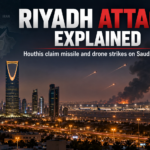
Yemen’s Iran-aligned Houthi movement has launched a series of missile and drone attacks against Saudi airports, with King Khalid International Airport in Riyadh suffering the most serious damage.
The attacks have killed civilians, injured hundreds, forced thousands of flight cancellations and exposed weaknesses in Saudi air defences.
More importantly, the strikes show that the Yemen conflict is no longer staying inside Yemen.
It is increasingly becoming part of the wider Gulf confrontation.
What Happened at Riyadh Airport?
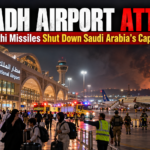
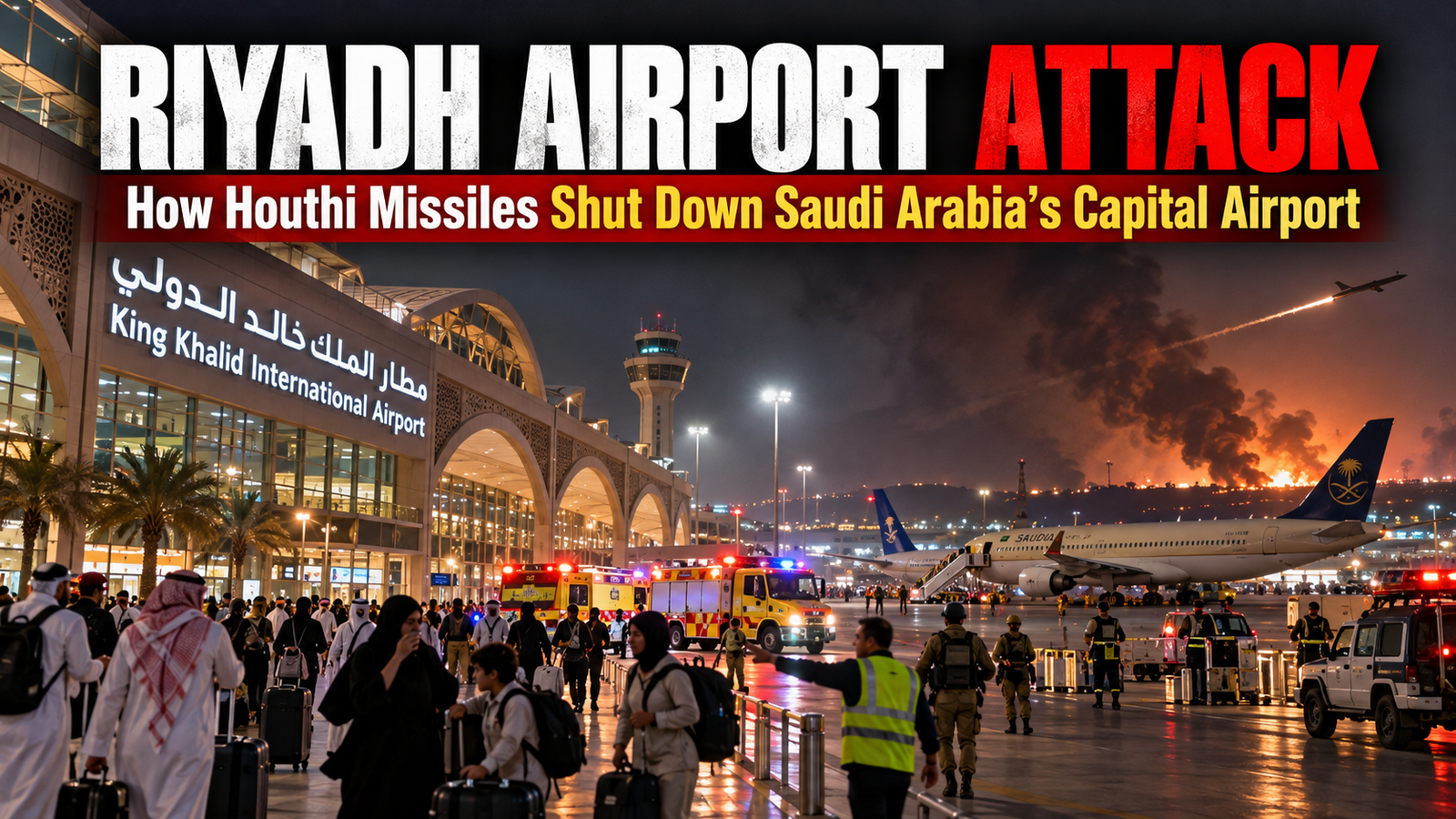
The most devastating attack occurred on October 10, when a missile struck King Khalid International Airport.
Saudi authorities said the strike killed 13 people after one injured victim later died, while more than 300 people were wounded. The casualties included citizens of several countries.
The airport was immediately thrown into chaos.
Flights were cancelled or diverted.
Passengers were evacuated from affected areas.
Emergency services responded to fires and damage around the terminals.
Then, just one day later, the airport was hit again.
On October 11, a projectile struck near Terminals 3 and 4, killing a Pakistani citizen and injuring another 11 people. Saudi forces also reported intercepting a cruise missile near the airport.
By October 12, the Houthis were still launching missiles and drones toward Saudi territory.
The Houthis Claimed Responsibility
Houthi military spokesperson Yahya Saree said the group had targeted Riyadh airport with ballistic missiles and also launched attacks on other Saudi military and infrastructure sites.
The group has warned international airlines and passengers that Saudi airports and airspace could remain targets, while excluding airports in Mecca and Medina from its warning.
The Houthis say their attacks are retaliation for Saudi military operations in Yemen.
Saudi Arabia, meanwhile, has described the strikes on civilian aviation infrastructure as attacks on civilians and has promised a strong response.
Riyadh Airport Has Been Shut Down
The scale of the threat forced Saudi authorities to close King Khalid International Airport.
Reuters reported that the airport is expected to remain closed until October 17 while authorities assess damage and security conditions.
The disruption has been enormous.
Major airlines including Lufthansa, Air France-KLM, Etihad, Air India, IndiGo and others have cancelled or suspended services to Riyadh.
Thousands of flights across Saudi Arabia have been affected.
At some points, the skies over Riyadh were almost empty.
For one of the Middle East’s busiest aviation hubs, this is a major economic and security shock.
How Did Houthi Missiles Get Through Saudi Air Defences?
This is now one of the biggest questions facing Riyadh.
Saudi Arabia has spent enormous sums on air-defence systems, including American-made Patriot interceptors and other missile-defence technology.
Yet some Houthi weapons still penetrated those defences.
Saudi Arabia has launched an investigation into how the attack reached the airport and why its air-defence network failed to intercept every incoming threat.
The problem is partly mathematical.
Attackers can launch combinations of:
ballistic missiles
cruise missiles
low-flying drones
decoy systems
at roughly the same time.
Defenders then have only minutes to identify, prioritize and intercept multiple targets.
Even sophisticated air-defence systems cannot guarantee that every missile will be stopped.
The Riyadh attack has therefore exposed an uncomfortable reality:
Saudi Arabia can spend billions on defence and still remain vulnerable to comparatively cheaper drones and missiles.
Why Is the Houthi Threat Growing?
The Houthis have spent years building a large missile and drone arsenal.
Their forces have previously attacked Saudi oil installations, ships and military targets.
But the current campaign appears broader and more aggressive.
Saudi airports in Riyadh, Dammam, Abha, Jazan and Najran have reportedly faced attacks or alerts during the recent escalation.
The Houthis are also operating within a wider regional confrontation involving Iran, the United States, Israel and Gulf states.
That makes the situation more dangerous.
A conflict that once centred primarily on Yemen now intersects with:
Iran-US tensions,
Saudi security,
Red Sea shipping,
oil infrastructure,
and international aviation.
Saudi Arabia Is Retaliating
Saudi-led forces have responded with airstrikes against Houthi-controlled areas in Yemen.
The coalition says it is targeting missile launch sites and military infrastructure.
The Houthis, however, have vowed to continue their attacks unless Saudi military operations stop.
That creates a familiar cycle:
Saudi strike → Houthi retaliation → Saudi escalation → further Houthi attacks.
Each round increases the chance of civilian casualties and broader regional involvement.
Could the United States Become More Directly Involved?
Washington is already deeply connected to Saudi defence through weapons, intelligence and military cooperation.
Following the Riyadh airport attacks, US officials condemned the strikes and began considering whether additional American military support or involvement may be required.
So far, there has been no announcement of a large new US offensive specifically in response to the airport attack.
But pressure is growing.
If Houthi missiles continue striking major Saudi civilian targets, Washington could face increasing demands from Riyadh to provide additional interceptors, intelligence or direct military assistance.
Why the Attack Matters for the Global Economy
This is not simply a Saudi-Yemen conflict.
Saudi Arabia sits at the centre of the global energy system.
If missile and drone attacks expand toward:
oil refineries,
Aramco facilities,
pipelines,
export terminals,
or airports supporting energy infrastructure,
global oil prices could react quickly.
Markets already responded to the latest attacks with renewed concern over Gulf instability.
Higher oil prices would affect countries far beyond the Middle East.
India would be particularly exposed because it imports most of the crude oil it consumes.
Europe and Asia would also face higher transport and energy costs.
Civil Aviation Is Becoming a Front Line
Perhaps the most disturbing part of this escalation is that civilian aviation is now directly affected.
Airports are not only economic infrastructure.
They are filled with ordinary passengers.
Families.
Workers.
Pilots.
Airport staff.
International travellers.
Once missiles begin hitting active commercial airports, the risk of mass civilian casualties rises sharply.
That is why international aviation authorities have issued additional warnings for Saudi airspace.
Some airlines are now rerouting flights entirely to avoid the region.
What Happens Next?
Three developments will determine whether this remains a limited escalation or becomes something much larger.
First, whether the Houthis continue targeting airports.
Second, whether Saudi Arabia expands its military campaign in Yemen.
Third, whether the United States or other regional powers become more directly involved.
There is also the question of Iran.
The Houthis are aligned with Tehran, but Iran has offered to mediate in the latest Saudi-Houthi escalation.
That creates a strange situation in which Iran is simultaneously linked politically to the Houthis while presenting itself as a possible diplomatic intermediary.
Conclusion
The Riyadh airport attack represents a major escalation in the Gulf conflict.
A missile reached one of Saudi Arabia’s most important civilian airports.
More than a dozen people were killed.
Hundreds were injured.
Flights were grounded.
Airlines suspended operations.
And Saudi Arabia’s expensive air-defence network failed to stop every incoming weapon.
The Houthis have shown that they are capable of creating serious disruption deep inside Saudi territory.
Saudi Arabia, in turn, has vowed retaliation.
That leaves the region facing a dangerous question:
Can both sides stop before retaliation becomes a wider war?
For now, Riyadh airport remains one of the clearest symbols of how quickly a conflict in Yemen can become an international aviation, energy and security crisis.
Frequently Asked Questions
Did the Houthis attack Riyadh airport?
Yes. The Houthis claimed responsibility for missile attacks targeting Riyadh’s King Khalid International Airport during the October escalation.
How many people were killed?
Saudi authorities reported at least 13 deaths from the October 10 strike, with another fatality in a subsequent airport attack. More than 300 people were injured.
Is Riyadh airport closed?
Yes. Saudi authorities have said King Khalid International Airport will remain closed until at least October 17 while security and operational conditions are reviewed.
Why are the Houthis attacking Saudi Arabia?
The Houthis say the attacks are retaliation for Saudi military operations in Yemen. Saudi Arabia supports forces fighting the Houthis and has launched strikes against Houthi positions.
Can Saudi Arabia stop Houthi missiles?
Saudi Arabia intercepts many missiles and drones, but recent attacks demonstrate that no air-defence system is perfect, especially when multiple types of weapons are launched simultaneously.
Could this affect oil prices?
Yes. Continued attacks on Saudi infrastructure or wider escalation in the Gulf could raise oil prices because Saudi Arabia is one of the world’s largest oil exporters.
Disclaimer: This article reflects publicly available information as of October 12, 2026. Casualty figures and battlefield claims may change as Saudi authorities, airlines and military officials release additional information.
