

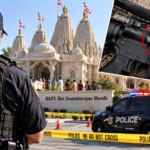














































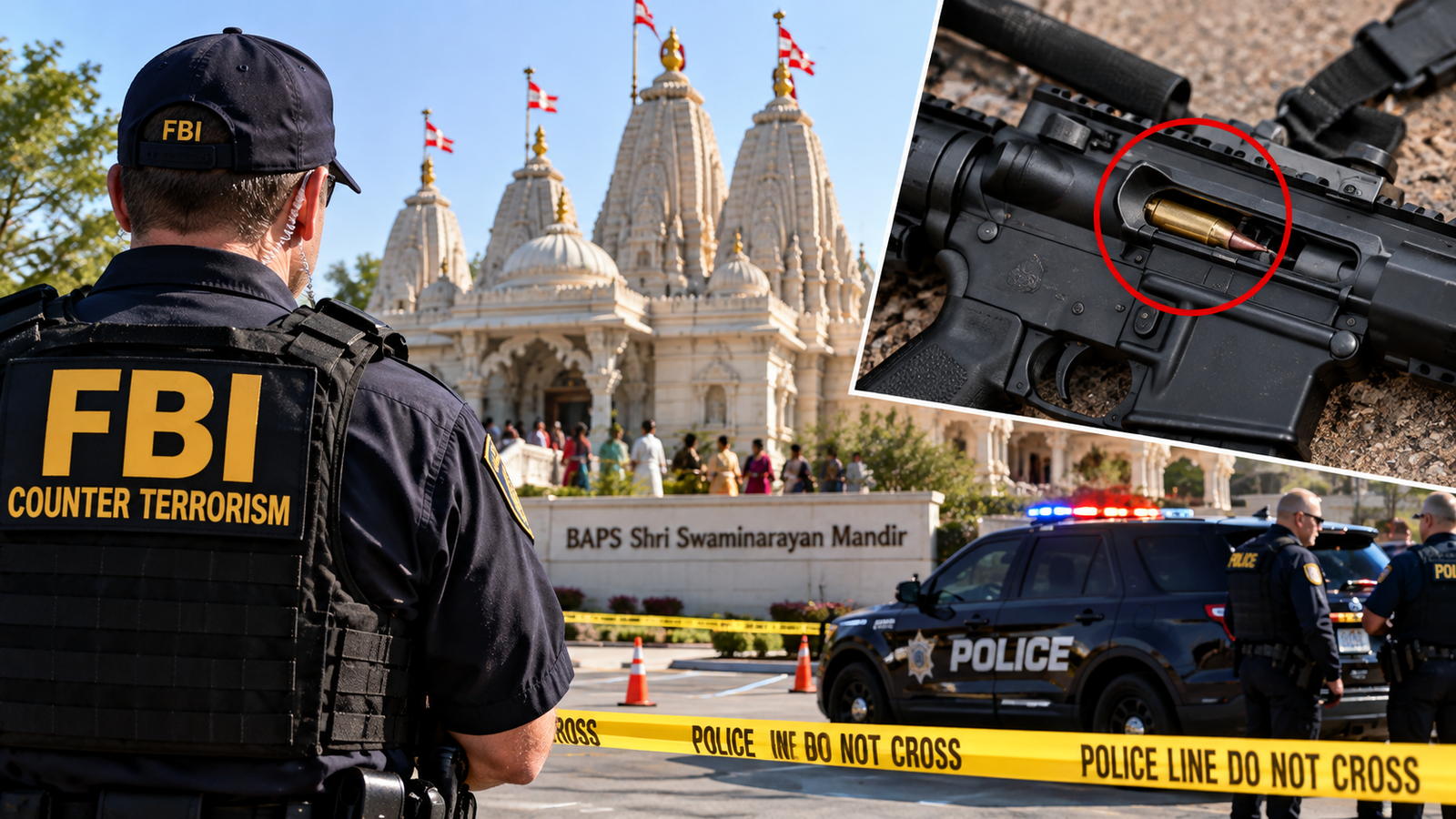
A planned terror attack on a Hindu temple by neo-Nazi suspect Alexandros Paporakis was thwarted when his firearm jammed.

Thousands of miles from India, Hindu families gathered at a temple in suburban Chicago expecting prayer, community and celebration.
According to prosecutors, a 19-year-old man arrived with an AR-style rifle, body armor and an alleged plan to carry out mass murder.
The attack did not fail because the target was well protected.
It did not fail because an intelligence agency intercepted the plot beforehand.
According to prosecutors, it failed at the most critical moment because the gun jammed.
The alleged target was the Sri Venkateswara Swami (Balaji) Temple in Aurora, Illinois, one of the largest Hindu temples in the Chicago region.
And the evidence authorities say they recovered makes it difficult to describe this merely as an ordinary gun incident.
The suspect allegedly identified himself as a white supremacist and neo-Nazi, expressed hatred toward Indians and other minorities, accumulated hundreds of rounds of ammunition and prepared a manifesto discussing mass murder.
This was allegedly violence motivated by ideology and directed at civilians because of who they were.
That is why the terrorism question cannot simply be brushed aside.
Who Is Alexandros Paporakis?
Alexandros Paporakis is a 19-year-old Illinois man accused by prosecutors of preparing an ideologically motivated mass shooting at a Hindu temple.
Authorities say his alleged manifesto identified him as a white supremacist and neo-Nazi.
Investigators also say he expressed hatred toward Indians, Jewish people, Black Americans and other minority groups.
A co-worker reportedly told investigators that Paporakis had spoken about wanting to kill Indian people.
Those allegations are central to understanding why this incident should not be reduced to an ordinary attempted shooting.
The alleged target was not random.
It was a Hindu temple.
The alleged victims were civilians.
And prosecutors say the motive was rooted in racial and ideological hatred.
The Rifle Jammed
Prosecutors allege that Alexandros Paporakis, 19, drove to the Aurora temple on Sunday carrying an AR-style weapon and body armor after planning a mass shooting for an extended period.
He allegedly tried to fire at a man from his vehicle.
The rifle malfunctioned.
He fled.
Paporakis later reportedly told a co-worker that the intended victim was “certainly saved by his God today.”
That co-worker and another employee contacted police, helping authorities locate and arrest him before he could allegedly return or attempt another attack.
For the Hindu community, the difference between an attempted massacre and an actual massacre may have been a mechanical malfunction measured in seconds.
Police Found 300 Rounds and Nazi Material
What investigators say they discovered afterward makes the alleged intent even more disturbing.
Authorities searching Paporakis’ residence reportedly recovered:
an AR-style rifle
loaded magazines
roughly 300 rounds of ammunition
body armor and tactical equipment
a gas canister
and items displaying Nazi or white-supremacist imagery.
Investigators also obtained an eight-page document titled “Why I Fought: A.K.A.: (Aurora Shooter’s Manifesto)”.
According to prosecutors, the document contained racist attacks on Indians, Jewish people and Black Americans and discussed killing as many people as possible.
Paporakis allegedly described himself in that document as a white supremacist neo-Nazi obsessed with mass murder.
These are allegations that will ultimately be tested in court.
But they are not minor details.
They speak directly to motive.
Hindus Were Allegedly Targeted Because They Were Hindus and Indians
Community leaders say the attempted attack should be understood in the context of growing anti-Hindu and anti-South Asian hatred.
The Associated Press reported that Hindu community leaders believe years of hateful online rhetoric against Hindus and Indians contributed to the environment surrounding the alleged plot.
A co-worker told authorities that Paporakis had spoken about wanting to “kill Indian people.”
India’s government has also condemned what it described as the anti-Hindu and racist nature of the alleged plot and called for a thorough investigation and preventive action.
That matters.
A Hindu temple is not a military installation.
The people inside were not soldiers.
They were civilians worshipping with their families.
Congressman Raja Krishnamoorthi Was Inside
Among the worshippers reportedly present was U.S. Representative Raja Krishnamoorthi, together with members of his family.
He later called for the FBI to investigate the incident as a hate crime.
The FBI is assisting local authorities with the investigation.
The temple has also increased security.
That should itself be troubling.
A place built for prayer should not need to operate like a fortified compound because worshippers fear being murdered over their ethnicity or religion.
Should This Be Called Terrorism?
This deserves a direct answer.
Under the U.S. statutory framework cited by the FBI, domestic terrorism includes dangerous criminal acts that appear intended to intimidate or coerce a civilian population and occur primarily inside the United States.
The FBI has also specifically warned that racially motivated violent extremists—often lone attackers using firearms—have represented an important domestic-terrorism threat, with minorities and other soft targets frequently selected.
In the Aurora case, prosecutors allege an ideologically motivated white supremacist prepared for mass killing, targeted a Hindu place of worship and tried to shoot a civilian.
The suspect has already been charged at the state level with making a terrorist threat, along with unlawful weapons possession.
Whether federal prosecutors eventually pursue additional hate-crime or terrorism-related charges is a separate legal question.
But calling the alleged conduct simply a random “shooting plot” risks ignoring its ideological character.
If civilians are targeted in order to terrorize a racial, ethnic or religious community, terrorism is plainly part of the discussion.
Terrorism Does Not Have One Religion
This point is especially important.
The word terrorism should not change meaning depending on the attacker’s religion, skin colour or ideology.
An Islamist extremist targeting civilians can commit terrorism.
A white supremacist targeting civilians can commit terrorism.
A neo-Nazi targeting worshippers can commit terrorism.
Political violence should be judged by conduct, intent and ideology, not by which community the attacker belongs to.
The FBI itself describes domestic-terrorism threats without limiting them to any one race or religion.
Consistency matters.
America Has a Minority-Safety Problem It Cannot Ignore
It would be inaccurate to say every Hindu or Indian living in America is unsafe.
Millions live, work and worship peacefully across the country.
But it would be equally wrong to treat incidents such as this as irrelevant simply because no one was killed.
The absence of deaths here was not evidence that the threat was insignificant.
According to prosecutors, the weapon failed.
Had it functioned as intended, America could have been discussing another massacre at a religious institution.
The country has already witnessed deadly attacks on churches, synagogues, mosques and Sikh places of worship.
The Aurora case is another reminder that Hindu temples and Hindu communities must also be included in conversations about religious security.
Online Hatred Can Become Offline Violence
Another important element is radicalization.
Community advocates interviewed by AP pointed to an increase in anti-Hindu and anti-South Asian hatred online.
The danger begins when dehumanizing language becomes normalized.
First an ethnic group becomes the target of jokes.
Then conspiracy theories.
Then claims that the group is invading, stealing jobs or destroying the country.
Eventually, a small number of unstable or extremist individuals can begin interpreting violence as justified.
That does not mean offensive speech automatically causes terrorism.
But history repeatedly shows that sustained dehumanization can create fertile ground for extremists.
The Co-Workers Who Called Police Deserve Recognition
There is another side to this story that should not be forgotten.
The alleged attack was prevented not only because the rifle jammed.
People acted.
Paporakis’ co-workers reportedly received disturbing messages and information about the alleged plan.
They contacted authorities.
Police acted quickly.
The suspect was arrested.
That demonstrates why warning signs must be taken seriously.
When someone openly talks about massacring an ethnic or religious group, society cannot dismiss it as internet edginess or dark humour.
Sometimes the threat is real.
Protecting Minorities Is a Test of a Democracy
America frequently speaks internationally about religious freedom and minority rights.
Those principles must also be protected at home.
Hindus should be able to enter a temple without wondering whether an armed extremist is waiting outside.
Sikhs should be safe in a gurdwara.
Jewish Americans should be safe in synagogues.
Muslims should be safe in mosques.
Christians should be safe in churches.
Protection cannot depend on which minority happens to be politically fashionable at a particular moment.
Religious freedom means very little if citizens are afraid to practise their religion openly.
Conclusion: America Was Extremely Lucky
There is a temptation to call the Aurora incident a foiled plot and move on.
That description does not fully capture what prosecutors allege happened.
The suspect reportedly reached the temple.
He allegedly had the rifle.
He allegedly had ammunition.
He allegedly wore protective equipment.
He allegedly tried to shoot.
The gun jammed.
According to prosecutors, even the suspect himself told a co-worker that the man he tried to shoot had been “saved by his God.”
That is how close this allegedly came.
America should not need a malfunctioning rifle to protect Hindu families from a massacre.
The alleged neo-Nazi motivation should be investigated with the same seriousness applied to every other form of ideologically motivated violence.
Hindu Americans and Indian Americans are part of American society.
Their temples deserve protection.
Their fears deserve to be taken seriously.
And hatred directed toward them should not be minimized because the attacker failed.
A functioning gun could have produced a very different headline.
The lesson from Aurora is therefore not merely that tragedy was avoided.
It is that tragedy came frighteningly close—and preventing the next one cannot be left to luck.
Frequently Asked Questions
What happened at the Hindu temple near Chicago?
Prosecutors allege a 19-year-old man drove to Sri Venkateswara Swami Temple in Aurora with a rifle and body armor intending to carry out a mass shooting. His rifle reportedly jammed and he fled.
Was the suspect a neo-Nazi?
According to prosecutors and court records, his alleged manifesto described him as a white supremacist neo-Nazi. Investigators also reportedly recovered Nazi-related material from his residence.
Was the attack motivated by anti-Hindu or anti-Indian hatred?
Authorities say the alleged manifesto contained racist material targeting South Asians, particularly Indians, and prosecutors say he had spoken about killing Indian people. India’s government characterized the plot as anti-Hindu and racist.
Has he been charged with terrorism?
He faces state felony charges including making a terrorist threat and unlawful weapons possession. Calls have also been made for an FBI hate-crime investigation.
Did the gun really jam?
Yes, according to prosecutors. They allege the rifle malfunctioned when the suspect attempted to fire and that he subsequently fled.
Was anyone killed?
No. No deaths were reported from the attempted attack. The firearm malfunction and the subsequent actions of the suspect’s co-workers and police helped prevent what prosecutors allege could have become a mass shooting.
Disclaimer: The defendant is accused and has not been convicted. Statements concerning his intentions, ideology and actions in this article are based on allegations by prosecutors, police and court records. Final criminal liability will be determined through the judicial process.
