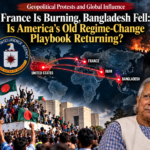


































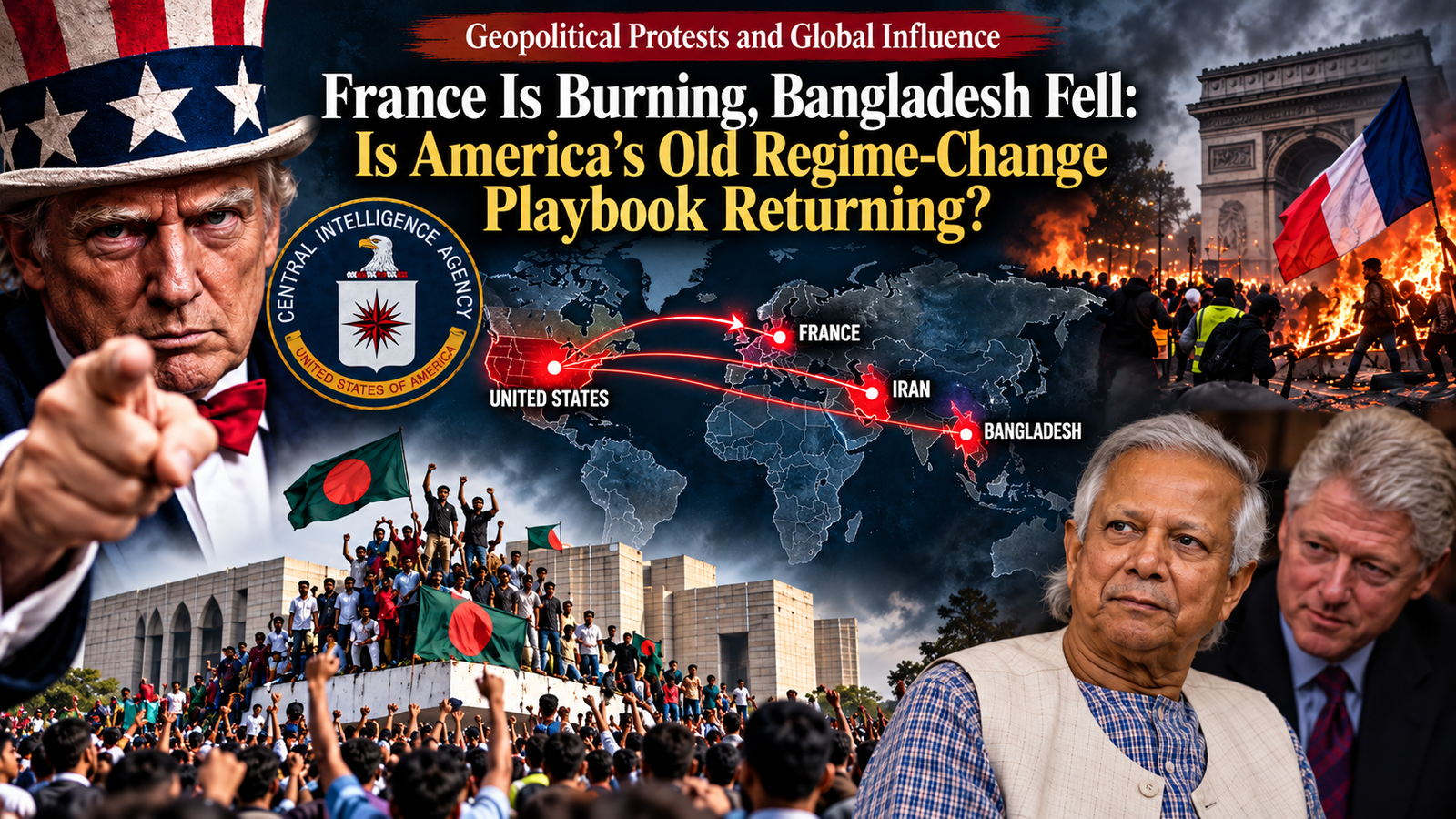
France Is Burning, Bangladesh Fell: Is America’s Old Regime-Change Playbook Returning?

France is burning. Bangladesh’s government fell in 2024. Nepal and Sri Lanka have experienced dramatic political upheavals.
Different countries. Different political systems. Different grievances.
Yet certain patterns repeatedly emerge: mass demonstrations, student mobilization, social-media campaigns, clashes with security forces and intense international scrutiny of the government.
This raises an uncomfortable question:
When governments fall amid mass protests, are we always witnessing spontaneous revolutions—or can powerful foreign actors exploit genuine public anger to achieve geopolitical objectives?
The United States has a documented history of covertly influencing political outcomes abroad.
And the historical evidence reveals why simply asking an intelligence agency whether it organized a covert operation is unlikely to settle the matter.
The CIA Has Already Documented Its Own Regime-Change Methods
In 1953, the CIA helped overthrow Iranian Prime Minister Mohammad Mosaddegh.
For decades, many details remained secret.
But a declassified memorandum prepared by the CIA in March 1954 provides a remarkable account of the operation.
It describes an American-approved effort to replace Mosaddegh with a pro-Western government.
The methods included coordinating opposition groups, launching propaganda campaigns, applying economic and psychological pressure, developing support inside the military and covertly assisting street demonstrations.
The document explicitly states that the operation successfully removed Mosaddegh in August 1953.
This is not speculation.
It comes from the CIA’s own historical records.
Primary source: U.S. State Department — Declassified CIA Memorandum on Iran, March 8, 1954
One year later, the CIA supported another operation against Guatemala’s President Jacobo Árbenz.
The agency’s declassified collection contains thousands of pages documenting preparations, covert actions, psychological operations and the outcome.
Primary source: CIA Declassified Guatemala Collection
These cases establish something important:
Political unrest and covert foreign involvement are not mutually exclusive.
A population can have genuine grievances while an outside government attempts to influence the direction or outcome of a political crisis.
That possibility is worth examining whenever foreign strategic interests overlap with major political upheaval.
Bangladesh: Why the Yunus–Clinton Connection Matters
Bangladesh provides a particularly interesting case.
In August 2024, Sheikh Hasina’s government collapsed after weeks of student-led demonstrations and a violent crackdown.
Hasina fled to India.
Soon afterward, Nobel Peace Prize laureate Muhammad Yunus became head of the interim government.
Yunus was not an unfamiliar figure in Washington.
His relationship with Bill and Hillary Clinton stretched back decades.
A 2016 Associated Press investigation, based partly on State Department records, documented that Yunus met Hillary Clinton three times and spoke with her by telephone during her tenure as secretary of state.
The report said Yunus sought assistance while Bangladeshi authorities were investigating his activities and pressuring him to leave Grameen Bank.
According to AP, Clinton instructed aides to explore ways of helping him.
The investigation also documented financial relationships between organizations associated with Grameen and the Clinton Foundation.
Grameen America contributed between $100,000 and $250,000, while Grameen Research contributed between $25,000 and $50,000.
These were organizational contributions, not evidence of payments to Yunus personally.
Source: Associated Press investigation, republished by PBS NewsHour
The relationship is significant because it establishes that Yunus enjoyed access to influential American political networks well before his appointment in Bangladesh.
However, the AP investigation does not establish that those networks orchestrated his appointment in 2024.
That distinction leaves a legitimate question for further investigation: whether longstanding political relationships influenced Washington’s approach to Bangladesh’s transition.
Sheikh Hasina, Saint Martin’s Island and the Strategic Geography
Another controversial element concerns Saint Martin’s Island, located in the Bay of Bengal near Myanmar.
The island sits within a strategically important maritime region connecting South Asia and Southeast Asia.
Hasina and her political allies previously raised concerns about alleged American interest in securing military access in the region.
Following her departure, the Economic Times published a statement attributed to Hasina alleging that Washington had sought control over Saint Martin’s Island and contributed to her removal.
The White House denied involvement.
But an important complication emerged: Hasina’s son, Sajeeb Wazed, disputed that she had issued the particular statement attributed to her.
Source: Reuters — US Says It Had No Role in Ousting Bangladesh’s Hasina, August 13, 2024
The island allegation therefore remains contested.
There is no verified evidence establishing that Washington demanded sovereignty over the island in exchange for keeping Hasina in power.
Nevertheless, the Bay of Bengal’s strategic importance is real.
India, China and the United States all have reasons to monitor regional security developments closely.
The existence of those competing strategic interests provides context for the allegations, although it does not independently establish that a covert operation occurred.
Washington Was Already Pressuring Hasina
Another part of the story deserves attention.
Before Hasina’s removal, the United States openly criticized Bangladesh’s democratic and electoral conditions.
Washington imposed visa restrictions aimed at individuals accused of undermining elections.
It also criticized aspects of Hasina’s government’s treatment of political opponents.
The U.S. State Department described Bangladesh’s January 2024 election as neither free nor fair.
Months later, Hasina was gone, and Yunus—who had longstanding relationships with influential American figures—headed the interim administration.
Source: Reuters — Bangladesh Political Transition, August 2024
The sequence is worthy of scrutiny.
But chronology alone cannot prove operational coordination.
To establish a U.S.-directed removal, investigators would need evidence connecting diplomatic pressure to specific instructions, financing, organizing activities or decisions during the uprising.
The Important Detail: Covert Operations Often Exploit Existing Grievances
One misconception about covert regime change is that a foreign intelligence service must create public dissatisfaction from nothing.
The historical CIA record shows a more complicated reality.
In Iran, the agency coordinated with domestic political actors, used propaganda and exploited existing divisions.
This suggests a useful investigative framework:
First, identify the country’s genuine domestic grievances.
Second, establish whether powerful foreign governments have strategic interests in a different political outcome.
Third, examine their relationships with opposition figures and institutions.
Fourth, trace funding, media activities and diplomatic communications.
Finally, investigate whether any evidence connects these activities to the organization or direction of political events.
This method does not require blindly accepting government denials.
Nor does it require assuming guilt before examining evidence.
It looks for the links that distinguish foreign interest from foreign influence and foreign influence from covert operational control.
Now Look at France
On October 17, 2026, France experienced major demonstrations that escalated into some of its worst unrest in years.
Between approximately 550,000 and 800,000 people participated nationwide, according to varying estimates.
Clashes occurred in Paris, Marseille, Lyon and other cities.
Buildings were attacked and looted, while Limoges City Hall was set ablaze.
Most demonstrators protested peacefully, but groups engaging in violence caused extensive damage.
Source: Reuters — Mass Protests in France Spiral Into Riots, October 17, 2026
The demonstrations were driven by concerns over education, deteriorating public services and living costs.
France has also experienced tensions with Washington over trade and tariff policies.
Does that combination raise questions about possible external exploitation of political instability?
It can.
But the available reporting does not establish that Washington organized the French protests or sought to overthrow Macron.
The documented explanation remains a movement rooted in domestic social and economic dissatisfaction, with extremist groups accused of contributing to the violence.
Bangladesh, Nepal, Sri Lanka and France: What Is the Common Pattern?
The common elements are visible.
In Bangladesh, job-quota protests developed into a movement against Hasina’s government.
In Nepal, anger over restrictions and corruption contributed to a broader political crisis.
In Sri Lanka, shortages, debt and economic collapse led to mass protests and the president’s resignation.
In France, dissatisfaction with living costs and public services has contributed to major demonstrations and violence.
Across these countries, digital communication accelerated political mobilization.
Public trust in institutions was under pressure.
And existing political opposition movements attempted to influence the outcome.
But the cases also differ.
Sri Lanka experienced a severe balance-of-payments and debt crisis.
Bangladesh’s protests followed a controversial quota system and a deadly crackdown.
Nepal’s unrest involved corruption and youth frustration.
France is experiencing economic and social unrest within an established European democracy.
Those differences matter when assessing whether a single organized template exists.
Similar tactics can result from similar political conditions without requiring the same foreign organizer.
Why India Must Understand Modern Foreign Interference
India cannot ignore the strategic consequences of political upheaval in neighbouring countries.
Bangladesh sits beside India’s northeastern states.
Nepal shares an extensive land border with India.
Sri Lanka occupies a strategically important position in the Indian Ocean.
Political instability in these countries can affect trade, security, migration and regional influence.
India also needs to monitor potential foreign interference in its own information ecosystem.
Covert financing, disinformation, cyber operations and concealed political coordination are legitimate security concerns.
But distinguishing peaceful protest from covert manipulation is essential.
A country becomes more resilient when it protects against unlawful foreign influence while addressing the legitimate economic and political concerns of its population.
The Question Is Not Whether Intelligence Agencies Admit Their Operations
History demonstrates that covert operations can remain concealed for many years.
Iran is an established example.
Guatemala is another.
A government denial therefore cannot, on its own, conclusively resolve an allegation of clandestine activity.
But a serious investigation must also recognize that absence of an admission is not proof that an operation occurred.
The strongest evidence would include financial records, authenticated communications, testimony supported by documentation, declassified intelligence material or corroborated operational links.
Those are the kinds of records that transformed older allegations into established historical facts.
The same standards are useful when investigating contemporary events.
Conclusion: Connect the Dots—but Identify Which Ones Are Proven
America’s history of covert regime change is documented.
The CIA’s own files establish that Washington previously used propaganda, economic pressure, domestic political networks and clandestine assistance to influence political outcomes abroad.
Muhammad Yunus’s relationships with the Clintons are documented.
American diplomatic pressure on Hasina’s government is documented.
The Saint Martin’s Island allegations are part of the historical record, although their central claims remain contested.
Bangladesh’s 2024 government transition is established fact.
And France is experiencing serious domestic unrest.
These facts create important geopolitical questions.
They do not yet establish one coordinated American operation connecting all of these events.
For India, the lesson is clear: foreign interference should be investigated through evidence, historical precedent and careful examination of political networks—not dismissed simply because an accused government denies involvement.
At the same time, intelligence analysis becomes more credible when it identifies exactly where the documentary trail ends.
Because understanding covert operations requires connecting the dots.
It also requires knowing the difference between a documented connection, a plausible hypothesis and a proven operation.
Frequently Asked Questions
Has the CIA previously conducted regime-change operations?
Yes. Declassified U.S. documents establish CIA involvement in Iran’s 1953 coup and Guatemala’s 1954 coup.
Did Muhammad Yunus have connections to the Clintons?
Yes. The Associated Press documented meetings and communications with Hillary Clinton, as well as relationships between Grameen-associated organizations and the Clinton Foundation.
Did the United States seek Saint Martin’s Island?
Hasina and her allies raised allegations concerning American interest in the island. The alleged arrangement and claims linking it to her removal have not been independently established.
Was Bangladesh’s 2024 uprising a proven CIA operation?
There is no verified public evidence establishing that conclusion. The allegations merit examination in light of the documented diplomatic context and America’s historical record.
Is America directing the current protests in France?
Current reporting does not establish that claim. The protests have documented domestic causes involving education, public services and living costs.
Can covert interference happen without government acknowledgment?
Yes. Historical operations were sometimes disclosed long after the events. Investigations rely on records and corroboration rather than official acknowledgment alone.
Editorial Disclaimer: This opinion-analysis article examines documented CIA operations, political relationships, public allegations and contemporary protest movements. The historical coups described are established, but the claim that the United States orchestrated the 2024 Bangladesh uprising or the 2026 French unrest remains unproven.
