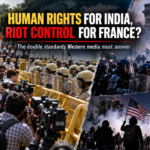

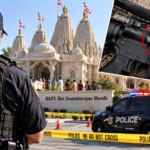





























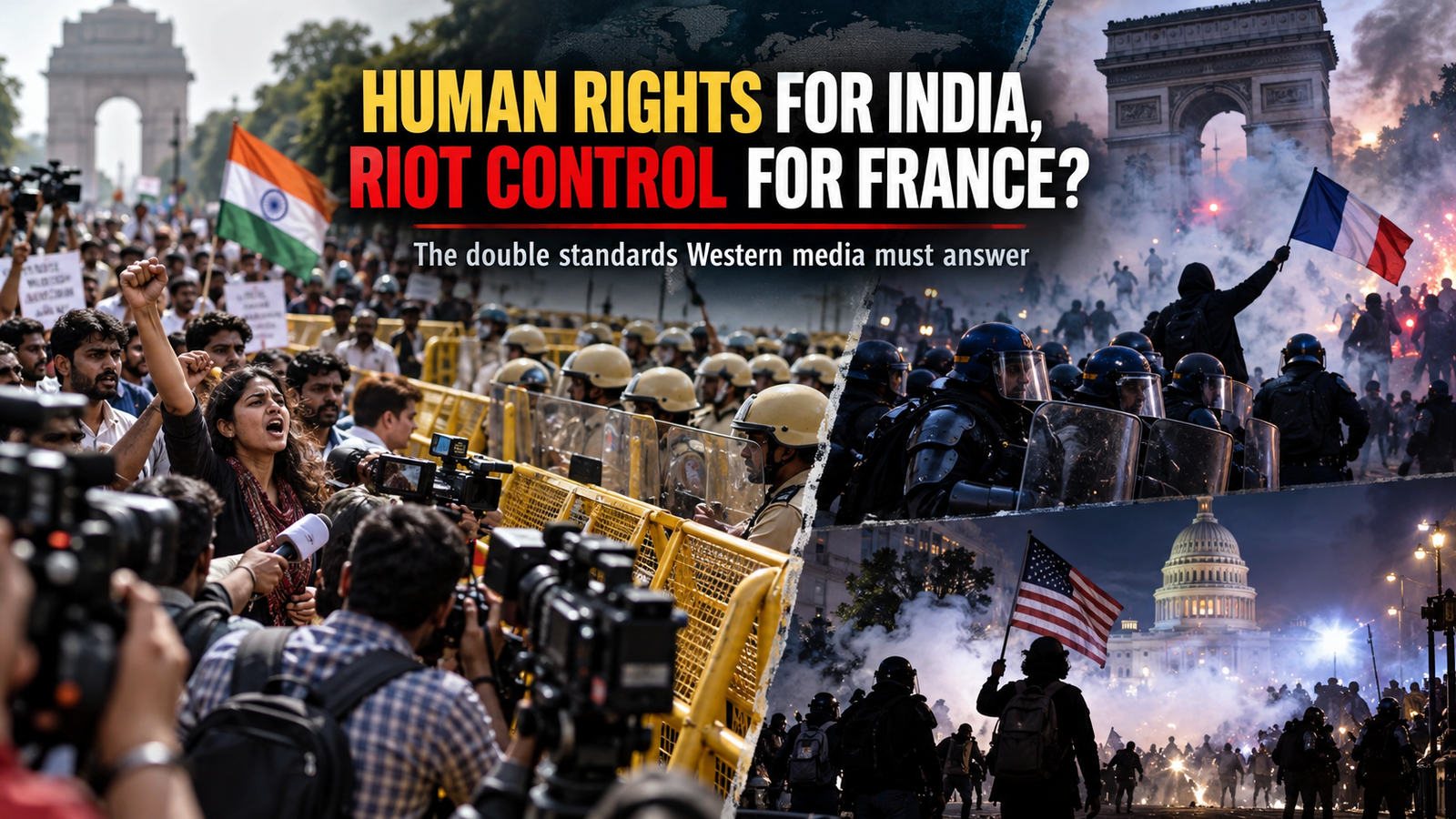
Human Rights for India, Riot Control for France? The Double Standards Western Media Must Answer

When police detain protesters in India, international headlines quickly raise questions about democracy, civil liberties and human rights.
But when French police deploy water cannons, tear gas and riot-control weapons against demonstrators, the story is frequently presented through another lens: restoring order amid violent unrest.
And when American immigration enforcement officers face allegations of excessive force, Washington’s officials often invoke law enforcement and public safety.
Shouldn’t the same human-rights standards apply everywhere?
That is the question major Western media organizations—including the BBC, CNN and The New York Times—should be prepared to answer.
India: Detentions Become a Democracy Story
In October 2026, thousands of demonstrators gathered in New Delhi to protest electoral-roll revisions and demand the resignation of India’s chief election commissioner.
Police detained protest organizers and participants, restricted access to demonstration sites and temporarily suspended mobile internet services.
CNN described the events as a police crackdown and repeatedly examined their implications for Prime Minister Narendra Modi’s government.
The network also invited commentators who characterized the government’s response as disproportionate.
Source: CNN Newsroom — October 11, 2026
Scrutinizing those actions is legitimate journalism.
Arbitrary detention, restrictions on peaceful assembly and internet shutdowns can raise serious civil-liberties concerns.
But detention is not automatically equivalent to the use of riot-control weapons or severe physical violence.
Coverage should distinguish what happened, why police intervened, whether protesters were violent, how long people were detained and whether courts found police actions unlawful.
The precise conduct matters.
France: Tear Gas, Water Cannons and Injured Students
Now examine France.
During October’s student demonstrations, French police deployed tear gas, water cannons and stun grenades.
Reuters footage from October 13 shows riot police charging demonstrators, spraying water cannons and firing tear-gas canisters.
Source: Reuters — French police deploy water cannon and tear gas against student protesters
The consequences were serious.
Reuters reported that a 14-year-old student suffered a broken jaw and shattered teeth after being struck by a tear-gas canister.
France’s police watchdog was investigating multiple allegations of injuries caused by riot-control weapons.
Source: Reuters — French policing under scrutiny as student protest injuries mount
Following the October 17–18 unrest, French authorities reported approximately 2,400 arrests.
There was also extensive vandalism, looting and damage to public property.
Those circumstances matter: policing a violent riot is different from preventing a peaceful demonstration.
But the distinction does not eliminate the obligation to investigate unnecessary or disproportionate force.
Where Is the Human-Rights Debate for France?
The more serious issue is editorial consistency.
How prominently is excessive force covered?
Are the actions of police investigated with equal intensity?
Are peaceful demonstrators distinguished from rioters?
Do journalists scrutinize the justification for preventive detention in every country?
And are allegations against Western governments followed as persistently as allegations against India?
Those are legitimate questions of news judgment and editorial accountability.
America: The ICE Question
The same standards should extend to the United States.
In October 2026, an Immigration and Customs Enforcement operation in New York ended with federal agents shooting and wounding a 28-year-old man.
His five-year-old son was inside the vehicle.
Federal officials said the driver endangered officers. The local district attorney opened an investigation into the shooting.
Source: CNN — October 10, 2026 coverage of the ICE shooting and protests
The facts are disputed, and the investigation must establish whether the use of force was justified.
But the human-rights questions are substantial.
Were officers facing an immediate threat?
Was firing a weapon necessary?
Were safer alternatives available?
How should the presence of a child affect an officer’s decisions?
These questions deserve the same scrutiny that American media apply to police conduct overseas.
It is worth noting that CNN did report the shooting and demands for accountability. The issue is not a complete absence of coverage, but whether the same standards consistently guide it.
BBC, CNN and The New York Times: How Headlines Shape Perception
The power of international media extends beyond individual facts.
It also comes from framing.
A report emphasizing government crackdown encourages readers to focus on state power.
A report emphasizing violent riots directs attention toward public disorder.
A report emphasizing police restoring order foregrounds the government’s security justification.
All three descriptions can contain true elements.
But choosing which element leads the story shapes how audiences understand the event.
The BBC covered the French unrest under the headline “Hundreds arrested at France protests.”
CNN, meanwhile, used the language of a crackdown in its India coverage.
Sources: BBC World Service — October 17 France protests | CNN Newsroom — India protests
Those examples are worth comparing, although two headlines alone cannot establish systematic institutional bias.
The New York Times has also examined the Indian demonstrations through the experiences of young protesters, with reporting discussed by its South Asia bureau chief on CNN.
The proper test is not whether a newspaper criticized India once.
It is whether equivalent events receive equivalent attention to evidence, context, police conduct and fundamental rights.
India Also Deserves Fact-Based Scrutiny
An effective criticism of Western media should not require denying documented allegations against Indian police.
Human Rights Watch alleged that officers used excessive force, arbitrarily detained demonstrators and interfered with journalists during the October protests.
The Indian Express separately reported complaints of physical assaults in detention, including allegations supported by medical records.
Sources: Human Rights Watch — October 13, 2026 | Indian Express — Protesters allege assaults in detention
These claims deserve independent investigation and responses from the authorities.
But criticism of India should also be precise.
Was a particular protest peaceful or violent?
Were people briefly detained and released, or formally arrested?
Were allegations of police assault corroborated?
Were the restrictions proportionate to a demonstrable security threat?
Human rights reporting should answer these questions rather than rely on sweeping labels.
The Problem With Selective Moral Authority
International media shape the reputations of governments around the world.
When countries in Asia, Africa or the Global South face political unrest, their democratic credentials often become part of the story.
Western democracies also deserve that scrutiny.
A French government does not receive a different human-rights standard because France is European.
American federal agents do not receive a different standard because they enforce immigration law.
And Indian authorities should not face a lower—or higher—threshold of scrutiny because India is a developing democracy.
The test should be conduct, legality, necessity and proportionality—not geography.
Conclusion: One Standard for Every Democracy
Western media organizations have every right to question the Indian government.
They should investigate detention, censorship, electoral disputes and allegations of police misconduct.
That is part of independent journalism.
But the same determination must extend to Paris, Washington, New York and every other Western city.
When French students are injured by riot-control weapons, the human-rights implications matter.
When American immigration agents shoot someone, accountability matters.
Human rights are not a privilege reserved for countries that Western editors happen to sympathize with.
Nor should accusations of repression be applied without examining the actual conduct of law enforcement.
If international media want their reporting on India to command trust, consistency is essential.
The principle is simple:
One definition of excessive force. One standard of evidence. One commitment to civil liberties—whether the government under scrutiny is in New Delhi, Paris or Washington.
Frequently Asked Questions
Do Western media criticize Indian protest policing?
Yes. CNN, the BBC and The New York Times have reported on demonstrations in India, while rights organizations have raised concerns about detention and police conduct.
Did French police use tear gas and water cannons?
Yes. Reuters documented both tactics during October 2026 demonstrations in Paris.
Were protesters injured in France?
Yes. Reuters reported serious injuries among student protesters, including injuries allegedly caused by riot-control weapons.
Were Indian protesters only detained without any violence?
Not in every reported case. While many were detained and subsequently released.
What standard should apply to all countries?
Policing should be evaluated according to legality, necessity, proportionality, due process and protection of peaceful assembly, regardless of the country’s political system.
Editorial Disclaimer: This article critiques the consistency of international protest coverage. The examples establish differences in wording and documented police actions, but do not by themselves prove a coordinated editorial agenda or systematic bias across all reporting by the organizations discussed.
