

















































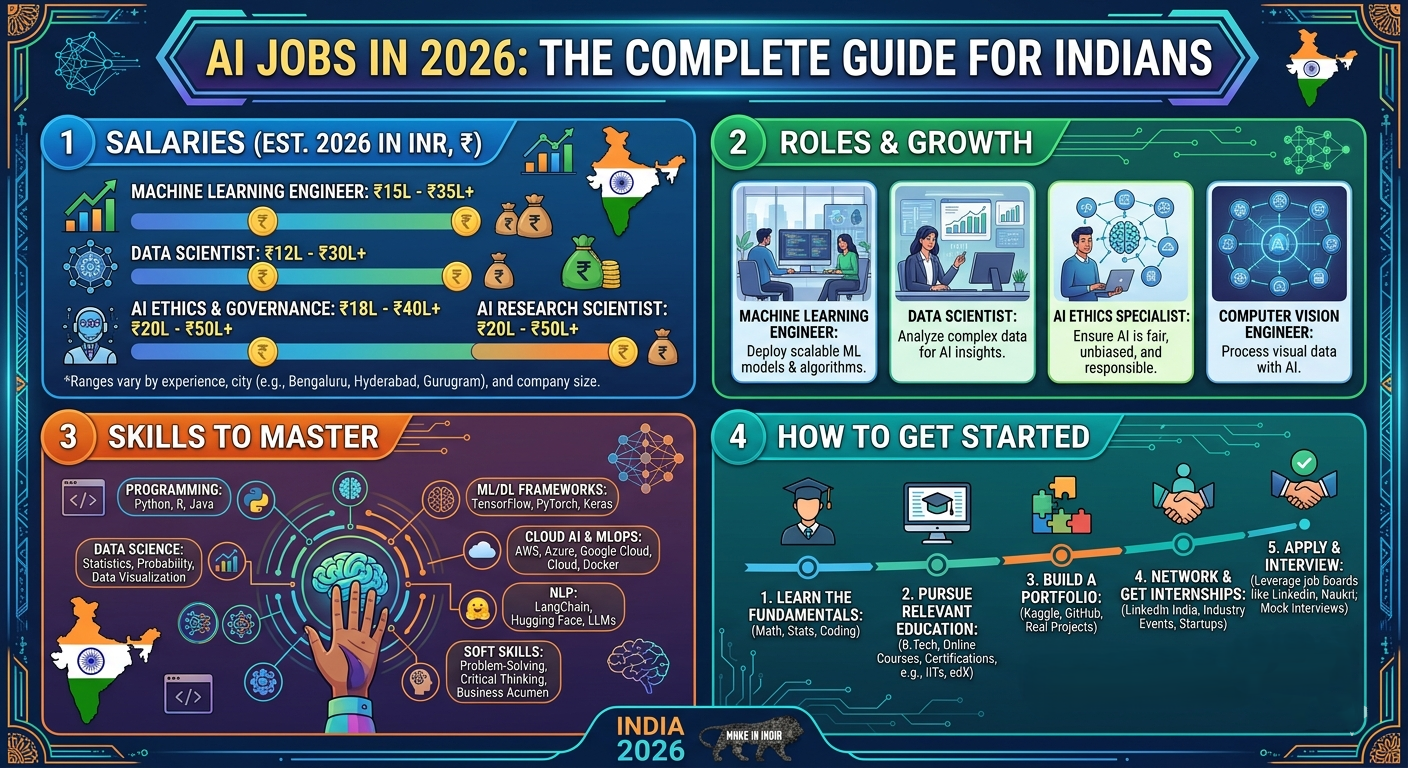
AI Jobs in 2026: The Complete Guide for Indians — Salaries, Roles, Skills and How to Get Started

170 million new jobs. A 56% salary premium for AI-skilled workers. India adding 490,000 AI positions in 2025 alone. Whether you are a student, a working professional, or a career-switcher — this guide tells you exactly what AI jobs exist, what they pay, what skills you need, and how to get started in 90 days.
| Here is the single most important career fact of 2026: workers with AI skills earn a 56% wage premium over peers in identical roles who do not have AI skills. That number — from PwC’s 2025 Workforce Survey — tells you everything you need to know about where to invest your time and learning budget. This guide breaks down every major AI career path, what it pays in India and globally, what skills you actually need, and how to go from zero to job-ready in under six months. |
The Numbers: Why AI Is the Biggest Career Opportunity of Our Lifetime
Let’s start with the data, because the data is extraordinary.
| 🌍 | 170M | New jobs projected globally by 2030 (WEF Future of Jobs Report 2025) |
| 🚫 | 92M | Jobs displaced globally by AI by 2030 — net gain of 78 million positions |
| 💰 | 56% | Wage premium earned by workers with AI skills vs peers without (PwC, 2025) |
| 🇮🇳 | 490K+ | New AI-related jobs added in India in 2025 alone — tops developing markets |
| 📈 | 380K | AI-related job openings projected in India in 2026 (up from ~290K in 2025) |
| 🧠 | $434B | Global AI market size in 2026 (Mordor Intelligence) |
| 🇮🇳 | $17B+ | India’s AI market projected to cross by 2027 (Nasscom-BCG) |
| 📊 | 22% | Share of today’s formal jobs that will change significantly by 2030 (WEF) |
The most important thing to understand about these numbers: the WEF projects net positive job growth. AI will not eliminate work — it will restructure it. The workers who thrive are those who position themselves on the right side of that restructuring.
| The honest caveat: The net gain of 78 million jobs does not mean every displaced worker automatically gets a new AI role. The jobs being created and the jobs being destroyed are not the same jobs, do not require the same skills, and are not in the same locations. The transition is real and sometimes painful. The purpose of this guide is to help you be on the right side of it. |
India’s AI Moment: Why Now Is the Best Time to Upskill
India occupies a uniquely powerful position in the global AI economy — and most Indians do not fully appreciate it yet.
- India is the second-largest AI talent hub in the world, behind only the United States, according to LinkedIn data and India Skill Report 2026
- Nearly 12% of all job postings in India’s tech sector now require AI skills — up from under 3% in 2022
- Bengaluru, Hyderabad, Pune, Chennai, and Delhi-NCR are the five major AI hiring hubs. Jaipur and Mysuru are emerging fast
- AI-related salaries in India are growing at 15–20% year-on-year, significantly outpacing the 8–10% average for non-AI IT roles
- India’s government has committed ₹10,000 crore to the National AI Mission (IndiaAI), directly funding compute infrastructure, datasets, research, and skill development
- The Asia-Pacific region added close to 1.1 million AI-related positions in 2025 — and India led all developing markets with 490,000+ new roles
| The talent gap opportunity: India may require nearly one million AI-skilled workers by 2026 — and the current supply falls far short. This gap is not a problem for job-seekers; it is an opportunity. When demand massively outstrips supply, salaries rise, hiring standards become more flexible, and even candidates with 6–12 months of focused learning can compete for roles that would otherwise require years of experience. |
The Top AI Jobs in 2026: Roles, Salaries and What They Actually Do
Here is a comprehensive breakdown of every major AI role, what it pays in India and globally, and the core skills required. Arranged from most technical to most accessible.
| Role | India Salary | Global Salary | Growth | Key Skills | |
| 🧠 | AI Research Scientist | ₹20–40 LPA | $120K–250K | Very High | PhD or MSc, PyTorch, research papers, maths |
| 🤖 | ML Engineer | ₹12–25 LPA | $110K–180K | Very High | Python, TensorFlow, MLOps, cloud (AWS/GCP) |
| 📊 | Data Scientist | ₹10–22 LPA | $95K–160K | High | Python, SQL, statistics, Pandas, visualisation |
| ⚙️ | AI/ML Solutions Architect | ₹18–35 LPA | $130K–200K | Very High | Cloud platforms, system design, ML at scale |
| 🔍 | Data Analyst | ₹4–12 LPA | $55K–110K | High | SQL, Excel, Power BI, Tableau, Python basics |
| 🔐 | Cybersecurity AI Analyst | ₹10–20 LPA | $100K–160K | Very High | Security tools, ML anomaly detection, SIEM |
| 🌐 | Prompt Engineer | ₹6–18 LPA | $70K–130K | Explosive | LLMs, ChatGPT, Claude, Gemini, writing skills |
| 💻 | Generative AI Engineer | ₹12–25 LPA | $120K–200K+ | Explosive | Python, LangChain, RAG, fine-tuning, APIs |
| 📦 | AI Product Manager | ₹15‑30 LPA | $120K–190K | Very High | Product sense, AI understanding, stakeholder mgmt |
| 🌿 | AI Ethics & Governance | ₹8–18 LPA | $80K–140K | Emerging | Law, policy, AI fairness, explainability, writing |
| 🧭 | NLP Engineer | ₹10‑22 LPA | $100K–165K | High | Python, Hugging Face, transformers, linguistics |
| 🤝 | AI Automation Consultant | ₹6–16 LPA | $70K–130K | High | RPA tools, AI agents, workflow design, no-code |
| 🏷️ | AI Data Labeller / Annotator | ₹5–2K/hr | $15–50/hr | Very High | Attention to detail, domain knowledge, tools |
| 🇮🇳 India salary note: Salaries vary significantly by city, company size, and individual skills. The ranges above represent the market for 2–6 years of experience at Tier-1 companies in Bengaluru, Hyderabad, or Pune. Freshers with strong skills and projects can expect to enter at 40–60% of the midpoint. Senior roles with 8+ years of specialised experience can exceed the stated ranges significantly. |
The Three Paths: Technical, Semi-Technical, and Non-Technical AI Careers
One of the biggest misconceptions about AI careers is that they all require a computer science degree. They do not. Here is how to think about the landscape:
Path 1: The Technical Route (Engineers & Scientists)
Roles: ML Engineer, AI Research Scientist, Data Scientist, NLP Engineer, Generative AI Engineer
What you need: Strong programming in Python, mathematics (linear algebra, statistics, calculus), and hands-on experience with frameworks like TensorFlow, PyTorch, or Hugging Face. A degree in CS, maths, or engineering is the typical entry point, though self-taught engineers with strong GitHub portfolios are increasingly hired.
Timeline to entry: 12–24 months from zero for a career-changer; 6–12 months for someone with adjacent technical skills.
Path 2: The Semi-Technical Route (Builders & Analysts)
Roles: Prompt Engineer, AI Automation Consultant, Data Analyst, AI Product Manager, Generative AI applications builder
What you need: Comfort with technology and data, strong domain expertise in your existing field, and fluency with AI tools. You do not need to build the AI — you need to deploy and apply it effectively. Prompt engineering, API integrations, and no-code AI tools are your core toolkit.
Timeline to entry: 3–6 months for someone with existing professional experience in any field.
Path 3: The Non-Technical Route (Governance, Ethics, Content & Labelling)
Roles: AI Ethics & Governance Specialist, AI Data Labeller/Annotator, AI Content Creator, AI Trainer, AI Policy Analyst
What you need: Domain expertise, strong communication skills, attention to detail, and basic familiarity with how AI systems work. AI data labelling is the most accessible entry point: it requires no coding, can be started in days, and pays ₹500–2,000 per hour for Indian freelancers.
Timeline to entry: 3 days to 4 weeks to start earning; 6–12 months to build a meaningful income stream.
The Fastest-Growing AI Skills of 2026
Not all AI skills are equal. Here are the skills that will command the highest premium in the job market in 2026 and beyond, ranked by demand growth:
| # | Skill | Why It’s Exploding in 2026 | Difficulty to Learn |
| 1 | Generative AI & LLM Fine-tuning | Every company is building GenAI products. Engineers who can fine-tune or deploy LLMs are the rarest and highest-paid | Hard — 12–18 months |
| 2 | Agentic AI & Autonomous Agents | Nasscom calls agentic AI the biggest shift of 2026. Tools like LangChain, CrewAI, and AutoGen are hot | Medium — 4–6 months |
| 3 | Prompt Engineering | Deceptively powerful. The best prompts can replace months of coding. Universally applicable across all roles | Easy — 2–4 weeks |
| 4 | RAG (Retrieval-Augmented Generation) | Powers AI systems that retrieve real-world data. Core to enterprise AI deployment | Medium — 2–3 months |
| 5 | MLOps & AI Infrastructure | Taking AI from prototype to production. Massively underserved talent area | Hard — 12–18 months |
| 6 | AI in Cloud (AWS/GCP/Azure) | Every cloud provider is racing to sell AI services. Certified cloud + AI = premium package | Medium — 4–6 months |
| 7 | Computer Vision | Powering manufacturing, healthcare imaging, autonomous vehicles, and surveillance | Hard — 12+ months |
| 8 | AI Ethics & Explainability | Growing regulatory pressure globally — EU AI Act, India’s Digital India Act. Lawyers & policy experts needed | Medium — 3–4 months |
The 90-Day AI Career Roadmap for Indians: From Zero to Job-Ready
This roadmap is designed for someone starting with no AI experience — but who has a working knowledge of computers and is serious about making a change. Adapt the timeline to your pace.
| Phase | What to Do — and Why |
| Days 1–14 | Understand AI Fundamentals Watch Andrew Ng’s AI for Everyone on Coursera (free). Read WEF Future of Jobs 2025 summary. Decide which of the 3 paths (technical, semi-technical, non-technical) fits your background and goals. Create a LinkedIn profile optimised for AI. |
| Days 15–30 | Learn Python Basics (Technical) or AI Tools (Non-Technical) Technical path: Complete Python for Everybody (Coursera). Non-technical: Get fluent with ChatGPT, Claude, and Gemini through daily practice. Prompt Engineering for Everyone course (free on DeepLearning.AI). Build 2 small projects using AI tools. |
| Days 31–45 | Specialise in One Role Pick ONE role from the table above and go deep. Data science: start Kaggle beginner competitions. Prompt engineering: write 100 different prompts, document results. AI automation: build a no-code AI workflow using n8n or Make.com. |
| Days 46–60 | Build Your Portfolio Create 3 projects that show employers what you can do. Upload everything to GitHub. Write 2 LinkedIn posts about what you learned. Join AI communities: Hugging Face forums, Kaggle, Reddit r/MachineLearning, local Bengaluru/Hyderabad AI meetups. |
| Days 61–75 | Get a Certification Complete at least one credible certification: Google Machine Learning Crash Course, AWS Cloud Practitioner, DeepLearning.AI Specialisation, or Microsoft AI-900. Certifications are not everything but they open doors for interviews. |
| Days 76–90 | Apply and Iterate Apply to 20–30 roles on LinkedIn, Internshala, Naukri, and Wellfound. Target roles that are 1 level below your ideal — it is easier to get your first AI role and then advance than to hold out for the perfect job. Ask for feedback on every rejection. Iterate on your portfolio. |
| The one thing that matters most: Employers do not care how many YouTube videos or Coursera courses you have completed. They care what you have built. A GitHub repository with three strong, well-documented AI projects will get you further in interviews than a wall of certifications. Build first. Certify second. Apply third. |
The Best Free Resources to Learn AI in 2026 (India-Focused)
Free Courses
- DeepLearning.AI (deeplearning.ai) — Andrew Ng’s platform has 20+ free short courses on Gen AI, LLMs, prompt engineering, agents, and RAG. The single best free resource for beginners.
- Google Machine Learning Crash Course (developers.google.com/machine-learning) — Free, structured, and built by Google engineers. Covers the fundamentals.
- Fast.ai — Top-down, practical deep learning. Beloved by self-taught ML engineers globally. Free.
- Kaggle Learn (kaggle.com/learn) — Free micro-courses in Python, ML, data science, SQL, and deep learning. Comes with free GPU compute.
- NPTEL AI/ML courses — Free IIT-level courses available on SWAYAM. Highly credible for Indian resumes.
Free Tools to Practice With
- Google Colab — Free Jupyter notebook environment with free GPU/TPU access. Essential for ML practice.
- Hugging Face — Open-source models, datasets, and community. The GitHub of AI models.
- Kaggle — Free datasets, competitions with prize money, and free compute. The best place to build a portfolio.
- GitHub — Host your projects. Employers will look at your GitHub. Make it good.
- ChatGPT, Claude, Gemini — Use them daily. The more you use AI tools, the better you understand their strengths and limits — which is itself a career skill.
India-Specific Platforms and Schemes
- IndiaAI Mission (indiaai.gov.in) — Government portal with datasets, compute access, and skill programmes
- NASSCOM FutureSkills Prime (futureskillsprime.in) — Subsidised AI and data science courses for Indian professionals
- iGOT Karmayogi — Government upskilling platform with AI modules for public sector workers
- AICTE-recognised AI programmes — Many universities now offer 6-month PG diplomas in AI with AICTE recognition, making them valuable for promotions and government roles
Which Jobs Are at Risk? An Honest Assessment
It would be dishonest to write a guide about AI jobs without addressing the jobs that AI is displacing. Here is what the evidence shows:
High Risk of Automation
- Data entry and processing clerks — Highly repetitive, rules-based. Already being automated widely.
- Basic customer service agents — Script-based call centre work. AI chatbots are replacing tier-1 support.
- Junior copywriters doing templated content — Generic product descriptions, basic SEO articles.
- Basic graphic design (templated work) — Canva + AI tools are replacing commodity design tasks.
- Entry-level accounting and bookkeeping — Automated by tools like Tally AI, QuickBooks, and Zoho Books.
Medium Risk — Roles That Will Change, Not Disappear
- Software developers — Junior coding tasks automated, but demand for senior developers is actually rising. AI makes senior engineers more productive, not redundant. BLS projects 17.9% employment growth for software developers 2023–2033.
- Content creators and journalists — AI handles research and drafts; human judgement, sourcing, and voice remain critical.
- Teachers and trainers — AI personalises curriculum delivery, but human mentorship and motivation cannot be replaced.
Low Risk — Safe and Growing
- Healthcare professionals (doctors, nurses, surgeons) — AI assists diagnosis; it does not replace clinical judgement, empathy, and physical care.
- Skilled tradespeople (plumbers, electricians, carpenters) — Physical dexterity in unstructured environments is extremely hard to automate.
- Social workers, counsellors, and mental health professionals — Human connection is the entire product.
- AI and data professionals (this entire guide) — The people who build, train, and govern AI are the last to be displaced by it.
| The key insight: AI is replacing tasks, not entire roles. Most jobs contain a mix of automatable and non-automatable tasks. The workers who survive and thrive are those who double down on the parts of their role that AI cannot do — judgement, relationships, creativity, physical dexterity, and ethical reasoning — while using AI to handle the repetitive parts more efficiently. |
The India-Specific AI Career Strategy: What Works Here
The global AI career advice you read on Western websites does not always translate directly to India. Here are the differences that matter:
- Service sector is the entry point. Most AI jobs in India are in IT services companies (TCS, Infosys, Wipro, HCL, Tech Mahindra) implementing AI solutions for global clients. These companies are hiring aggressively for ML engineers, AI consultants, and data analysts.
- Product companies pay more. Indian startups (Zepto, Meesho, Swiggy, CRED, Razorpay, PhonePe) and global product companies (Google, Microsoft, Amazon, Flipkart) pay 2–3x more than service companies for similar AI roles. Getting into a product company is harder but the financial upside is significant.
- Freelancing is a real option. India’s talent is globally competitive but salaries are India-priced. Freelancing on platforms like Upwork, Toptal, and Contra for international clients can earn you global rates — $50–$200/hour for strong AI skills.
- Government AI jobs are coming. The National AI Mission is creating public sector AI roles. DRDO, ISRO, NIC, and various ministries are hiring data scientists and AI engineers. These jobs offer stability, CGHS benefits, and pension.
- Bengaluru remains #1, but other cities are rising. Hyderabad (Amazon, Microsoft, Google offices), Pune (Infosys, Cognizant), and Chennai (Zoho, Freshworks) offer strong AI job markets with lower cost of living than Bengaluru.
Frequently Asked Questions
Is it too late to get into AI in 2026?
No. The demand-supply gap in AI talent is wider in 2026 than it has ever been. India needs approximately one million AI-skilled workers and has a fraction of that available. If anything, this is still the early phase of adoption for most companies. The workers who start upskilling in 2026 will be senior practitioners by 2030, when AI adoption reaches full penetration.
Do I need a degree to get an AI job?
For research scientist and senior ML engineer roles, a Master’s or PhD is typically expected. For most other AI roles — including prompt engineering, data analysis, AI automation, and generative AI engineering — a strong portfolio of projects, relevant certifications, and demonstrable skills matter more than a formal degree. Many of India’s top AI practitioners are self-taught.
What is the starting salary for an AI job in India?
Entry-level AI roles in India typically start at ₹4–8 LPA at service companies and ₹8–15 LPA at product companies or startups. Freshers with strong portfolios and projects can command higher starting offers, particularly at companies that are actively trying to build AI capabilities.
What is the single most in-demand AI skill in India right now?
Based on job posting data from Naukri, LinkedIn, and Foundit (2026): Python programming combined with machine learning fundamentals is the baseline skill required for most roles. Among emerging skills, Generative AI fluency — working with LLMs, building RAG systems, and deploying AI applications using APIs — is the fastest-growing and highest-compensated skill set.
How long does it take to become job-ready in AI?
It depends on your starting point and target role. For non-technical entry points (data labelling, AI content, basic prompt engineering): 2–4 weeks. For semi-technical roles (data analyst, AI automation, junior prompt engineer): 3–6 months of focused learning. For technical roles (ML engineer, data scientist): 12–24 months from zero, or 6–12 months for someone with adjacent technical skills.
What is Prompt Engineering and is it really a job?
Prompt engineering is the skill of designing, refining, and optimising the text inputs (‘prompts’) given to AI systems like ChatGPT, Claude, or Gemini to produce specific, high-quality outputs. It is a real and growing job category, with specialists earning ₹6–18 LPA in India and $70K–$130K globally. The role is part art, part science, and is one of the most accessible AI career paths for people without a technical background.
| Sources | WEF Future of Jobs 2025, PwC, Nasscom, India Skill Report 2026, Nasscom-BCG |
Disclaimer: This article is for informational and educational purposes only. It is based on publicly available reports and policy updates. It should not be considered financial, investment, legal or business advice.