









































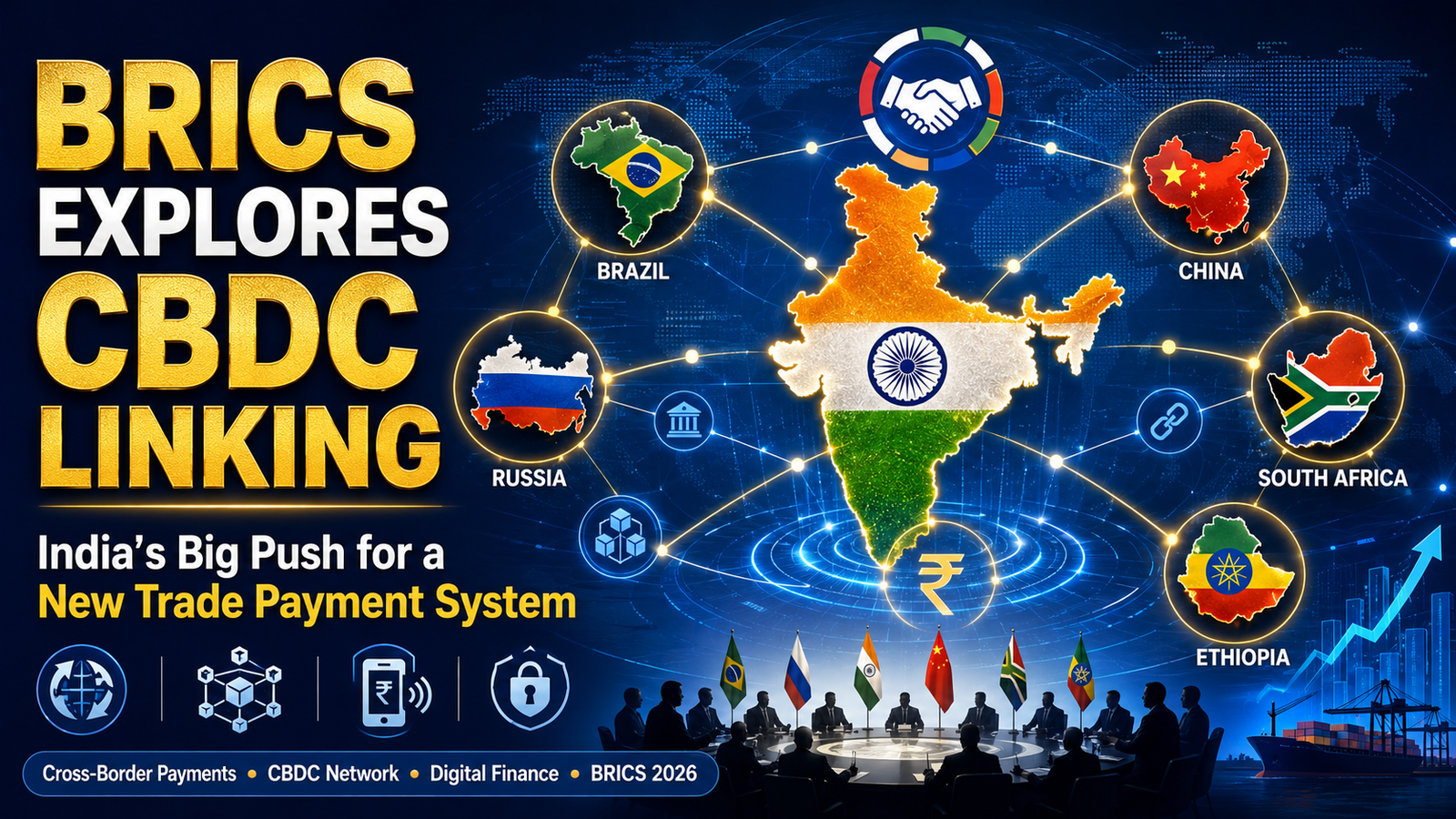
BRICS Explores CBDC Linking: India’s Big Push for a New Trade Payment System

BRICS Wants a New Payment Future
BRICS nations are exploring a major financial idea: linking their fast payment systems and central bank digital currencies, also known as CBDCs, to make trade and cross-border payments faster, cheaper and less dependent on traditional dollar-based routes.
Reuters reported that RBI Governor Sanjay Malhotra said BRICS members are discussing possible links between their payment systems and CBDCs. Reuters had earlier reported that the RBI recommended placing a CBDC-connection proposal on the agenda for the 2026 BRICS Summit hosted by India.
This is not just a banking story. It is a geopolitical story.
If BRICS can build a reliable payment network, it could reduce transaction costs, improve trade settlement and give emerging economies more financial flexibility.
What Is CBDC Linking?
A CBDC is a digital version of a country’s official currency issued by its central bank. India’s CBDC is called the Digital Rupee, or e₹. RBI explains that the e₹ is a digital form of the rupee banknote, is legal tender and is a liability of the Reserve Bank of India.
CBDC linking means different countries’ digital currencies could become interoperable for trade, tourism and cross-border settlement.
For example, in the future, an Indian exporter may receive payment through a digital rupee-linked system instead of waiting through multiple correspondent banks. A Brazilian buyer, an Emirati trader or a South African business could settle faster using connected digital payment rails.
That is the real attraction: speed, lower cost and less friction.
Why India Is Pushing This at BRICS
India is hosting the XVIII BRICS Summit in 2026 and also holds the BRICS Chairship. The 2025 Rio Declaration extended support to India’s 2026 Chairship and called for continued discussion on the BRICS Cross-Border Payments Initiative and greater interoperability of BRICS payment systems.
India is in a strong position to lead this discussion because it already has a powerful digital payments ecosystem.
UPI has become a global example of low-cost, instant payments. RBI Governor Sanjay Malhotra said India has already taken UPI global with acceptance in eight countries and is working to connect it with more systems, including the European Central Bank’s TARGET Instant Payment Settlement system.
That gives India credibility. India is not only talking about digital payments. India has already built them at scale.
This Is Not a BRICS Currency
It is important to avoid fake hype.
BRICS is not suddenly launching one common currency tomorrow. The current discussion is more practical: connect payment systems, promote local currency settlement and explore CBDC interoperability.
That is smarter than making dramatic announcements.
A common currency is politically and economically difficult because BRICS members have different inflation rates, exchange-rate systems, trade balances, central banks and strategic interests.
But linking CBDCs and payment systems is more realistic. It allows each country to keep its own currency while making cross-border settlement easier.
Why This Matters for De-Dollarisation
The U.S. dollar will not disappear overnight. It remains the world’s most powerful reserve and trade currency.
But BRICS countries want more options.
Reuters reported that RBI’s CBDC-linking proposal could make cross-border trade and tourism payments easier and may reduce reliance on the U.S. dollar as geopolitical tensions rise.
This is the key point: BRICS is not only trying to replace the dollar. It is trying to reduce vulnerability.
When trade payments depend heavily on Western-controlled systems, countries can face sanctions pressure, payment delays, currency conversion costs and geopolitical risk. A BRICS-linked payment network would give emerging economies another route.
That does not end the dollar system, but it creates competition.
Why BRICS Has the Scale
BRICS is no longer just Brazil, Russia, India, China and South Africa. It now includes countries such as Egypt, Ethiopia, Indonesia, Iran, Saudi Arabia and the UAE. PIB noted that BRICS now comprises 11 countries and accounts for nearly half of the world’s population and around 40% of global GDP.
That makes payment cooperation powerful.
BRICS includes major energy exporters, large consumer markets, manufacturing powers, technology players and fast-growing economies. If even part of their trade begins using faster local-currency or CBDC-based systems, it could reshape global payment discussions.
India’s Opportunity
For India, this is a major opportunity.
A BRICS payment architecture can support the internationalisation of the rupee, help Indian exporters, reduce settlement delays and strengthen India’s role as a digital public infrastructure leader.
The Department of Financial Services says India is working on international trade settlement in rupees, promoting UPI and RuPay globally, and expanding India’s digital public infrastructure internationally.
This fits perfectly with India’s broader strategy.
India does not want to be only a participant in the global financial system. India wants to help design the next version of it.
Challenges Ahead
This idea is exciting, but it will not be easy.
BRICS members need common technical standards, cybersecurity rules, anti-money-laundering safeguards, currency conversion systems, settlement mechanisms and trust between central banks.
There are also geopolitical complications. Some BRICS members have strong ties with the West. Others face sanctions. Some want faster de-dollarisation, while others prefer a cautious approach.
India must ensure that any BRICS CBDC system is transparent, secure, compliant and not dominated by any single country.
This is especially important because India’s interest is not to replace one dependency with another. The goal should be a balanced, multipolar financial system.
Final Thoughts
BRICS exploring CBDC linking is one of the most important financial stories of 2026.
India’s BRICS Summit could become a major platform for building a new cross-border payment architecture based on digital currencies, fast payment systems and local currency trade.
This does not mean the dollar is finished. It does not mean a BRICS currency is arriving tomorrow.
But it does mean the world is changing.
Countries want faster payments. Businesses want lower costs. Emerging economies want financial independence. India wants the rupee and its digital payment model to play a bigger global role.
If done carefully, BRICS CBDC linking can become a practical step toward a more multipolar financial order.
For India, this is not only about payments.
It is about leadership.
FAQs
What is BRICS CBDC linking?
BRICS CBDC linking means connecting central bank digital currencies and fast payment systems of member countries to make cross-border payments faster and cheaper.
Is BRICS launching a common currency?
No. Current discussions are about payment-system interoperability and CBDC linking, not an immediate common BRICS currency.
Why is India important in this discussion?
India is hosting the 2026 BRICS Summit and has strong digital payment experience through UPI and the Digital Rupee.
Will this replace the U.S. dollar?
Not immediately. The dollar will remain powerful, but BRICS payment links could reduce dependence on dollar-based settlement routes.
How can this help Indian businesses?
It can potentially reduce transaction costs, speed up export payments, support rupee settlement and make trade with BRICS partners easier.
Disclaimer: This article is for informational and educational purposes only. CBDC and BRICS payment discussions are still evolving. This article does not provide financial, investment or legal advice.