













































Trump’s $5,000 Midterm Promise: Economic Dividend or Attempt to Buy Votes?
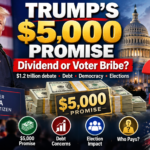
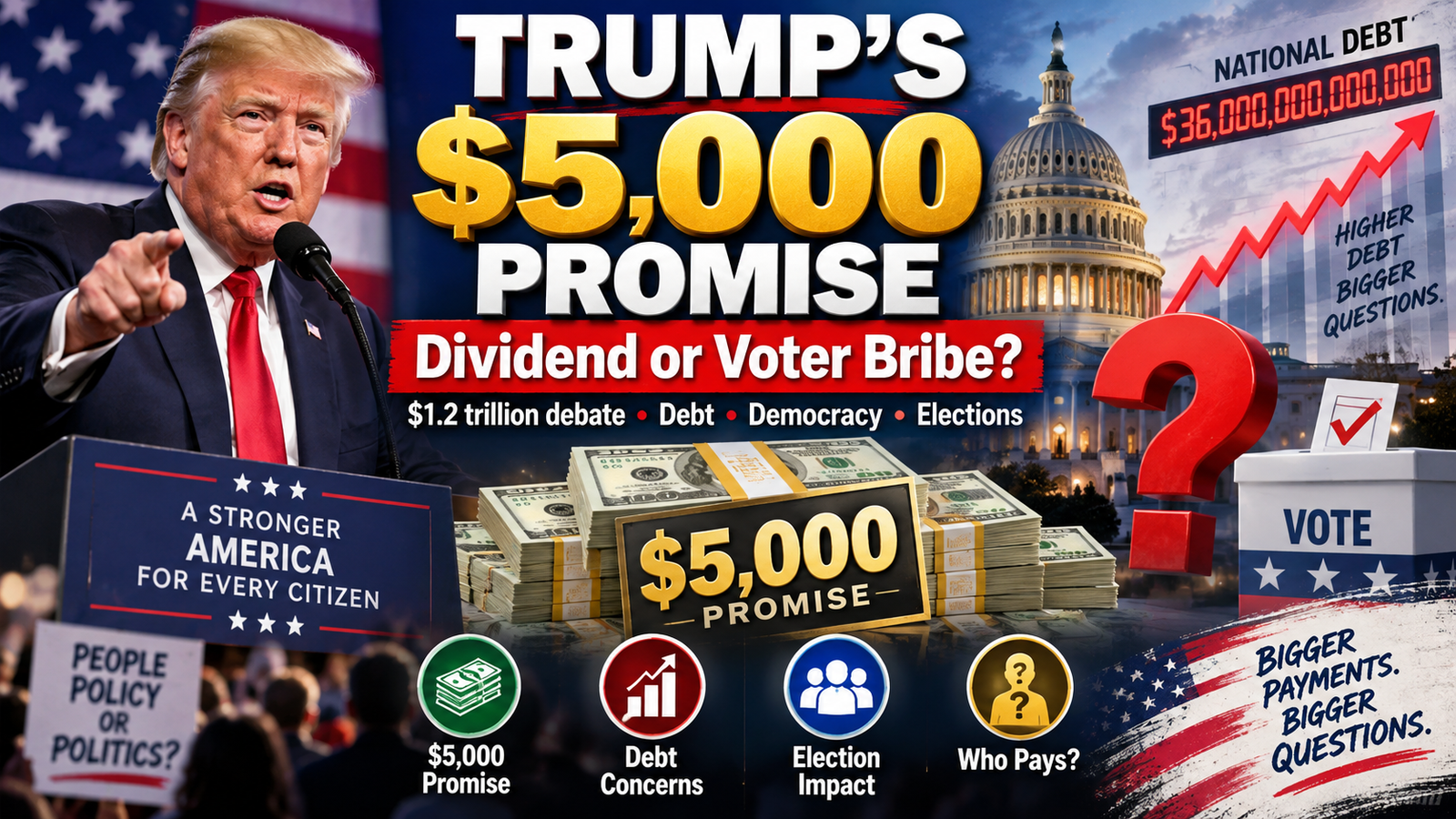
US President Donald Trump has made one of the most extraordinary promises of the 2026 midterm-election campaign: every adult American citizen will receive $5,000 if Republicans retain control of both the House of Representatives and the Senate.
Trump calls it the “Trump Dividend.” Critics call it an attempt to buy votes using public money.
The proposal immediately raises three important questions:
- Is it legally considered voter bribery?
- How would the government finance a payment costing approximately $1.2 trillion?
- What precedent would it establish for future American elections?
The answer is complicated. Trump is not offering money only to individual voters who prove they supported Republicans. Therefore, it may not satisfy the legal definition of vote-buying.
Politically and ethically, however, promising a massive taxpayer-funded payment explicitly conditional on one party winning Congress risks turning an election into a bidding contest.
What Exactly Did Trump Announce?
Trump made the announcement during the Republican midterm convention in Dallas on September 9, 2026.
He said every adult US citizen would receive $5,000 if Republicans retained control of both chambers of Congress in the November 3 midterm elections.
The money would reportedly have to be spent inside the United States. Trump described the proposed payment as a dividend produced by America’s economic success.
However, he did not explain:
- When the payments would arrive
- Which adults would qualify
- Whether high-income Americans would be excluded
- Whether recipients would pay tax on the money
- How domestic spending would be enforced
- Which government department would distribute it
- How the federal government would finance it
Vice President JD Vance later suggested that wealthy Americans might not qualify and that tariff revenue could help pay for the plan.
That means the administration was already modifying or clarifying the proposal shortly after Trump announced it.
According to Reuters, approximately 240 million adult US citizens could qualify. At $5,000 each, the total cost would be around $1.2 trillion.
Did Trump Promise Money Only to Republican Voters?
No. This distinction is essential.
Trump did not say citizens would have to prove they voted Republican before receiving the money. The payment would reportedly go to all qualifying adults if Republicans collectively retained Congress.
That would include:
- Republican voters
- Democratic voters
- Independent voters
- People who voted for third-party candidates
- Eligible adults who did not vote at all
Therefore, the proposal is not a direct exchange in which an individual receives money after proving how he or she voted.
The payment is instead conditional on the overall election result.
That difference may protect the proposal from being classified as criminal vote-buying, but it does not eliminate the broader democratic concern.
Is the $5,000 Promise Legally Voter Bribery?
Federal law prohibits offering money to a person in exchange for voting, withholding a vote or voting for or against a particular candidate.
For example, 18 US Code Section 597 criminalises offering an expenditure to influence an individual’s vote. Another federal provision prohibits paying someone to register or vote in a federal election.
However, political candidates routinely promise policies that financially benefit voters. These can include:
- Tax reductions
- Student-debt relief
- Pension increases
- Healthcare subsidies
- Agricultural support
- Stimulus payments
- Child-tax credits
Courts generally distinguish between a public-policy promise benefiting a group of citizens and a private payment offered in exchange for a particular person’s vote.
A legal expert interviewed by the Associated Press argued that Trump’s proposal would likely be legal because everyone would receive the payment regardless of how—or whether—they voted.
Based on the information currently available, it would therefore be inaccurate to declare the proposal illegal bribery as a confirmed fact.
But legality is only one part of the debate.
Why the Proposal Still Resembles an Electoral Inducement
Although the payment may not meet the legal definition of bribery, Trump explicitly connected a large personal financial benefit with a Republican victory.
The political message is simple:
If Republicans win Congress, adults receive $5,000. If Republicans lose, they receive nothing.
That framing is different from presenting a detailed tax or welfare policy with identified funding, eligibility rules and long-term objectives.
The payment was announced at a Republican convention less than two months before the election. It was presented as an immediate reward for producing a specific partisan result.
This creates the appearance that public money is being used as an election incentive.
The concern is not limited to Trump or the Republican Party. If this strategy succeeds, future Democratic and Republican candidates may feel pressure to offer even larger payments.
One party could promise $5,000. The other could promise $7,000. A future candidate could offer debt cancellation, tax refunds or other payments explicitly conditional on an electoral victory.
Elections could gradually become auctions financed by taxpayers who must ultimately repay the debt.
Is This Different From Normal Campaign Promises?
Supporters can reasonably argue that nearly every election involves financial promises.
Politicians routinely tell voters that electing them will result in lower taxes, higher benefits or more public spending. Democratic candidates linked control of Congress to COVID-19 relief payments during the 2021 Georgia Senate elections, while Trump has previously campaigned on tax reductions and tariff-funded dividends.
The difference is mainly one of design and presentation.
A normal policy proposal usually identifies a social or economic objective. For example, unemployment benefits support people who have lost jobs, while child-tax credits help families raising children.
Trump’s $5,000 proposal was announced as a broadly distributed cash reward explicitly triggered by Republican control of Congress.
That does not automatically make it unlawful. It does make the democratic ethics far more questionable.
How Much Would the Trump Dividend Cost?
The basic calculation is straightforward:
240 million adult citizens × $5,000 = $1.2 trillion
The final figure could change if wealthy citizens were excluded or if additional eligibility conditions were introduced.
Nevertheless, the original promise to every adult citizen would create one of the largest single federal cash-distribution programmes in American history.
For comparison, the three rounds of pandemic relief produced 476 million individual payments collectively worth approximately $814 billion. Those payments were spread across 2020 and 2021 and were intended to respond to a major economic emergency.
The proposed Trump Dividend could cost substantially more than all three COVID-era payment rounds combined.
Can Tariff Revenue Pay for It?
JD Vance suggested that the payment could be financed using tariff revenue.
The numbers do not currently support that explanation.
The Congressional Budget Office estimated that the federal government had collected approximately $167 billion in tariff revenue during the fiscal year through the time of Trump’s announcement.
That is far below the estimated $1.2 trillion required.
The proposed payment would be more than seven times the tariff revenue collected during that period. Even if the government diverted every dollar of tariff revenue to the dividend, a funding gap of approximately $1 trillion would remain.
Tariff revenue is also not free foreign money. Tariffs are collected from American companies importing products into the United States. Businesses may absorb part of the cost, but they can also pass it to consumers through higher prices.
Using tariffs to distribute $5,000 checks could therefore create a circular system in which Americans pay higher prices on imported goods and then receive part of that money as a government payment.
Tariff revenue is already included in the federal budget. Redirecting it to new checks without reducing spending elsewhere could still increase the deficit.
America Already Has More Than $40 Trillion in Debt
The United States’ national debt crossed $40 trillion in August 2026.
The more immediate fiscal problem is the annual budget deficit—the difference between what the government spends and what it collects each year.
The Congressional Budget Office expects the federal government to spend approximately $2.1 trillion more than it collects during the current fiscal year.
A new $1.2 trillion programme financed entirely through borrowing could increase that annual shortfall dramatically.
If the complete cost were borrowed, it would also add an amount equal to roughly 3% of the existing $40 trillion national debt in a single programme.
The government would then have to pay interest on that additional borrowing for years.
Financial markets are already concerned about federal deficits and borrowing requirements. Reuters reported that US debt recently exceeded $40 trillion as long-term Treasury yields remained elevated.
Higher government borrowing costs eventually affect taxpayers because more federal revenue must be used for interest instead of infrastructure, healthcare, defence or social programmes.
How Could Trump Actually Pay for the Plan?
There are only four realistic methods.
1. Increase Taxes
Congress could impose new taxes to finance the payment. However, collecting money from citizens and returning it through a dividend would reduce the programme’s net benefit.
2. Use Tariff Revenue
Tariffs could cover part of the cost, but current collections are nowhere near sufficient to finance the original proposal.
3. Reduce Other Government Spending
Congress could cut approximately $1.2 trillion from existing programmes. Such cuts would be politically difficult and could affect healthcare, defence, infrastructure, education or social benefits.
4. Borrow the Money
The easiest political option would be issuing more Treasury debt. It would also deepen the deficit and transfer part of the cost to future taxpayers.
There is no fifth source of free government money. Every federal payment must ultimately come from taxes, reduced spending, existing revenue or borrowing.
Can Trump Send the Checks Without Congress?
No.
The president does not have unlimited authority to distribute $1.2 trillion from the US Treasury.
Congress controls federal spending under the Constitution. Lawmakers would need to approve the payment or provide the necessary budget authority.
Republicans currently hold narrow congressional majorities, but even some fiscal conservatives within the party have expressed concern about the proposal.
Legislation could also face procedural barriers in the Senate, where most bills require 60 votes to advance. Republicans might attempt to use the budget-reconciliation process, but that would still require sufficient support within their own party.
Trump’s statement is therefore a campaign promise—not an approved government programme. No payment has been authorised or scheduled.
Could the Payment Increase Inflation?
A sudden injection of $1.2 trillion into consumer spending could increase demand for goods and services.
If businesses cannot expand supply quickly enough, stronger demand can push prices higher. Housing, vehicles, travel, electronics and other consumer sectors could experience additional pressure.
The domestic-spending condition might intensify the effect by directing the money specifically towards American goods and services.
The economic result would depend on:
- Whether the payment is means-tested
- How quickly the money is distributed
- Whether it is financed through taxes or borrowing
- How much recipients spend instead of saving
- The inflation rate when payments are issued
- The Federal Reserve’s monetary-policy response
If the programme raises inflation, the Federal Reserve may be forced to maintain higher interest rates. That could make mortgages, car loans, business financing and government borrowing more expensive.
The payment might create a short-term boost in consumer spending while producing longer-term costs through inflation, interest payments and additional debt.
Why This Sets a Dangerous Democratic Precedent
Democracy depends on citizens judging competing policies, leadership records and national priorities.
Directly linking a large cash payment to one party retaining power can weaken that principle. It encourages voters to evaluate an election as a personal financial transaction rather than a decision about governance.
The greatest danger is repetition.
If politicians learn that large cash promises can decide close elections, fiscal discipline may disappear during every campaign. Parties will have an incentive to promise increasingly expensive benefits regardless of whether the country can afford them.
This problem would exist whether the proposal came from Republicans, Democrats or any other political movement.
A government with a genuine surplus could openly debate returning money to taxpayers. But the United States currently has neither a balanced budget nor surplus funds waiting to be distributed.
Calling a debt-financed payment a “dividend” is therefore misleading unless the administration identifies sufficient new revenue or equivalent spending cuts.
The Final Verdict
Trump did not offer $5,000 only to people who personally vote Republican. Because the proposed payment would reportedly go to qualifying citizens regardless of their individual votes, the currently disclosed plan is unlikely to constitute conventional criminal vote-buying.
Nevertheless, the proposal creates a serious ethical problem.
A sitting president announced a major taxpayer-funded payment and explicitly tied it to his political party retaining Congress. That blurs the line between offering public policy and offering an electoral reward.
The financial case is even weaker.
The programme could cost approximately $1.2 trillion, tariff collections would cover only a small portion, the annual federal deficit is already projected at around $2.1 trillion, and national debt has exceeded $40 trillion.
Until the administration produces legislation, eligibility rules and a credible funding source, the Trump Dividend should be treated as an unapproved campaign promise—not money that Americans are guaranteed to receive.
Frequently Asked Questions
Did Trump promise $5,000 to everyone who votes Republican?
No. Trump said adult US citizens would receive the payment if Republicans retained the House and Senate. He did not say recipients must prove they personally voted Republican.
Is the Trump Dividend voter bribery?
Critics describe it as an attempt to buy votes, but it may not meet the legal definition of bribery because the proposed payment is not conditioned on an individual’s vote.
How much would the payment cost?
Providing $5,000 to approximately 240 million adult citizens would cost around $1.2 trillion.
Can tariff revenue cover the cost?
Not under current figures. The proposed payment is several times larger than the tariff revenue collected during the fiscal year.
Can Trump distribute the money without Congress?
No. A payment of this size would require congressional spending authority.
Has the Trump Dividend been approved?
No. It is currently a campaign proposal. No legislation, confirmed eligibility system or payment schedule has been approved.
Would the payment increase America’s national debt?
It could if Congress approved it without sufficient taxes, tariff revenue or spending reductions. Borrowing the full amount would add approximately $1.2 trillion to federal debt.
Disclaimer: This article is based on public statements, government financial estimates and credible reporting available as of September 10, 2026. The Trump Dividend is a political proposal and has not been approved by Congress. Descriptions such as “electoral inducement” or comparisons with voter bribery represent political and legal analysis; no court has ruled that the announced proposal constitutes criminal bribery. This content is intended for news and educational purposes and does not provide legal or financial advice.
