



































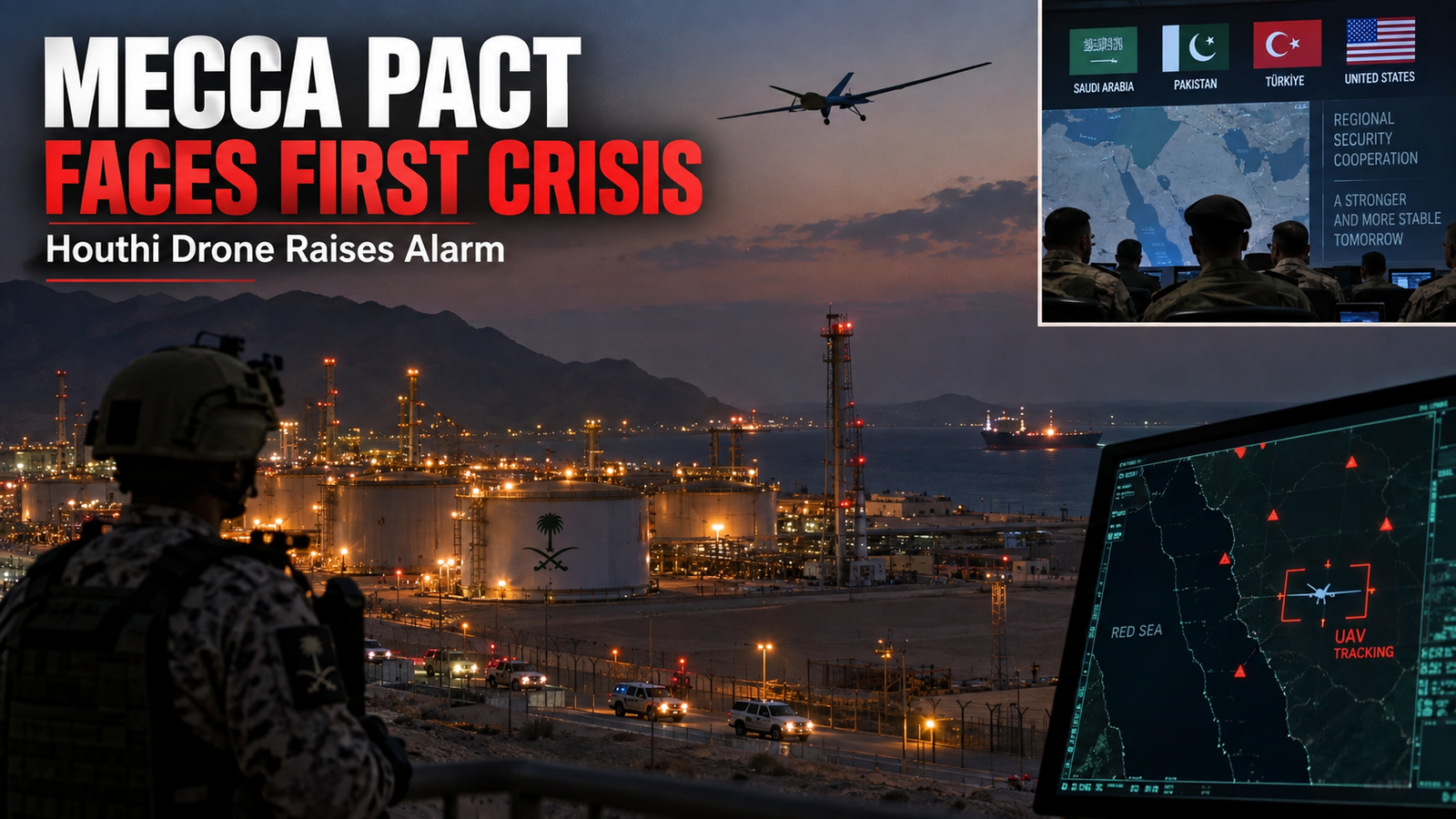
Mecca Pact Faces First Crisis as Houthi Drone Raises Alarm

Mecca Pact Faces First Crisis as Saudi Arabia Confronts Houthis Alone
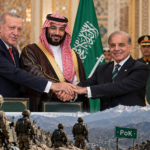
The Mecca Joint Defence Agreement was presented as a powerful new security alliance linking Saudi Arabia, Pakistan and Türkiye.
Its central promise sounded clear: an armed attack against one member would be considered an attack against all three.
Barely a month after its signing, however, Saudi Arabia is facing repeated Houthi drone and missile attacks—and neither Pakistan nor Türkiye has announced direct military intervention.
The crisis has intensified after Saudi Arabia said it intercepted a Houthi drone south of Mecca before it entered restricted airspace over Islam’s holiest city. The Houthis denied targeting Mecca or any religious site.
The incident has raised an unavoidable question: is the Mecca Pact a genuine collective-defence alliance or primarily a political declaration?
What Is the Mecca Pact?
Saudi Arabia, Pakistan and Türkiye signed the Mecca Joint Defence Agreement on August 7, 2026.
The pact was designed to strengthen regional deterrence and reduce the members’ dependence on outside powers. It also called for greater military coordination, joint exercises, defence production and cooperation in air defence, drones and electronic warfare.
The agreement resembles NATO’s collective-defence principle because an attack on one member is supposed to be treated as an attack on all.
However, the original statement did not explain exactly what each country must do following an attack. It did not guarantee automatic troop deployments, airstrikes or entry into a war.
That ambiguity is now becoming the pact’s biggest weakness.
Why the Pact Appears to Be Failing Its First Test
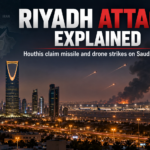
Houthi forces have attacked Saudi cities, military facilities, oil infrastructure and shipping routes. They have also captured strategic territory near the Bab el-Mandeb Strait.
Yet Saudi Arabia remains largely responsible for its own military response.
Pakistan condemned the attacks and reportedly warned Iran to restrain the Houthis. However, Islamabad said on September 10 that no military response under the Mecca Pact was being discussed.
A Pakistani Foreign Ministry spokesperson said the country would act when the appropriate time arrived, but provided no details about what would trigger that action. Reuters reported that Pakistan continues to describe the agreement as defensive.
Türkiye has supported stronger military coordination and participated in discussions about protecting Red Sea shipping, but it has not announced direct combat operations against the Houthis.
This does not mean the pact has formally collapsed. Intelligence sharing, diplomacy, air defence and technical assistance can all count as support.
Nevertheless, its deterrent effect is being questioned. If repeated attacks on Saudi territory do not activate a visible collective response, potential adversaries may conclude that the alliance is less automatic than its wording suggests.
Are the Houthis Planning to Attack Mecca?
There is no independently verified evidence proving that the Houthis have announced a plan to attack Mecca.
Saudi Arabia said its air defences intercepted a Houthi drone south of the city on September 15 before it entered prohibited airspace. Coalition spokesperson Turki al-Malki described the security of Mecca and Medina as a “red line.”
According to Reuters, Saudi officials described the incident as the second Houthi attempt to target Mecca, following an alleged ballistic-missile launch in 2017.
The Houthis denied threatening Mecca or any other holy site. The drone’s intended target has not been independently established.
This distinction is essential. A drone flying toward or near Mecca creates a serious security risk, but it does not by itself prove a publicly declared Houthi plan to attack the Grand Mosque.
Any deliberate attack on Mecca would provoke outrage across the Muslim world and could dramatically widen the conflict. It could also create the political pressure needed to activate the Mecca Pact more forcefully.
Why Is Saudi Arabia Receiving Limited Military Help?
Pakistan and Türkiye have several reasons to avoid entering another regional war.
Pakistan maintains relations with both Saudi Arabia and Iran. A direct attack on the Houthis could damage that balance and create domestic political opposition. Islamabad appears to prefer diplomacy while limiting any possible military role to defending Saudi territory.
Türkiye is already managing commitments connected to NATO and several regional conflicts. Ankara may offer defence technology, intelligence and political support without launching an open-ended military campaign in Yemen.
The United States has reportedly supplied intelligence and logistical assistance but remains reluctant to open another direct front.
Egypt has expressed political support for Saudi Arabia and the security of Red Sea shipping. However, the Associated Press reported that Cairo is unlikely to send military forces.
The United Arab Emirates, once a major participant in the Saudi-led coalition, has also distanced itself from the Yemen war following disagreements between Saudi- and Emirati-backed factions.
Saudi Arabia is therefore not completely without allies, but no partner has yet committed to a major direct military intervention.
A Failure of Deterrence, but Not Yet a Dead Pact
The Mecca Pact has not necessarily failed as a legal agreement because its members never promised an automatic military response to every drone or missile attack.
It is, however, experiencing a serious failure of deterrence.
The purpose of such an alliance is to make adversaries believe that attacking one member will produce a powerful collective response. The Houthis have continued attacking despite the agreement, suggesting that they are not yet convinced by that threat.
The pact’s credibility will depend on whether its members establish clear activation rules and demonstrate practical cooperation. This could include integrated air defences, shared intelligence, maritime patrols and protection of Saudi territory.
Without visible action, the pact risks becoming a symbolic political arrangement instead of an effective defence alliance.
Conclusion
The confrontation with the Houthis has exposed the difference between signing a defence agreement and implementing one during a real crisis.
Saudi Arabia says a Houthi drone approached restricted airspace south of Mecca, while the Houthis deny targeting the holy city. Until independent evidence emerges, claims of a planned attack on Mecca must be treated cautiously.
Pakistan, Türkiye, Egypt and the United States are providing varying degrees of diplomatic, technical or political support. But Saudi Arabia remains largely alone in conducting direct military operations.
The Mecca Pact is not officially dead. Yet its first major test has revealed vague obligations, hesitant partners and weak deterrence.
If the attacks continue without a coordinated response, the pact may be remembered not as an “Islamic NATO,” but as an ambitious alliance that failed when its credibility mattered most.
Frequently Asked Questions
What is the Mecca Pact?
It is a joint defence agreement signed by Saudi Arabia, Pakistan and Türkiye in August 2026. It states that an armed attack against one member will be regarded as an attack against all three.
Has Pakistan refused to defend Saudi Arabia?
Pakistan has not abandoned the agreement. However, it said that no immediate military response was under discussion and has so far focused on diplomacy and defensive support.
Did the Houthis announce an attack on Mecca?
No independently verified public announcement of such a plan has been reported. Saudi Arabia says it intercepted a Houthi drone south of Mecca, while the Houthis deny targeting the city.
Has the Mecca Pact failed?
It has not formally collapsed, but its deterrent credibility has been weakened because attacks on Saudi Arabia have continued without a visible joint military response.
Disclaimer: This article is based on official statements and credible media reports available as of September 16, 2026. Saudi Arabia says the intercepted drone was directed toward Mecca’s restricted airspace, while the Houthis deny targeting Mecca or other holy sites. The drone’s intended target has not been independently verified. This article provides news analysis and does not endorse military action, religious hostility or violence against any community.
