















































Rare Earth Magnets: The Tiny Technology That Could Decide India’s EV, Defence and Clean Energy Future

The Small Magnet With Massive Power
Most people have never heard of rare earth magnets. But these tiny components are quietly becoming one of the most important technologies in the world.
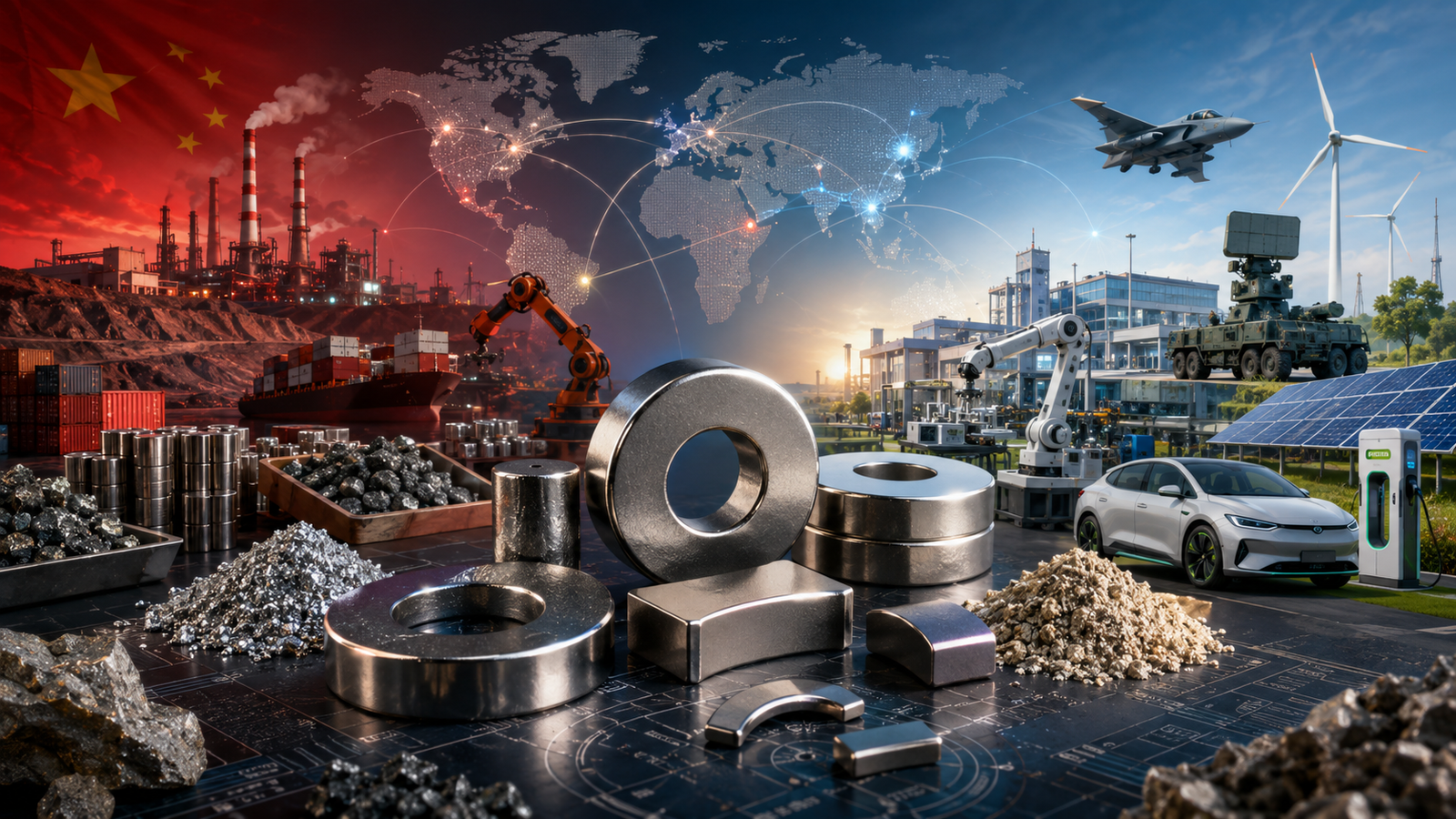
They are used in electric vehicles, wind turbines, drones, missiles, fighter aircraft, smartphones, robotics, medical equipment, satellites and advanced electronics.
In simple words, rare earth magnets are small parts with huge strategic importance.
That is why countries are suddenly worried. The world does not only need oil, gas and semiconductors. It also needs magnets.
Why Rare Earth Magnets Are Trending
Rare earth magnets are trending because China controls a major part of the global supply chain. China is not only strong in mining; it is even more powerful in processing, refining and magnet manufacturing.
This matters because a country may have rare earth reserves, but if it cannot process them and turn them into magnets, it still remains dependent.
Reuters reported that China introduced export controls on certain heavy rare earths and magnets in April 2025, and Japan’s heavy rare earth supply from China remained restricted in June 2026. Japan has the world’s biggest rare earth magnet sector outside China, but still depends on China for some inputs. (reuters.com)
That one fact tells the whole story: even advanced economies are vulnerable.
Why These Magnets Matter for EVs
Electric vehicles need powerful and efficient motors. Many EV motors use rare earth permanent magnets because they provide high performance in a small size.
Without a stable magnet supply, EV production can face delays, higher costs and weaker competitiveness.
This is why India cannot dream of becoming a global EV manufacturing hub while depending too much on imported magnets. Batteries are important, but motors are also critical.
The Government of India has recognized this issue. A PIB release said rare earth magnets are essential for electric vehicle motors and wind turbine generators, both of which are central to India’s clean energy transition and Net Zero 2070 target. (pib.gov.in)
Defence and National Security Angle
Rare earth magnets are not only about cars.
They are used in defence systems, aerospace, radar equipment, precision weapons, drones, submarines, satellites and communication systems. In modern warfare, supply chains are as important as weapons.
If a country depends on another power for critical components, it creates a national security risk.
For India, this is especially important because the country faces a difficult security environment. India cannot depend on uncertain foreign supply chains for technologies linked to defence, energy and mobility.
China’s Real Strength Is Processing
Many people think rare earth dominance is only about having minerals in the ground. That is not true.
The real power lies in the full chain: mining, separation, refining, alloy making, magnet manufacturing and high-quality industrial scaling.
An academic study on rare earth supply chains found that strategic vulnerabilities are often deeper in midstream products such as magnets, ceramics and phosphors, not just raw minerals. The study also noted that China dominates the low-risk, high-influence cluster in rare earth supply networks. (arxiv.org)
This is why India must not stop at mining. It must build the entire ecosystem.
India’s Big Move: ₹7,280 Crore Magnet Scheme
India has now started moving seriously.
The Union Cabinet approved a ₹7,280 crore scheme to promote manufacturing of Sintered Rare Earth Permanent Magnets in India. The goal is to create 6,000 metric tonnes per annum of integrated rare earth permanent magnet manufacturing capacity. (pmindia.gov.in)
This is a major step because it aims to build an integrated domestic ecosystem from oxide feedstock to finished magnets. The International Energy Agency’s policy database also describes the scheme as an effort to establish a fully integrated domestic manufacturing ecosystem for rare earth permanent magnets in India. (iea.org)
This is not just an industrial policy. It is a strategic independence policy.
Why This Is an Evergreen Story
This topic will remain relevant for years because rare earth magnets sit at the center of multiple future industries.
Electric vehicles need them.
Wind turbines need them.
Robotics need them.
Defence systems need them.
Drones need them.
Satellites need them.
AI infrastructure indirectly needs them through clean energy and advanced electronics.
As the world moves toward electrification, automation and clean energy, magnet demand will continue rising.
That means rare earth magnets are not a temporary trend. They are part of the next industrial race.
India’s Challenge
India has talent, demand and policy momentum. But the challenge is execution.
Rare earth processing is technically difficult, capital-intensive and environmentally sensitive. India must build capacity without damaging local communities or ecosystems.
The country also needs skilled engineers, clean processing technology, private-sector participation, recycling systems and partnerships with trusted countries such as Australia, Japan, the United States and Vietnam.
India should also invest in alternatives, including rare-earth-free motor technologies and magnet recycling. The PIB noted that India’s PLI-Auto scheme includes rare earth magnets for electric motors and also promotes alternative rare-earth-free motor technologies. (pib.gov.in)
What This Means for Indian Companies
If India succeeds, the benefits can be huge.
Indian EV makers can reduce supply-chain risk. Defence manufacturers can get more secure components. Wind energy companies can scale faster. Electronics and robotics startups can build locally. India can also become a trusted alternative supplier for the world.
This is how Make in India becomes real: not only assembling final products, but manufacturing the critical components inside them.
Final Thoughts
Rare earth magnets may be small, but they are becoming one of the biggest strategic technologies of the future.
China understood this early and built dominance across the supply chain. Now the world is trying to catch up.
For India, this is both a challenge and an opportunity. If India builds mining, processing, magnet manufacturing, recycling and alternative technologies together, it can reduce dependence and become a serious player in the global clean-tech and defence supply chain.
The next global race will not only be about oil, chips or AI models. It will also be about the hidden components that make modern machines move.
And rare earth magnets are one of the most important hidden components of them all.
FAQs
What are rare earth magnets?
Rare earth magnets are powerful permanent magnets made using rare earth elements such as neodymium and dysprosium. They are used in EVs, wind turbines, electronics, defence systems and robotics.
Why are rare earth magnets important for India?
They are important for India’s electric vehicle industry, renewable energy, defence manufacturing, drones, aerospace and electronics supply chains.
Why does China dominate rare earth magnets?
China built strong capabilities in mining, processing, refining and magnet manufacturing, giving it major control over the global supply chain.
What is India doing to reduce dependence?
India has approved a ₹7,280 crore scheme to build domestic rare earth permanent magnet manufacturing capacity.
Is this topic important for the future?
Yes. Rare earth magnets will remain important as EVs, clean energy, robotics, drones and advanced manufacturing continue to grow.
Disclaimer: This article is for informational and educational purposes only. It does not provide investment, industrial or policy advice. Rare earth supply chains are complex and may change depending on trade rules, technology, environment regulations and global demand.