


































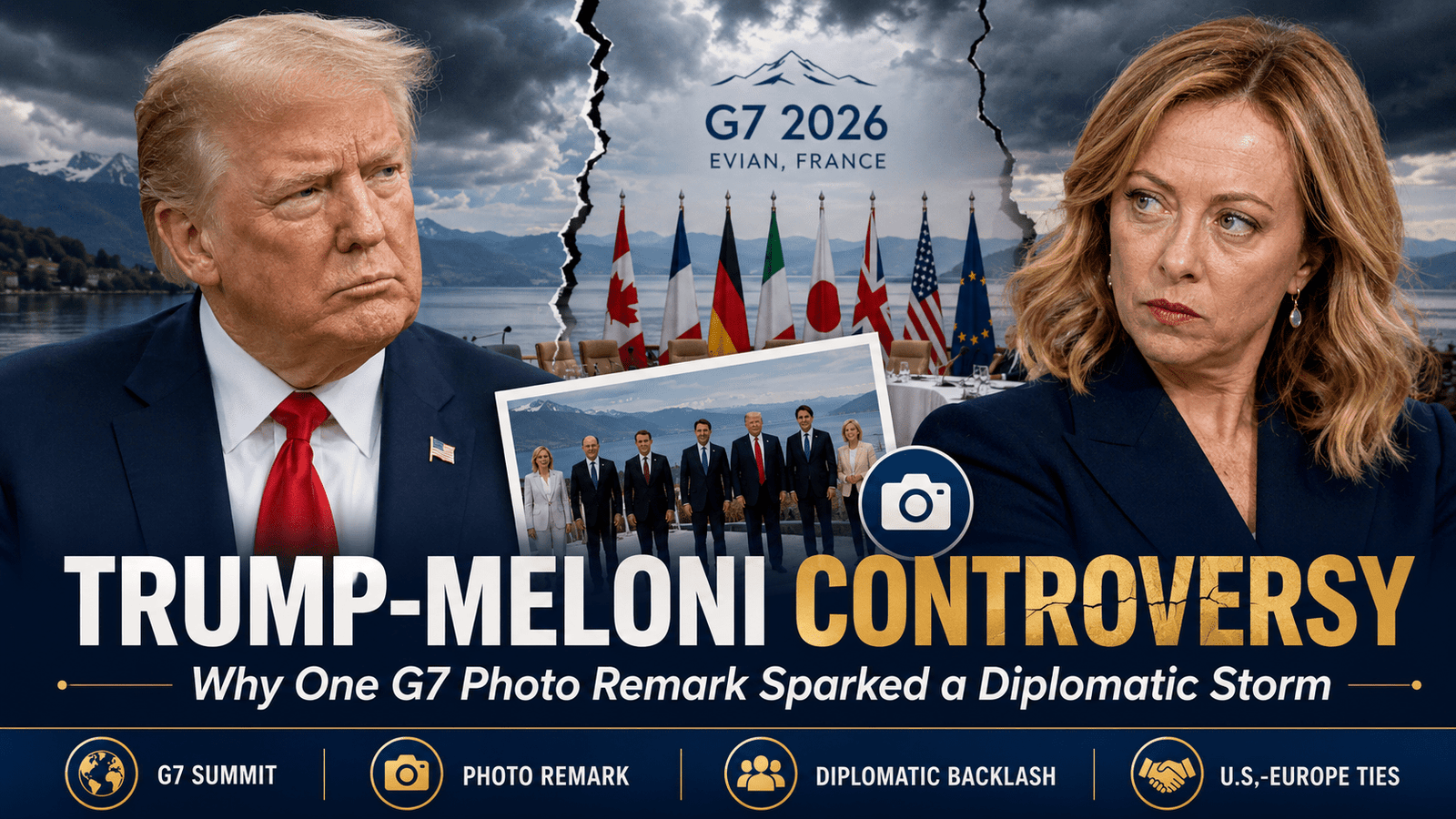

A new controversy between U.S. President Donald Trump and Italian Prime Minister Giorgia Meloni has become one of the most talked-about political moments after the G7 Summit in France. What looked like a small comment about a photo quickly turned into a serious diplomatic issue involving respect, alliance politics and the future of U.S.-Europe relations.
The controversy began after Trump reportedly claimed during an interview with Italian broadcaster La7 that Meloni had “begged” him for a photo during the G7 summit in Évian-les-Bains. The comment immediately triggered anger in Italy, where many saw it as disrespectful not only toward Meloni but toward the country itself.
Meloni responded strongly. In a video message, she rejected Trump’s claim and called it completely fabricated. Her message was clear: Italy is a sovereign country and its leader does not need to beg anyone for recognition.
The reaction did not stop there. Italy’s Foreign Minister Antonio Tajani cancelled a planned visit to the United States, saying Trump’s words were offensive to Italy. Political leaders from across Italy’s spectrum also backed Meloni, showing rare unity in defending the dignity of the Italian government.
Why This Controversy Matters
At first glance, the issue may look like a personal argument between two leaders. But it is much bigger than that.
Meloni was once seen as one of Trump’s closest allies in Europe. She attended his inauguration in 2025 and tried to position herself as a bridge between Washington and the European Union. Both leaders shared conservative political language on migration, national identity and sovereignty.
However, their relationship has been under pressure for months. Differences over Ukraine, tariffs, the Iran conflict and Trump’s criticism of Pope Leo created distance between the two leaders. The G7 photo remark appears to have pushed that tension into the open.
This matters because Italy is a key NATO member, a major European economy and an important U.S. ally. When public disagreements become personal, diplomatic trust can weaken. Strong alliances are not built only on military deals or trade agreements; they also depend on mutual respect.
Meloni’s Strong Response
Meloni’s reply was significant because she did not stay silent. Instead, she directly challenged Trump’s version of events and defended Italy’s national dignity.
Her response may also help her domestically. In Italian politics, critics have often accused Meloni of being too close to Trump. By pushing back publicly, she showed that her support for Western cooperation does not mean accepting personal insults or political pressure.
For many Italians, this was not just about a photograph. It was about whether Italy should be treated as an equal partner by the United States.
A Larger Problem for the West
The controversy comes at a sensitive time for the Western alliance. The U.S., Europe and NATO are already dealing with major challenges: the Russia-Ukraine war, Middle East tensions, trade disputes, migration pressure, energy security and rising political polarization.
At such a moment, public disputes between allied leaders can weaken unity. Rivals of the West may use these moments to argue that the transatlantic alliance is divided.
This is why diplomatic language matters. Leaders can disagree on policy, but personal remarks can damage relationships faster than formal disputes.
What Happens Next?
The Trump-Meloni controversy may not permanently damage U.S.-Italy relations. Both countries have deep military, economic and cultural ties. But it does show that Meloni is no longer willing to quietly absorb Trump’s criticism.
For Trump, the incident may reinforce concerns among European leaders that his style of diplomacy can create uncertainty. For Meloni, it may mark a turning point from being seen as Trump’s European ally to being seen as a more independent leader.
The G7 summit was supposed to focus on global issues such as trade, security, Ukraine, energy and artificial intelligence. Instead, one remark about a photo became a symbol of a bigger question: can Western leaders maintain unity when personal politics keeps getting in the way?
Final Thoughts
The Trump-Meloni controversy is more than political drama. It reflects a deeper struggle inside the Western alliance over respect, leadership and independence.
Meloni’s message was simple: allies should be treated as allies. If the United States and Europe want to remain strong together, their leaders must avoid turning diplomatic differences into personal humiliation.
At a time when the world is facing war, inflation, energy risks and geopolitical competition, the West cannot afford unnecessary divisions. The real test now is whether Trump and Meloni can move beyond the controversy and focus on the larger challenges facing their countries.
Disclaimer: This article is for informational and educational purposes only. It is based on publicly available reports and should not be considered political, legal or diplomatic advice.