














































India Approves Its First Dengue Vaccine: Why Qdenga Could Be a Big Public Health Breakthrough

India Gets Its First Dengue Vaccine
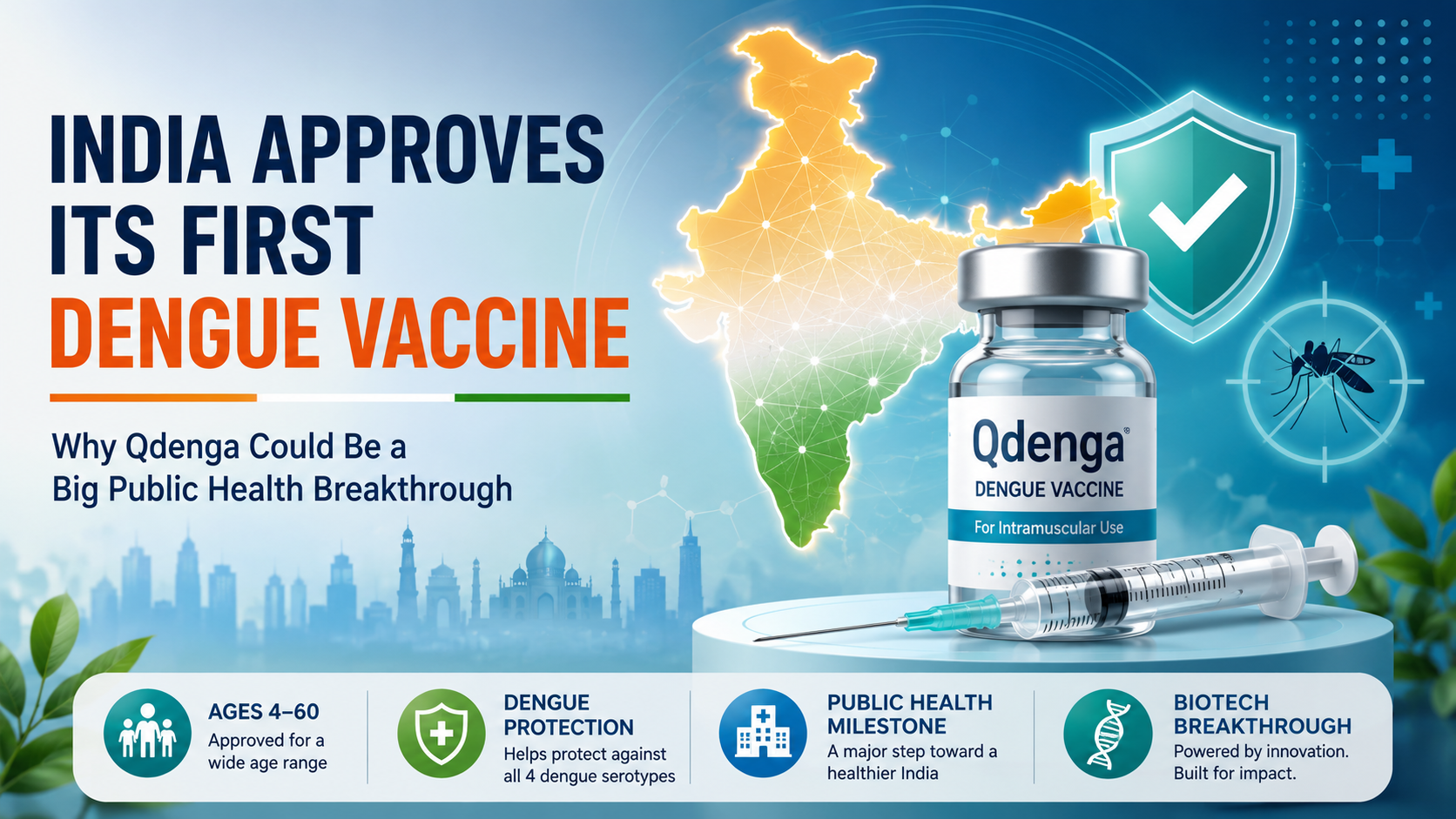
India has taken a major step in public health after the Central Drugs Standard Control Organisation, under the Ministry of Health and Family Welfare, approved Qdenga, India’s first dengue vaccine. The vaccine is manufactured by Takeda GmbH, Germany, and will be imported by Takeda Biopharmaceuticals India.
This is a big moment for India because dengue is no longer a small seasonal illness. It has become a serious urban and rural health threat, especially during and after the monsoon season.
Reuters reported that dengue cases in India rose 11-fold in the past two decades, while the World Health Organization recorded 232,425 dengue cases and 233 deaths in India in 2024.
For families, hospitals and city health departments, this approval could become an important new tool in the fight against dengue.
What Is Qdenga?
Qdenga is a live attenuated tetravalent dengue vaccine. In simple language, it is designed to protect against all four dengue virus types: DENV-1, DENV-2, DENV-3 and DENV-4.
PIB says the vaccine was developed using recombinant DNA technology and is administered as a subcutaneous injection. It has been approved in India for individuals aged 4 to 60 years.
The recommended schedule is two doses of 0.5 ml, given three months apart.
This is important because dengue is complicated. Infection from one dengue type does not guarantee full protection against the others. In some cases, a second dengue infection can be more dangerous.
Why This Approval Is Significant
The biggest significance is that India finally has a regulated dengue vaccine option.
Until now, dengue prevention mainly depended on mosquito control, removing stagnant water, using repellents, early diagnosis and hospital management. Those steps are still essential, but a vaccine adds another layer of protection.
PIB called the approval an important milestone in India’s dengue response and said it will complement vector control, surveillance, early diagnosis and case management under the National Vector Borne Disease Control Programme.
This is the right way to understand the vaccine: it is not a replacement for mosquito control, but it can become a powerful support tool.
How Effective Is Qdenga?
According to Reuters, Qdenga showed 80.2% efficacy against confirmed dengue cases one year after the second dose in a late-stage trial. It also showed 90.4% efficacy against dengue-related hospitalizations after 18 months.
That is significant because hospitalization is one of the biggest burdens of dengue. During outbreaks, hospitals face sudden pressure, families face medical expenses and patients can suffer severe complications.
A vaccine that reduces hospitalization can reduce pressure on both families and the healthcare system.
No Pre-Vaccination Testing Required
One of the biggest advantages of Qdenga is that it can be used regardless of previous dengue exposure.
Reuters reported that Qdenga does not require pre-vaccination testing, unlike Sanofi’s Dengvaxia, which is recommended only for people with prior dengue infection because of safety concerns in some people without previous exposure.
This makes Qdenga easier to use in public health settings, though doctors and health authorities will still decide how it should be rolled out.
Why Dengue Is Becoming a Bigger Threat
Dengue is spreading faster because of urbanization, climate change, waterlogging, poor drainage, travel and mosquito breeding in cities.
The WHO says dengue is now endemic in more than 100 countries, and reported cases rose from 505,430 in 2000 to 14.6 million in 2024.
Takeda has also noted that dengue incidence has increased globally over recent decades due to urbanization, travel and climate change, with Asia carrying a major share of the global burden.
For India, this is especially relevant because monsoon flooding, rapid construction, water storage and dense cities create ideal conditions for mosquito breeding.
India’s Role in Global Vaccine Manufacturing
This story is not only about medicine. It is also about India’s biotech and vaccine manufacturing power.
Takeda partnered with Hyderabad-based Biological E. Limited in 2024 to expand Qdenga manufacturing. Biological E is expected to produce up to 50 million doses per year, helping Takeda reach a global manufacturing target of 100 million doses annually by 2030.
This is important for India’s biotech ecosystem. India is not only a market for vaccines; it is becoming a manufacturing and supply-chain partner for global public health.
After COVID-19, the world already saw India’s strength in vaccine production. Dengue could become another area where India plays a major global role.
When Will It Be Available?
Reuters reported that Takeda expects Qdenga to become available in India in the first half of 2027, initially through private healthcare settings after market authorization.
This means people should not assume the vaccine will be immediately available everywhere. Pricing, supply, doctor guidance and public-health strategy will matter.
Not a Magic Bullet
This vaccine is a breakthrough, but it will not end dengue overnight.
Doctors have warned that Qdenga can help reduce disease severity and hospitalizations, but outbreaks may still continue as long as mosquitoes keep spreading the virus.
That means India must continue the basics: clean stagnant water, control mosquito breeding, improve drainage, strengthen surveillance, diagnose early and treat patients properly.
A vaccine plus mosquito control is stronger than either one alone.
Final Thoughts
India’s approval of Qdenga is one of the biggest public health and biotech developments of 2026.
It gives India its first approved dengue vaccine, creates new hope for families living in high-risk regions and strengthens the country’s fight against a disease that is becoming more unpredictable every year.
The real success will depend on safe rollout, affordability, doctor awareness, public trust and continued mosquito control.
Dengue has become a modern climate-health challenge. India’s first dengue vaccine is not the final answer, but it is a major step forward.
FAQs
What is India’s first dengue vaccine?
India’s first approved dengue vaccine is Qdenga, developed by Takeda.
Who can take Qdenga in India?
It has been approved for individuals aged 4 to 60 years.
How many doses are required?
The vaccine is given in two doses of 0.5 ml each, three months apart.
Does Qdenga protect against all dengue types?
Yes. It is a tetravalent vaccine designed against all four dengue virus serotypes.
Will the vaccine stop dengue outbreaks completely?
No. It can help reduce disease and hospitalization, but mosquito control and early diagnosis remain essential.
Disclaimer: This article is for informational and educational purposes only. It is not medical advice. Dengue vaccination decisions should be made only after consulting a qualified doctor or public health authority. People should continue mosquito-control measures even after vaccine approval.