




































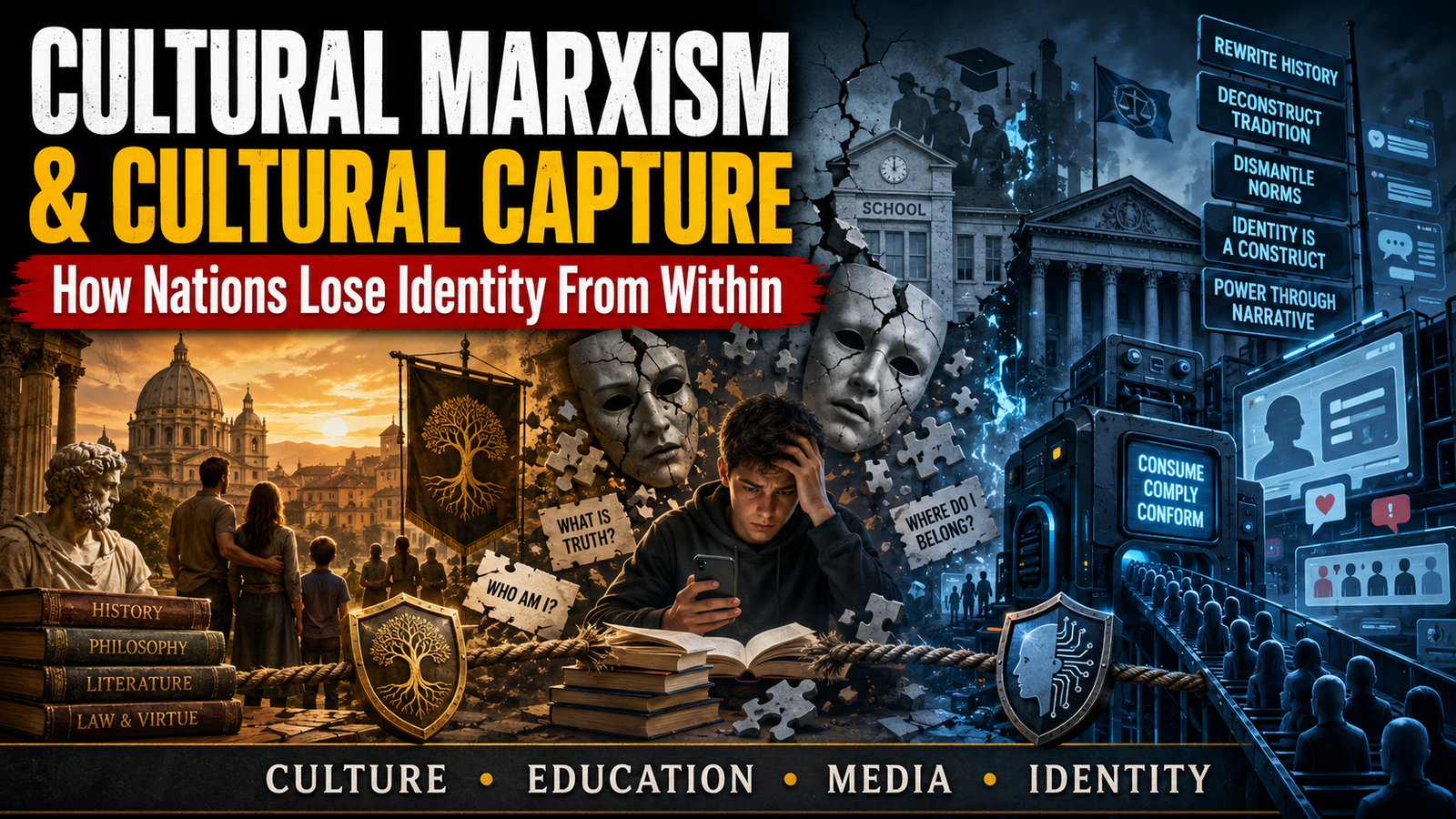

A civilization rarely disappears in a single dramatic moment. More often, it weakens gradually—when younger generations begin seeing their history only as a source of shame, traditions are treated as backward, religious faith is reduced to superstition, and inherited social institutions lose legitimacy.
Critics commonly describe this process as “Cultural Marxism.” They argue that when economic revolution fails, political activists shift their attention to culture—capturing universities, media, entertainment and civil society to reshape how people understand family, religion, gender, history and national identity.
But the phrase is also deeply controversial. Many researchers consider the popular idea of a centrally coordinated “Cultural Marxist” campaign to be an unproven conspiracy theory. Therefore, a serious discussion must separate three different things:
- The genuine intellectual history of Marxist cultural criticism
- Modern ideological activism inside institutions
- Documented foreign influence and information operations
Blending all three into one hidden global plot may attract attention, but it replaces evidence with speculation. The real threat of cultural capture, however, deserves careful examination.
What Does Cultural Marxism Actually Mean?
Traditional Marxism primarily interpreted history through economic class conflict between workers and owners. During the twentieth century, scholars associated with the Frankfurt School expanded Marxist analysis into culture, mass communication, authority, family and social institutions.
Thinkers such as Antonio Gramsci also argued that political power depends partly on cultural hegemony—the ability of influential institutions to define what society considers normal, respectable and true.
These ideas influenced academic disciplines, though modern progressive movements cannot all be traced to a single school or coordinated organization.
Today, “Cultural Marxism” is used far more broadly. It has become a political label for developments such as identity politics, hostility toward traditional religion, radical reinterpretations of history, censorship and the portrayal of national culture as inherently oppressive.
Academic researchers warn that the broader claim—that a small intellectual group secretly planned to destroy civilization by capturing its institutions—is unsupported and sometimes overlaps with older extremist narratives. Cambridge University Press describes this interpretation as a widely travelled conspiracy theory.
That does not mean cultural conflict is imaginary. It means criticism should target identifiable ideas, policies, funding networks and institutional decisions—not an undefined enemy blamed for everything.
How Cultural Alienation Can Weaken a Society
Every healthy society must be able to examine its mistakes. Slavery, caste discrimination, communal violence, colonial collaboration and discrimination against women should not be hidden.
But education becomes ideological when history is taught only as an indictment of the civilization itself.
There is an important difference between teaching:
“Our society committed injustices, and reformers fought to correct them.”
and teaching:
“Your culture is fundamentally oppressive, and liberation requires rejecting it.”
The first approach creates informed citizens. The second can create cultural alienation.
Young people who learn only their country’s failures may start believing that everything inherited from previous generations is morally contaminated. Meanwhile, other civilizations may be presented only through their achievements, producing a distorted comparison.
A nation that cannot admire anything in its past eventually struggles to imagine a shared future.
The Education System Is the Critical Battleground
Education does more than prepare students for employment. It shapes their understanding of justice, history, citizenship and belonging.
Ideological capture can occur when:
- One political interpretation is presented as unquestionable truth
- Students fear disagreeing with fashionable opinions
- Indigenous intellectual traditions are ignored
- Historical figures are judged without acknowledging their time and circumstances
- National identity is reduced entirely to oppression
- Activism replaces research, evidence and open debate
India’s National Education Policy 2020 attempts to balance modern learning with a system “rooted in Indian ethos.” It supports multilingual education, critical thinking, Indian knowledge systems and familiarity with the country’s cultural heritage. India’s Ministry of Education also maintains an initiative devoted to integrating Indian knowledge traditions into education.
From Foreign Funding to Political Influence
Foreign funding is not automatically illegitimate. International partnerships finance valuable work in healthcare, disaster relief, education, scientific research and poverty reduction.
The danger emerges when money is hidden, politically conditioned or used to manufacture domestic consent for an external objective.
Foreign influence may operate through:
- Media outlets and online personalities
- Research grants and advocacy organizations
- Scholarships, fellowships and academic networks
- Religious or humanitarian institutions
- Political consultancies and front organizations
- Coordinated disinformation campaigns
- Fake social-media accounts that intensify existing divisions
India regulates certain overseas funding through the Foreign Contribution (Regulation) Act, particularly where foreign contributions intersect with political, social, educational or religious activity.
India and other Quad countries have formally recognized foreign information manipulation and interference as a threat that can undermine trust and sow social discord. Their joint statement calls for greater cooperation against these tactics. Ministry of External Affairs
This is not merely theoretical. States across the ideological spectrum conduct influence operations. They may promote conflicting narratives simultaneously—not because they support either side, but because social polarization weakens the targeted country.
Is Cultural Activism a Tool for Regime Change?
Culture can become part of a regime-change strategy, but cultural disagreement alone is not proof of a foreign operation.
External actors may attempt to exploit unemployment, corruption, ethnic tensions, religious conflict or public anger. They can fund sympathetic networks, amplify selected grievances and portray every institutional failure as evidence that the entire state has lost legitimacy.
Research by RAND found that foreign disinformation campaigns can divide, intimidate and discredit societies. However, it also found limited evidence that such campaigns easily change deeply held beliefs; their long-term strategic effects remain uncertain. RAND’s study on foreign disinformation suggests that hostile influence usually exploits existing divisions rather than creating them from nothing.
A typical destabilization pattern may look like this:
- Identify a genuine social grievance.
- Remove it from its historical or economic context.
- Present the problem as proof that the entire civilization is illegitimate.
- Divide society into permanent oppressor and victim identities.
- Discredit courts, elections, media and every constitutional institution.
- Encourage confrontation while offering no workable post-crisis plan.
Yet governments must not misuse “foreign influence” as a blanket accusation against peaceful critics. Citizens have the right to question authority, organize, protest and demand accountability. Evidence—not political convenience—must distinguish legitimate dissent from covert interference.
Religion Is Often Targeted—But Also Politicized
Religion carries memory, ethical traditions, community networks and a sense of continuity. For that reason, it can become a target during ideological conflicts.
Religious communities may be portrayed as uniformly irrational or oppressive. At the opposite extreme, political groups may exploit religion to silence criticism, spread hostility or demand unquestioning loyalty.
Both approaches weaken society.
A durable civilization protects religious freedom while preserving the right to debate religious institutions. It neither teaches young people to hate their faith nor forces them to accept every practice simply because it is old.
Tradition should be capable of reform without being erased.
The “Perfect Society” That Exists Only on Paper
Radical ideologies frequently promise a world without hierarchy, discrimination or inequality. These goals can sound morally compelling. The danger begins when achieving them supposedly requires destroying every inherited institution before a workable replacement exists.
On paper, the new society appears perfectly inclusive. In reality, it may produce:
- Conformity disguised as tolerance
- Censorship presented as protection
- Political loyalty presented as education
- Social fragmentation presented as empowerment
- Fear of disagreement presented as harmony
A society becomes hollow when citizens repeat approved slogans publicly but are afraid to express honest thoughts privately.
Real pluralism does not mean everyone reaches the same conclusion. It means people with different conclusions can live together without being dehumanized.
How India Can Protect Its Cultural Sovereignty
India does not need isolation from the world. It needs the confidence to engage globally without surrendering intellectual independence.
Practical safeguards should include:
- Transparent disclosure of foreign funding
- Independent audits of politically active organizations
- Strong media-literacy education
- Greater study of Indian philosophy, science, literature and constitutional history
- Academic freedom for both progressive and conservative scholars
- Support for Indian-language publishing and digital platforms
- Clear evidence before accusing an individual or organization
- Constitutional protection for peaceful dissent and religious freedom
Most importantly, India must make its culture meaningful to young people. Heritage cannot survive through compulsory slogans alone. It survives when children encounter it through engaging literature, festivals, philosophy, music, family stories, local languages and honest history.
Final Verdict: Defend Culture Without Inventing Enemies
The popular “Cultural Marxism” narrative oversimplifies a complicated reality. There is no convincing evidence that every progressive movement, university debate or criticism of tradition belongs to one centrally directed conspiracy.
But the underlying concerns—cultural alienation, ideological conformity, opaque foreign funding, institutional capture and information warfare—are real and deserve democratic scrutiny.
A confident civilization neither hates its past nor hides its failures. It teaches both achievement and injustice. It allows reform without demanding self-erasure. It welcomes foreign ideas without allowing foreign interests to secretly control domestic debate.
The strongest defence against manipulation is not censorship. It is a population that understands its history, respects its roots, questions every ideology and refuses to let either outsiders or domestic political groups weaponize its divisions.
Frequently Asked Questions
Is Cultural Marxism a real ideology?
Marxist cultural theory is real, and thinkers such as Gramsci and the Frankfurt School studied culture and institutions. However, the claim that they created a centrally coordinated plan to destroy civilization is not supported by reliable historical evidence.
Can foreign funding influence education and culture?
Yes. Funding can shape research priorities, advocacy and public narratives. It can also support legitimate humanitarian and educational work. Transparency and examination of specific evidence are therefore more useful than assuming all overseas funding is malicious.
How do foreign influence operations divide societies?
They often amplify existing grievances, promote misleading narratives, impersonate citizens and encourage distrust between social groups. Their objective may be polarization rather than support for one consistent ideology.
Does protecting culture mean opposing social reform?
No. Cultures remain strong by correcting injustice while preserving civilizational continuity. Reform and cultural confidence can coexist.
Should controversial political ideas be banned from universities?
Generally, no. Universities should expose students to competing ideas and teach them how to challenge claims using evidence. Open debate is a stronger safeguard than ideological censorship.
Disclaimer: This article examines a contested political concept. It does not allege wrongdoing by any person, religion or organization without specific evidence.