







































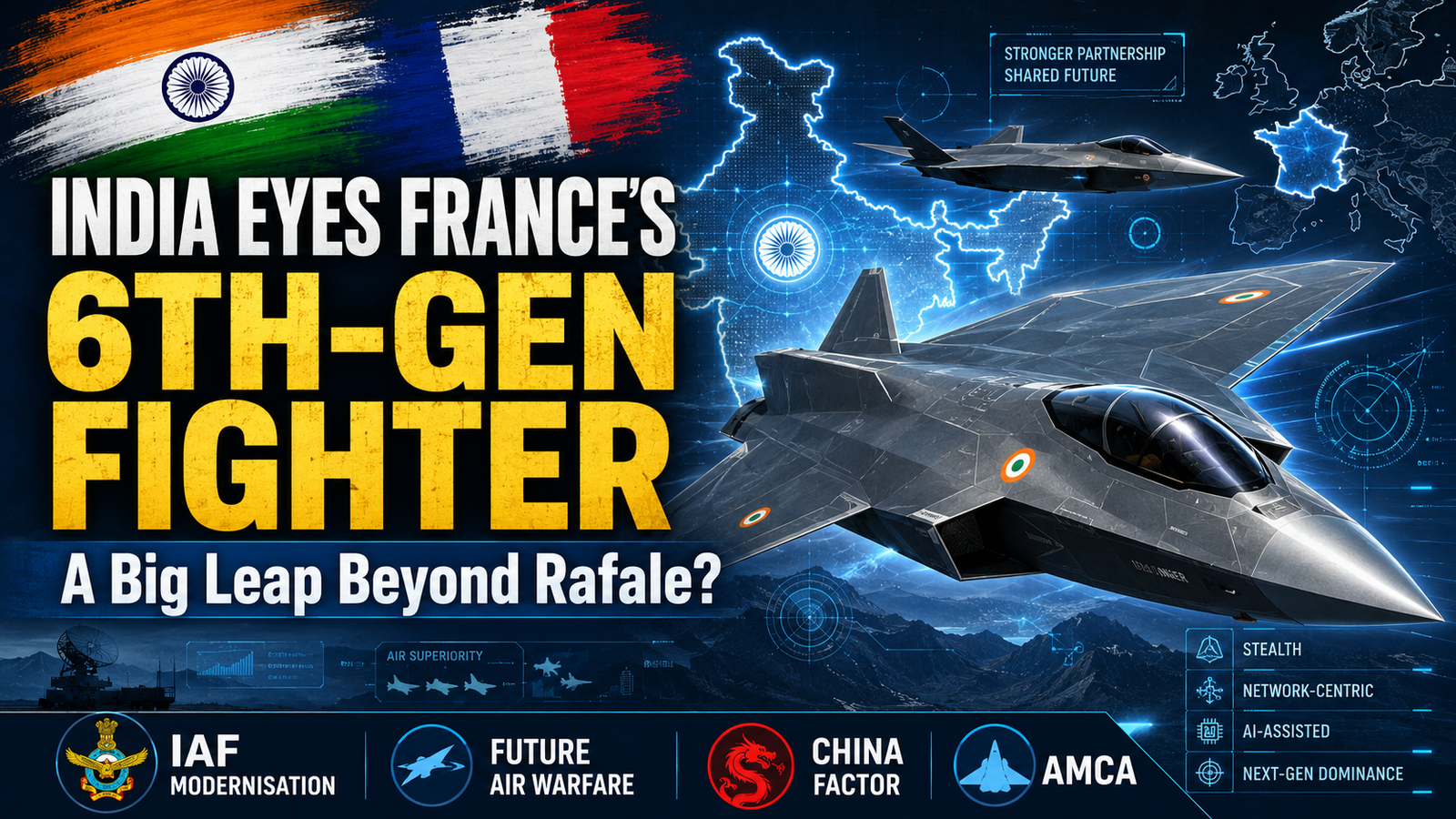
India Eyes France’s Sixth-Generation Fighter Programme: A Big Leap Beyond Rafale?

India Looks Beyond Today’s Fighter Jets
India is preparing for the next era of air warfare.
According to recent reports, the Defence Ministry has informed a parliamentary panel that it has initiated efforts to join the French-led Future Combat Air System, or FCAS, a sixth-generation fighter aircraft development programme. Economic Times reported that India has formally started efforts to explore joining the programme spearheaded by the French government.
This is a major development because India is not only thinking about buying aircraft anymore. It is thinking about co-development, technology access and future air dominance.
After the Rafale success, India-France defence cooperation may now move into a much bigger space: sixth-generation combat aircraft.
What Is a Sixth-Generation Fighter?
A sixth-generation fighter is not just a more advanced jet. It is a complete air-combat ecosystem.
Airbus describes FCAS as a “system of systems” where piloted New Generation Fighters work with uncrewed remote carriers and connect with platforms in space, air, land, sea and cyberspace through a data network called the Combat Cloud.
Dassault Aviation has also described FCAS as a system involving New Generation Fighters, Remote Carriers and a Combat Cloud, showing that the future fighter will not fight alone.
In simple words, the fighter pilot of the future may not just fly one aircraft. He or she may control drones, share battlefield data, use AI support and operate inside a connected combat network.
That is why sixth-generation technology matters.
Why India Is Interested in France
France is one of India’s most trusted defence partners.
India already operates the Rafale fighter, and France completed delivery of 36 Rafale aircraft to India in 2022. The India-France defence relationship also includes the P-75 Scorpene submarine project, where the sixth submarine was commissioned into the Indian Navy in January 2025.
In February 2026, Defence Minister Rajnath Singh and French Armed Forces Minister Catherine Vautrin co-chaired the 6th India-France Annual Defence Dialogue in Bengaluru, where both sides reviewed regional security and defence-industrial cooperation.
This background matters because sixth-generation aircraft development requires deep trust. It involves engines, sensors, stealth, weapons, software, data links, AI, electronic warfare and intellectual property.
India will not want to remain only a buyer. It will want real technology participation.
Rafale Deal Creates a Strong Base
The timing is also important because India is moving closer to a possible deal for 114 Rafale fighters.
France has submitted a detailed technical and commercial proposal to India for the proposed government-to-government purchase of 114 Rafale multirole fighter jets. Economic Times reported that the proposal includes large-scale local manufacturing.
This could deepen the India-France aerospace relationship even more.
If India buys more Rafales and also explores FCAS cooperation, the long-term logic becomes clear: Rafale can strengthen the Indian Air Force in the near and medium term, while FCAS can prepare India for the 2040s battlefield.
What About India’s Own AMCA?
India is already developing the Advanced Medium Combat Aircraft, or AMCA, which is expected to become India’s indigenous fifth-generation stealth fighter.
So the big question is: why does India need FCAS if AMCA exists?
The answer is simple: AMCA and FCAS are not the same.
AMCA is India’s national fifth-generation fighter project. FCAS is a future sixth-generation air-combat ecosystem involving manned aircraft, drones, combat cloud, AI and next-generation sensors.
India should not abandon AMCA. In fact, AMCA is essential for India’s self-reliance. But joining or learning from a sixth-generation programme can give India exposure to technologies that may be needed after AMCA.
This is not about choosing one path. It is about reducing future risk.
China Factor: Why India Cannot Wait
India’s security environment is becoming more complex.
China is investing heavily in next-generation aircraft, stealth technology, drones, missiles and electronic warfare. Pakistan is also modernising its air force with Chinese support.
India cannot afford to think only in terms of today’s battlefield.
Future wars may involve stealth aircraft, loyal-wingman drones, AI-assisted targeting, hypersonic weapons, satellite networks and electronic attacks. A country that waits too long may face a technology gap that becomes difficult to close.
That is why India’s interest in FCAS is strategically important. It shows that New Delhi does not want to enter the sixth-generation race late.
The Big Opportunity for Make in India
If handled properly, FCAS cooperation could benefit Indian industry.
India should push for joint research, component manufacturing, avionics, sensors, software, AI systems, unmanned platforms, maintenance ecosystems and engine-related work.
The biggest mistake would be to participate only as a customer.
India must seek real workshare, technology access and industrial capability. The goal should be to strengthen Indian companies, DRDO, HAL, private defence firms and aerospace startups.
A sixth-generation fighter programme can create high-value jobs, advanced manufacturing and a stronger defence supply chain inside India.
The Risks India Must Watch
India should be ambitious, but also careful.
Sixth-generation fighter programmes are extremely expensive, slow and politically complicated. Europe’s FCAS programme has already faced industrial disputes between major partners. Reuters reported that Airbus and Dassault have had a deadlock over Europe’s next warplane, even as FCAS system elements such as combat cloud and drones continue to move forward.
India must therefore ask tough questions before joining any programme.
Will India get real technology?
Will Indian companies get meaningful workshare?
Will the aircraft meet Indian Air Force needs?
Will costs remain under control?
Will it support AMCA, or distract from it?
India should not enter any partnership blindly. It must negotiate from strength.
Why This Matters for the Indian Air Force
The Indian Air Force needs modernisation.
India needs fighters for today, stealth capability for tomorrow and sixth-generation planning for the future. That means Rafale, Tejas Mk1A, Tejas Mk2, AMCA and future systems must all fit into a clear roadmap.
FCAS can become one part of that roadmap if India gets the right terms.
The future of air power will not be decided only by the number of aircraft. It will be decided by sensors, networks, missiles, drones, stealth, software and electronic warfare.
That is why India’s interest in France’s sixth-generation programme is not just a defence purchase story. It is a national technology story.
Final Thoughts
India’s interest in joining France’s sixth-generation fighter programme is a bold signal.
It shows that India is thinking beyond Rafale, beyond today’s jets and beyond short-term procurement. New Delhi understands that future air warfare will be fought through networks, drones, AI, stealth and combat cloud systems.
But India must be careful. The country should not become only a funder or buyer in a foreign project. It must demand co-development, real technology sharing and meaningful industrial participation.
AMCA must remain India’s national priority. FCAS cooperation should strengthen India’s future capabilities, not weaken domestic self-reliance.
If India negotiates smartly, a France-India sixth-generation fighter partnership could become one of the most important defence collaborations of the next two decades.
The message is clear: India does not want to chase the future of air warfare. India wants to help build it.
FAQs
What is FCAS?
FCAS stands for Future Combat Air System. It is a next-generation air-combat programme involving a fighter aircraft, drones, sensors and a combat cloud network.
Is India joining France’s sixth-generation fighter programme?
Reports say India has initiated efforts to explore joining the French-led FCAS sixth-generation fighter programme, but final terms are not yet confirmed.
Is FCAS better than Rafale?
FCAS is a future sixth-generation air-combat system, while Rafale is a current-generation multirole fighter. They serve different timelines and roles.
What happens to India’s AMCA project?
AMCA should remain India’s indigenous fifth-generation fighter priority. FCAS cooperation could help India prepare for future sixth-generation technologies.
Why is France important for India’s defence?
France is a trusted defence partner of India, with cooperation including Rafale fighters, Scorpene submarines and growing aerospace-industrial ties.
Disclaimer: This article is for informational and editorial commentary only. It is based on publicly available reports and official sources. Defence programmes, negotiations and timelines may change.