























PM Modi’s Independence Day Speech 2026: AI Skills, Free Coaching and a Seven-Pillar Plan for Viksit Bharat

Prime Minister Narendra Modi used his 2026 Independence Day address to deliver a clear message: India must stop thinking small.
Speaking from the Red Fort on India’s 80th Independence Day, the Prime Minister placed youth, self-reliance, manufacturing, technology and national security at the centre of his vision for a developed India by 2047.
The address was both a review of the government’s record and a roadmap for the future. Its most important message was that India cannot become a global power by remaining only a market for foreign products—it must become a creator, manufacturer and exporter.
Here are the biggest highlights from PM Modi’s Independence Day speech 2026.
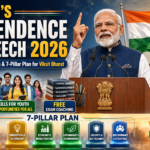
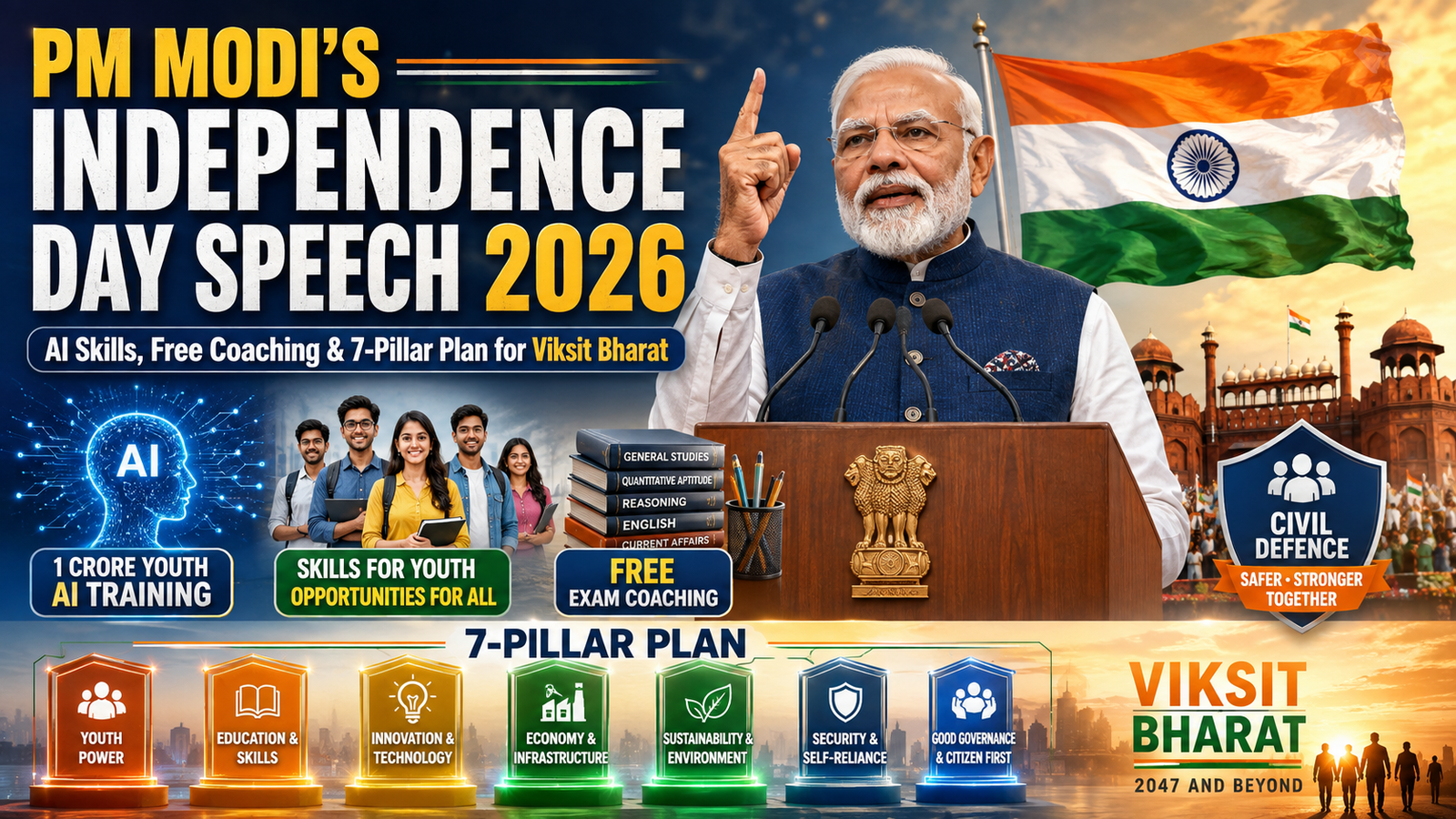
One Crore Young Indians to Receive AI Training
One of the most significant announcements concerned artificial intelligence.
PM Modi said the government would train one crore young Indians in AI skills within one year. The initiative is intended to prepare students and workers for opportunities emerging in automation, data science and other technology-driven sectors.
This announcement recognizes an important reality: AI will transform employment across the world. India’s advantage will depend not only on having a young population, but also on equipping that population with relevant skills.
The Prime Minister urged India to become an innovation hub in AI, quantum technology, robotics, space and next-generation communications—not merely a consumer market for technologies created elsewhere. Read the official PMO transcript.
Free Online Coaching for Competitive Examinations
PM Modi also addressed the growing financial pressure that coaching institutes place on middle-class and lower-income families.
He announced plans to build a nationwide digital network offering free online coaching for competitive examinations. The platform would combine India’s digital infrastructure with experienced teachers and educational resources.
If implemented effectively, the programme could benefit students who cannot afford expensive coaching or relocate to major education centres. However, its success will depend on teaching quality, multilingual accessibility and reliable internet access.
The Seven Pillars of Viksit Bharat
The central framework of the speech was “Sapta Dhara,” or seven streams of national strength. PM Modi identified seven areas that he believes can power India’s journey towards Viksit Bharat:
- Manufacturing
- Agriculture and food processing
- Technology and innovation
- Gati Shakti and modern infrastructure
- Defence power
- Green and blue economies
- India’s cultural and creative soft power
For manufacturers and MSMEs, his message was especially direct: Indian products must compete globally on cost, quality and scale.
He called for complete domestic value chains—from design and small components to finished products—and urged Indian companies to treat quality as the foundation of their global reputation.
Semiconductors, Nuclear Power and Energy Security
Self-reliance was the thread connecting almost every major section of the speech.
PM Modi said three semiconductor plants had begun operations and suggested that another five to eight plants could become operational over the next seven to eight years.
He also reaffirmed India’s target of achieving 100 gigawatts of nuclear-power capacity by 2047 and announced the goal of starting five new nuclear reactors within the current decade.
The broader message was that India’s digital future requires energy security. AI systems, data centres, factories and electric transportation will all demand reliable electricity on an enormous scale.
New Push for Defence and Civil Preparedness
The Prime Minister argued that India must become a global supplier of advanced defence technology. He specifically emphasized indigenous drones, counter-drone systems, cybersecurity and hypersonic defence capabilities.
Recognizing that modern conflicts can target banks, refineries, factories and data centres—not only military installations—he announced plans to establish a large voluntary civil-defence network equipped for contemporary emergencies.
This could become an important reform if it provides citizens with practical training for cyberattacks, natural disasters, infrastructure failures and other national crises.
Sports Talent Hunt for Children
PM Modi also announced a nationwide sports talent-identification programme for children between the ages of five and 15.
The campaign will search villages, cities and schools for young athletes who can receive specialized training. The initiative is linked to India’s ambition to host the 2036 Olympic Games and improve participation in sports where the country currently has limited representation.
Rather than focusing only on winning medals at the next tournament, the proposed programme attempts to build a long-term athletic pipeline.
Six Crore Lakhpati Didis
Women’s economic participation received prominent attention.
PM Modi said the country had crossed its target of creating three crore “Lakhpati Didis”—women associated with self-help groups who earn at least ₹1 lakh annually—and announced a new target of six crore.
He also appealed to political parties to support the implementation of 33% representation for women in the Lok Sabha and state legislative assemblies.
Naxalism, Security and National Unity
The Prime Minister declared that armed Naxalism was approaching its end, while warning that extremist ideologies could still encourage violence and disorder.
He described peace and development in formerly affected regions as a major national achievement. At the same time, the speech’s language about ideological supporters will attract political debate. Democratic criticism and peaceful dissent must remain distinct from advocacy of violence.
The strongest approach is one that protects national security while preserving the constitutional freedom to question governments and public policy.
The Larger Message: India Must Think Bigger
Beyond individual announcements, the speech was an appeal for greater national ambition.
PM Modi asked why India should not have 50 companies among the Fortune 500, a bank among the world’s five largest, globally recognized pharmaceutical companies and Indian leaders in consulting, accounting and technology.
His conclusion was simple: the next phase of India’s development cannot be delivered by government alone. States, businesses, institutions and citizens must participate.
Whether every target is achieved will depend on execution, investment, transparent governance and measurable outcomes. But the direction of the speech was unmistakable—India should no longer be satisfied with catching up. It should aim to lead.
Frequently Asked Questions
What were the biggest announcements in PM Modi’s 2026 Independence Day speech?
The major announcements included AI training for one crore young people, free online coaching for competitive examinations, a children’s sports talent hunt, a modern civil-defence volunteer network and a target of six crore Lakhpati Didis.
What is Sapta Dhara?
Sapta Dhara is PM Modi’s seven-part framework for Viksit Bharat. It covers manufacturing, agriculture, technology, infrastructure, defence, the green and blue economies, and Indian soft power.
What did PM Modi say about Viksit Bharat?
He reaffirmed the goal of transforming India into a developed nation by 2047 and called for faster reforms, self-reliance and greater citizen participation.
What did the Prime Minister announce about AI?
He announced a programme to train one crore Indian youth in artificial-intelligence skills within one year.
Final Takeaway
PM Modi’s Independence Day speech was not built around a single scheme. It presented a wider national strategy—train the youth, strengthen domestic industry, secure critical technologies, modernize defence and compete globally.
The real test will now move from the Red Fort to implementation.
Editorial Note: Government achievements and numerical claims in this article are attributed to the Prime Minister’s official address. Future targets and programmes remain subject to implementation and subsequent policy details.
