

















































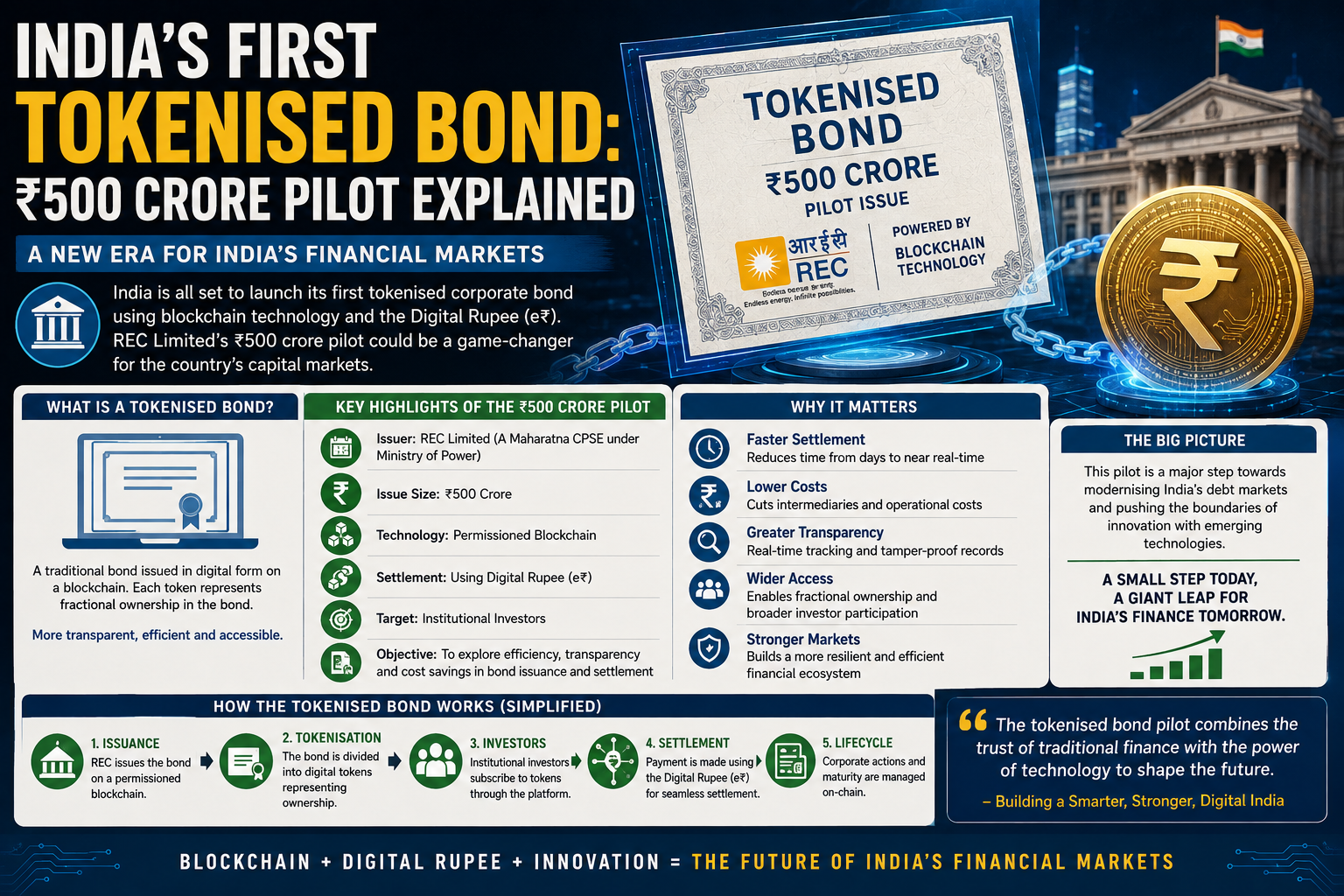

India’s First Tokenised Bond: How the ₹500 Crore Pilot Could Transform Finance
India is reportedly preparing to launch its first tokenised corporate bond—an important experiment that could bring blockchain technology and the Reserve Bank of India’s digital rupee into the country’s regulated financial market.
State-owned power-sector financier REC is expected to issue tokenised bonds worth less than ₹500 crore in September 2026. The pilot will initially be available only to selected investors.
Although modest in size, the project could change how Indian bonds are issued, purchased and settled.
What Is a Tokenised Bond?
A corporate bond is effectively a loan made by investors to a company. In return, the company agrees to pay interest and repay the principal according to the bond’s terms.
A tokenised bond offers the same basic financial rights, but its issuance, ownership and transfer are recorded digitally using blockchain or distributed-ledger technology.
It should not be confused with an unregulated cryptocurrency. The proposed Indian instrument would remain a regulated corporate security operating under the country’s financial-market framework.
What Do We Know About India’s Pilot?
According to an August 24 Reuters report, REC will issue less than ₹500 crore in tokenised bonds as part of the pilot.
The reported framework includes:
- Settlement using India’s wholesale central bank digital currency
- A new securities wallet known as DEMAT 2.0
- Participation limited to selected investors
- An initial three-month lock-in period
- A possible secondary market beginning in December 2026
Investors would reportedly need two compatible accounts: a wholesale CBDC wallet supplied by a bank and a securities wallet containing the tokenised bond.
The Reserve Bank of India and Securities and Exchange Board of India are said to be working together on the experiment. SEBI’s 2025–26 annual report also confirms plans for a corporate-bond tokenisation pilot.
However, RBI, SEBI and REC had not publicly confirmed all the reported operational details at the time of publication.
How Could the Digital Rupee Be Used?
India’s wholesale digital rupee, or CBDC-W, is designed mainly for transactions between regulated financial institutions.
In the proposed system, an investor could pay for the digital bond using the wholesale CBDC. The bond token and digital money could then be exchanged almost simultaneously.
This process is known as delivery-versus-payment. It can reduce the risk of one party transferring money while the other fails to deliver the security.
Traditional bond transactions already use regulated settlement infrastructure. The pilot will test whether distributed-ledger technology can make this process faster and more efficient.
Why This Development Matters
Faster settlement
Blockchain-based records could allow bond transactions to settle almost instantly instead of passing through several stages of reconciliation.
Lower operating costs
Automating ownership records, payments and compliance checks may reduce manual processing and administrative expenses.
Greater transparency
A shared digital ledger can create a traceable record of transactions, making it easier for authorised participants and regulators to verify ownership.
Programmable financial products
Smart contracts could eventually automate interest payments, maturity settlements and certain compliance requirements.
Stronger use case for the digital rupee
The pilot gives India’s wholesale CBDC a practical purpose beyond conventional interbank transfers. It could demonstrate how digital sovereign money can settle tokenised financial assets.
Will Ordinary Investors Be Able to Buy These Bonds?
Not initially.
The first issue is reportedly restricted to selected investors because regulators need to evaluate security, settlement, liquidity and operational risks before considering wider access.
Retail investors should also remember that tokenisation does not remove normal bond risks. The issuer could still face financial difficulties, interest-rate movements could affect value, and a limited secondary market could make selling difficult.
A bond does not become safer merely because it is recorded on a blockchain.
Challenges India Must Address
Before tokenised securities can enter the mainstream, regulators will need to address several issues:
- Cybersecurity and protection of digital wallets
- Legal recognition of blockchain ownership records
- Compatibility between banks, exchanges and depositories
- Investor grievance and recovery mechanisms
- Privacy of financial transactions
- Liquidity in the secondary market
- Reliability of smart-contract software
India already has mature demat and payment systems. Therefore, tokenisation must demonstrate clear improvements rather than introduce unnecessary technological complexity.
Could India Become a Global Tokenised-Finance Hub?
Financial centres in Europe, Singapore and Hong Kong are already experimenting with tokenised bonds and digital settlement.
India brings several advantages to this competition: a large financial market, advanced digital-payment infrastructure, growing domestic capital and an active CBDC programme.
If the REC pilot succeeds, tokenisation could eventually expand to government securities, corporate debt and other regulated assets. Wider adoption, however, will depend on the results of the pilot and subsequent regulatory decisions.
Conclusion
India’s first tokenised-bond pilot could mark the beginning of a new chapter in the country’s financial infrastructure.
Its importance is not the reported ₹500 crore issue size. The real significance lies in testing whether blockchain, digital securities wallets and sovereign digital currency can work together inside a regulated market.
If the technology delivers faster settlement, lower costs and strong investor protection, India could become an important global centre for tokenised finance. But regulators must proceed carefully because innovation without security and legal clarity can create new risks.
Frequently Asked Questions
What is India’s first tokenised bond?
It is a reported corporate-bond pilot in which issuance, ownership and settlement will be recorded using distributed-ledger technology.
Which company will issue the bond?
State-owned power-sector financier REC is expected to issue bonds worth less than ₹500 crore.
Is a tokenised bond a cryptocurrency?
No. It is a conventional financial security represented digitally on a regulated blockchain or distributed ledger.
Can retail investors buy it?
The initial pilot is reportedly limited to selected investors. Wider public participation has not been announced.
What is DEMAT 2.0?
DEMAT 2.0 is the reported name of a new electronic securities wallet being developed to hold tokenised bonds.
Disclaimer: This article is for news and educational purposes only and does not constitute financial or investment advice. Pilot details are based partly on media reports and may change until officially confirmed by RBI, SEBI and REC. Investors should review official documents and consult a qualified financial adviser before making investment decisions.