











































CIA Chief Visits Moscow as Russia Threatens UK: Is Putin Preparing to Attack Britain?
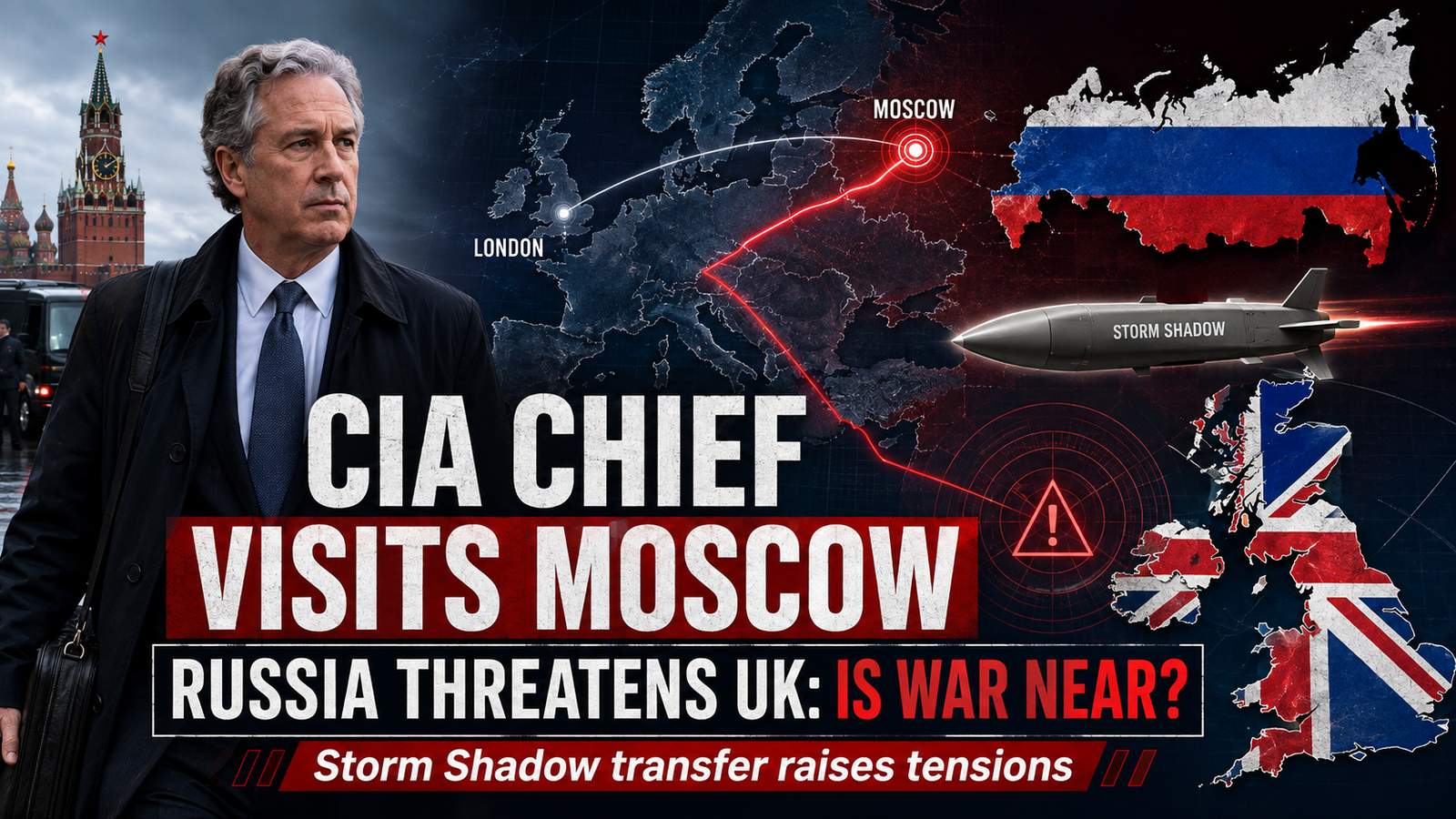
A rare visit to Moscow by CIA Director John Ratcliffe has triggered comparisons with the months before Russia invaded Ukraine.
The visit came as Russia issued one of its strongest warnings yet against Britain, threatening possible attacks on British military facilities in response to Ukraine’s use and planned production of the Anglo-French Storm Shadow/SCALP cruise missile.
The timing is alarming—but does it mean Russia is preparing to attack the United Kingdom?
The evidence does not currently support the conclusion that a direct Russian military strike on Britain is imminent. However, the risk of attacks on British interests, covert sabotage and a dangerous Russia–NATO escalation has clearly increased.
Why Did the CIA Director Visit Moscow?
CIA Director John Ratcliffe travelled to Moscow on August 25 for talks with senior Russian intelligence officials.
The Kremlin confirmed that Ratcliffe held discussions with Russian intelligence representatives but said he did not meet President Vladimir Putin. Putin was later briefed about the talks.
The visit was the first publicly known trip to Moscow by a CIA director since William Burns travelled there in November 2021.
According to Reuters, two sources familiar with Ratcliffe’s meeting said he raised the possibility of Russia conducting an operation against a NATO member. It remains unclear whether that was the main purpose of the visit.
Other reported subjects included:
- The risk of Russia escalating against NATO
- Russia’s military and political support for Iran
- The continuing war in Ukraine
- Possible efforts to restart peace negotiations
- A potential Trump–Putin–Zelensky summit
President Donald Trump described the trip as “semi-routine” and said Putin would not attack NATO territory. The Kremlin also rejected reports that Moscow was preparing such an attack.
Because intelligence meetings are secret, the complete discussion is unlikely to become public.
The 2021 CIA Visit Before Russia Invaded Ukraine
The historical comparison is important—but the date must be corrected.
William Burns visited Moscow in November 2021, not 2022. He warned Putin and other senior Russian officials that the United States knew Russia was considering a large-scale invasion of Ukraine.
Burns reportedly explained that an invasion would bring severe economic sanctions and a coordinated Western response.
Approximately three months later, on February 24, 2022, Russia launched its full-scale invasion.
The current visit resembles the 2021 meeting because Washington again used the CIA director as a confidential messenger during a period of dangerous military tension.
However, the similarity does not prove that another invasion has already been decided.
In 2021, Russia had assembled a massive invasion force around Ukraine. No comparable Russian mobilisation for an attack on Britain has been publicly verified.
Which Missile Technology Is Britain Giving Ukraine?
The missile is the SCALP-EG, the French version of Britain’s Storm Shadow cruise missile.
Storm Shadow and SCALP are closely related long-range, air-launched precision weapons developed using shared British and French technology. They can strike command centres, ammunition facilities, bridges, airbases and hardened military infrastructure from more than 250 kilometres away.
On August 24, the British government announced that MBDA could release classified information concerning British-made components used in SCALP.
The decision will allow France and Ukraine to advance plans for local missile assembly inside Ukraine.
The official UK announcement does not say that Britain is transferring every part of the Storm Shadow design or immediately giving Ukraine a fully independent manufacturing capability.
It specifically authorises the release of classified information about British components required for planned SCALP assembly lines.
Operational production is therefore unlikely to begin immediately.
Why Is Russia Calling This a Red Line?
Ukraine already possesses a limited number of Storm Shadow and SCALP missiles supplied by Britain and France.
Local assembly would be more significant because it could eventually:
- Reduce Ukraine’s dependence on limited Western stockpiles
- Increase the number of available long-range missiles
- Replace weapons used during combat
- Support sustained attacks against Russian logistics
- Allow future modifications based on battlefield experience
Russia is particularly concerned because Storm Shadow and SCALP can strike targets far behind the front line.
Moscow argues that Western intelligence, technical support and advanced weapons are making NATO countries direct participants in the conflict. Britain maintains that Ukraine has the right to defend itself against Russia’s invasion.
The phrase “red line” represents Russia’s political and military warning. It is not an internationally agreed legal boundary.
What Exactly Has Russia Threatened?
Russian Foreign Ministry spokesperson Maria Zakharova warned that British military installations and equipment “in Ukraine and beyond its borders” could be targeted in response to Ukrainian attacks carried out with British weapons.
Russia accused Britain of being one step away from legal complicity in what Moscow calls attacks against Russian civilians. It warned of potentially “catastrophic consequences” if London did not change its policy.
According to Reuters’ report on the warning, Moscow’s language was more forceful and urgent than its earlier threats.
The warning followed Russia’s allegation that Ukraine used Storm Shadow missiles against a shopping centre in Russian-controlled Donetsk. The circumstances and responsibility for that reported attack have not been independently established.
The Kremlin separately said it was collecting information about future missile-production locations inside Ukraine so Russian forces could destroy them.
Is Russia Planning to Attack the UK?
There is currently no publicly verified evidence that Russia has decided to launch a conventional missile attack or invasion against the British homeland.
Such an attack would be extraordinarily risky.
The United Kingdom is:
- A nuclear-armed country
- A founding NATO member
- Protected by advanced air and naval forces
- Closely integrated with US and European defence systems
- Capable of retaliating against Russian military targets
A deliberate Russian attack on British territory could trigger consultations and collective-defence measures under NATO’s Article 5. It could turn the Ukraine war into a direct confrontation between nuclear powers.
That makes a large, openly acknowledged attack on Britain unlikely unless Russia is willing to accept an uncontrollable escalation.
What Kind of Russian Response Is More Likely?
Russia has several options below the threshold of openly attacking British territory.
Strikes on Ukrainian Missile Facilities
The most immediate danger is that Russia will attack any SCALP assembly, storage or testing facility established inside Ukraine.
Such locations would be treated as high-priority military targets.
Attacks on British Equipment in Ukraine
Moscow could strike British-supplied weapons, training facilities or military equipment located inside Ukraine.
The danger would rise significantly if British personnel were present at a targeted facility.
Cyberattacks and Sabotage
Cyber operations against government systems, defence companies, energy networks or transportation infrastructure would allow Russia to impose costs while making attribution more difficult.
GPS Jamming and Infrastructure Disruption
Russia could intensify electronic warfare, interfere with navigation or target undersea cables and communications infrastructure through deniable operations.
Covert or Proxy Actions
Intelligence operations, disinformation campaigns, suspicious fires, industrial sabotage or attacks carried out through intermediaries may be more attractive than an openly declared military strike.
These “grey-zone” actions can increase pressure while remaining below the threshold that would guarantee a NATO military response.
Why the CIA Visit Still Matters
Ratcliffe’s visit suggests that Washington believes direct communication with Moscow is urgently necessary.
Intelligence chiefs are sometimes used when normal diplomacy becomes too public, too slow or too politically difficult. Their private channels can deliver warnings while also testing whether the other side is willing to negotiate.
The visit could therefore serve several purposes at the same time:
- Warn Russia against attacking NATO
- Clarify which actions would trigger a Western response
- Prevent misinterpretation of military movements
- Discuss Iran and other security disputes
- Explore whether peace talks can be revived
- Keep an emergency communication channel open
The fact that a similar warning in 2021 failed to prevent the invasion of Ukraine explains the current concern. But history does not automatically repeat itself.
Warning Signs of a Real Russia–NATO Attack
A direct Russian attack would probably be preceded by more substantial indicators, including:
- Large troop and missile movements towards NATO borders
- Reserve mobilisation beyond Ukraine’s requirements
- Dispersal of strategic aircraft or nuclear forces
- Evacuation of Russian diplomatic families
- Major changes in military communications
- Coordinated cyberattacks on NATO infrastructure
- Closure of airspace or important sea routes
- Explicit military ultimatums with deadlines
These indicators have not been publicly verified on the scale expected before an attack on Britain.
Conclusion
The CIA director’s Moscow visit is serious, particularly because the last known CIA-chief visit occurred shortly before Russia invaded Ukraine.
Britain’s decision to release classified information for SCALP missile assembly has also crossed an important technological threshold. Ukraine may eventually be able to produce more long-range missiles instead of relying entirely on limited foreign deliveries.
Russia has responded with an unmistakable threat against British military interests.
However, threatening Britain is not the same as making a final decision to attack the British homeland. The more immediate risks are Russian strikes on missile facilities in Ukraine, cyberattacks, covert sabotage and actions intended to test NATO without triggering a full-scale war.
The real danger is miscalculation. If British-supported missiles strike sensitive targets inside Russia and Moscow retaliates against British personnel or facilities, both sides could move closer to a direct confrontation neither may originally have intended.
Quick FAQs
Who is the CIA director who visited Russia?
CIA Director John Ratcliffe travelled to Moscow on August 25, 2026, and met Russian intelligence officials.
Did the CIA director meet Vladimir Putin?
No. The Kremlin said Ratcliffe met intelligence counterparts but did not meet Putin. Putin was briefed afterward.
Which missile will Ukraine assemble?
Ukraine and France are planning local assembly of the SCALP-EG cruise missile, the French version of Britain’s Storm Shadow.
Is Britain giving Ukraine the complete Storm Shadow design?
The British government has authorised MBDA to share classified information on British components required for SCALP assembly. It has not publicly confirmed the transfer of every element of the missile design.
Has Russia officially declared war on Britain?
No. Russia has not declared war on the United Kingdom. It has threatened possible attacks on British military facilities and equipment in response to Ukrainian strikes using British weapons.
Is a Russian attack on the UK imminent?
There is no publicly verified evidence of an imminent direct attack on the British homeland. Hybrid attacks and strikes against British-linked assets inside Ukraine are more plausible near-term risks.
Disclaimer: This article is based on official government announcements, publicly available statements and credible reporting as of August 30, 2026. Intelligence discussions are secret, and reports about the purpose of the CIA director’s Moscow visit remain partly based on anonymous sources. Russian and Ukrainian battlefield claims may not be independently verifiable. The analysis of possible escalation scenarios represents an assessment, not confirmation of an imminent attack. This content is intended solely for news, education and public-interest discussion.