













































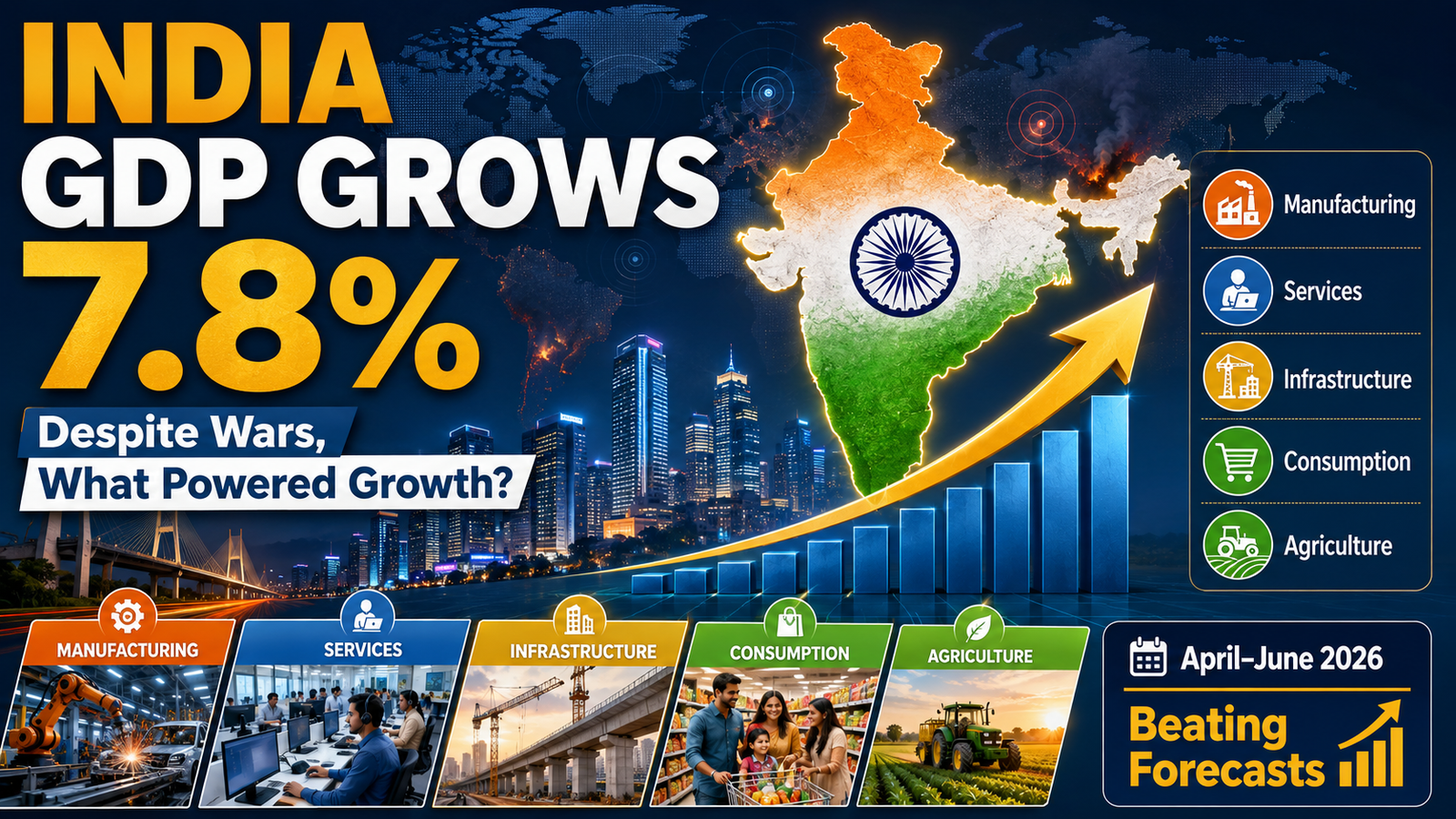

India’s GDP Grows 7.8% Despite Global Wars: What Is Powering the Economy?
India’s economy has delivered a major positive surprise.
Real gross domestic product expanded 7.8% year-on-year during April–June 2026, comfortably exceeding the Reserve Bank of India’s 7% projection and the 7.1% forecast in a Reuters survey of economists.
The performance is particularly significant because it came amid the West Asia conflict, the continuing Russia–Ukraine war, elevated energy prices and uncertainty across global trade routes.
According to the Ministry of Statistics and Programme Implementation, India’s real GDP reached ₹81.36 lakh crore during the first quarter of FY2026–27, compared with ₹75.46 lakh crore a year earlier.
However, the figure needs to be interpreted correctly. The 7.8% represents growth compared with the same quarter last year—not growth of 7.8% within three months.
India Beats Both RBI and Market Forecasts
The latest GDP number exceeded almost every major expectation.
- Actual GDP growth: 7.8%
- RBI’s Q1 projection: 7%
- Reuters economists’ forecast: 7.1%
- Growth in April–June 2025: 6.9%
- Revised growth in January–March 2026: 8.6%
Therefore, growth accelerated compared with the same period last year, although it moderated from the previous quarter’s year-on-year rate.
Nominal GDP, which includes the effects of inflation, grew by 10.3% to approximately ₹88.27 lakh crore.
What Powered India’s 7.8% GDP Growth?
The latest expansion was supported by several parts of the economy rather than one isolated sector.
Investment Growth Was the Biggest Surprise
Gross fixed capital formation—a broad measure of investment in infrastructure, factories, machinery and other productive assets—grew by 11.9%.
That was more than double the 5.8% recorded in the corresponding quarter last year.
Government infrastructure spending continued to support construction and industrial activity. Private investment also showed improvement in areas such as data centres, electricity, metals and manufacturing.
This is important because investment can create productive capacity and employment beyond the current quarter.
Manufacturing Expanded by 9.2%
Manufacturing was another major contributor, expanding by 9.2% at constant prices.
Companies continued producing despite higher energy and raw-material costs caused partly by the West Asia crisis. Strong demand, infrastructure activity and improving supply chains helped offset some of those pressures.
Electricity, gas, water supply and utility services grew by 8.9%, while construction expanded by 7.7%.
Together, the secondary sector—which includes manufacturing, construction and utilities—grew by 8.6%.
Services Remained India’s Strongest Engine
The services sector grew by 10%, making it the economy’s fastest-expanding broad segment.
Financial services, real estate, information technology and professional services recorded particularly strong growth of 12.1%.
Trade, hotels, transport and communication services expanded by 8.5%, while public administration, defence and other services grew by 7.5%.
The strong services performance demonstrates the continuing importance of banking, technology, digital businesses, professional consulting and real estate to India’s growth story.
Indian Consumers Continued Spending
Private consumption expanded by 7.1%, suggesting that household demand remained resilient despite higher prices.
Consumer spending accounts for more than half of India’s economy. When families spend on food, transport, housing, appliances and services, that demand supports businesses across multiple industries.
A broadly stable monsoon could further strengthen rural consumption, although regional rainfall differences may still affect agricultural incomes.
Exports Grew Despite Global Uncertainty
Real exports increased by 12% during the quarter, even as wars, trade restrictions and shipping disruptions created uncertainty in international markets.
This indicates that Indian goods and services continued finding overseas demand. Diversification across pharmaceuticals, engineering products, electronics, petroleum products and digital services may have helped reduce dependence on any single market.
Which Sectors Were Weak?
The headline figure was impressive, but not every sector performed strongly.
Agriculture and allied activities grew by 3.6%—positive, but considerably slower than manufacturing and services.
Mining and quarrying contracted by 2.4%, making it the weakest major sector. Fuel-mineral production and natural-gas consumption also remained under pressure.
These differences matter because high national GDP growth does not necessarily mean that every industry, region or household is experiencing the same improvement.
How Did India Grow Despite the Wars?
The West Asia conflict created a direct threat to India because the country imports nearly 89% of its crude-oil requirements. Higher oil and gas prices can increase transportation, electricity, fertiliser and manufacturing costs.
The continuing Russia–Ukraine war also affects energy markets, fertiliser supplies, shipping, sanctions compliance and international payments.
India managed these pressures through a combination of:
- Diversifying crude-oil suppliers
- Maintaining purchases from multiple regions
- Supporting infrastructure investment
- Using subsidies and tax measures to limit some price shocks
- Depending on its large domestic consumer market
- Expanding manufacturing and services exports
According to Reuters’ analysis of the GDP release, investment, consumption, government spending and exports helped offset input-cost pressures arising from the West Asia conflict.
The result does not mean that India is unaffected by global wars. It shows that the economy absorbed the first-quarter shocks better than economists expected.
What Does 7.8% Growth Mean for Ordinary Indians?
Strong GDP growth can support employment, business revenues, government tax collection and household incomes—but those benefits are neither immediate nor evenly distributed.
The encouraging part of the latest data is that growth came from investment, manufacturing and construction, which can create jobs across different skill levels.
For households, sustained growth could produce:
- More employment opportunities
- Higher business activity
- Greater government spending capacity
- Stronger credit demand
- Improved corporate earnings
- Rising demand for skilled workers
However, GDP growth alone does not guarantee higher real incomes. Inflation, job quality, wage growth and the cost of housing, food and fuel determine whether families actually feel better off.
Can India Maintain This Growth Rate?
Before the latest release, the RBI expected India’s economy to grow 6.7% during FY2026–27. Several economists may now raise their forecasts closer to 7%.
Continued investment, healthy consumption and a stable monsoon could keep momentum strong. India may also benefit if global businesses continue diversifying production and supply chains.
But important risks remain:
- Prolonged high crude-oil prices
- Further escalation in West Asia
- Continued disruption from the Russia–Ukraine war
- Rupee depreciation
- Higher inflation
- Weak global demand
- Trade tariffs and protectionism
- Uneven monsoon conditions
- Insufficient employment creation
India’s oil-import dependence remains its biggest external vulnerability. A prolonged energy-price shock could increase inflation, widen the trade deficit and reduce consumer purchasing power.
A Strong Number—but Not a Reason for Complacency
The latest GDP figure confirms that India entered FY2026–27 with stronger momentum than expected.
Manufacturing expanded, investment accelerated, services recorded double-digit growth and household consumption remained resilient. These are healthier foundations than growth driven only by government spending or statistical effects.
However, India must convert this expansion into better jobs, higher productivity and rising household incomes. It must also reduce dependence on imported energy and strengthen domestic manufacturing supply chains.
Conclusion
India’s 7.8% GDP growth is a powerful sign of economic resilience at a time of war, expensive energy and global uncertainty.
The country has demonstrated that its large domestic market, infrastructure investment, manufacturing expansion and services sector can protect growth from international shocks.
But the wars have not become irrelevant. Higher oil prices, shipping disruptions and inflation could still weaken future quarters.
The strongest conclusion is that India has successfully weathered the initial turbulence—but maintaining growth near 7% or higher will require continued investment, job creation, stable prices and careful management of external risks.
Frequently Asked Questions
What was India’s latest GDP growth rate?
India’s real GDP grew by 7.8% year-on-year during April–June 2026, the first quarter of FY2026–27.
Did India’s economy grow 7.8% in only three months?
No. The figure compares economic output in April–June 2026 with the same three-month period in 2025.
Which sector grew the fastest?
Financial, real estate, IT and professional services grew by 12.1%. Overall services expanded by 10%.
How fast did Indian manufacturing grow?
Manufacturing recorded real growth of 9.2% during the quarter.
What is the RBI’s GDP forecast for FY2026–27?
The RBI projected full-year growth of 6.7% before the latest GDP result. Forecasts may be revised following the stronger-than-expected first-quarter number.
Could wars still slow India’s economy?
Yes. Prolonged conflicts could raise energy, shipping and input costs, weaken exports and increase inflation.
Disclaimer: This article is based on official government data and credible reporting available as of August 31, 2026. Quarterly GDP estimates may be revised as additional information becomes available. Economic projections and sectoral outlooks are subject to changes in inflation, energy prices, monetary policy, weather and geopolitical conditions. This content is provided for news and educational purposes and does not constitute financial or investment advice.