























PM Modi’s SCO Summit 2026 Visit: What Did India Achieve in Bishkek?
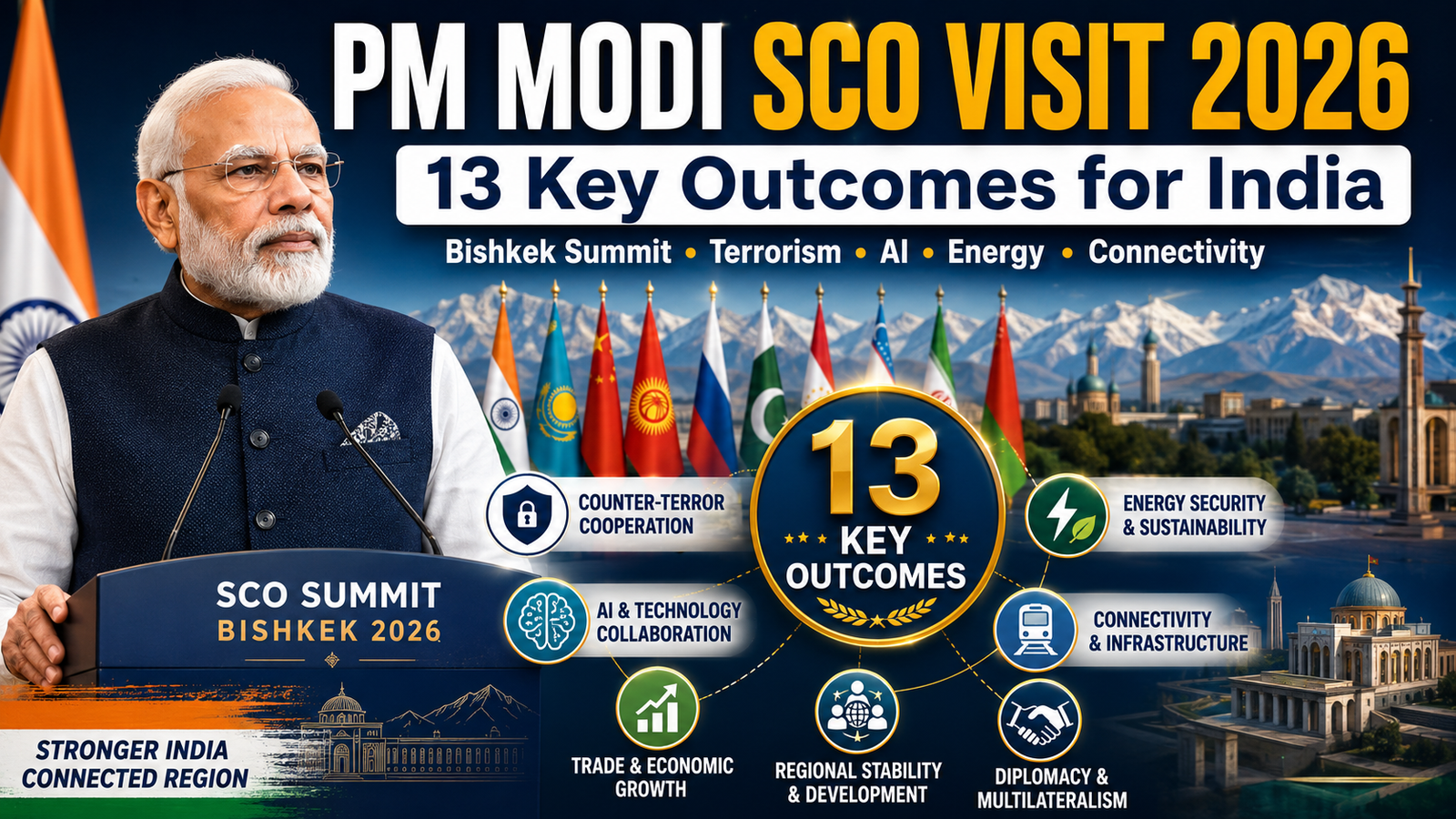
Prime Minister Narendra Modi has concluded an important visit to Kyrgyzstan for the 26th Shanghai Cooperation Organisation Summit.
Held in Bishkek from August 31 to September 1, the summit brought together leaders from major Eurasian powers, including India, Russia, China, Iran, Pakistan and the Central Asian republics.
The meeting ended with the adoption of the Bishkek Declaration, four memorandums of understanding and more than 20 decisions and statements covering security, artificial intelligence, energy, climate change, nuclear safety, disaster response and narcotics control.
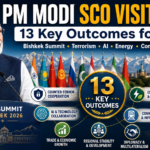
India highlighted 13 significant outcomes from the summit. Several reflected proposals that New Delhi had promoted for years, including making English an official SCO language and strengthening action against terrorism.
Here are the most important results of PM Modi’s SCO visit.
Modi’s Three-Pillar Message to the SCO
Addressing the summit, PM Modi presented India’s vision through three pillars:
- Security
- Connectivity
- Opportunity
Modi argued that the SCO’s next 25 years must produce measurable benefits for citizens instead of remaining limited to official declarations.
He called for greater cooperation against terrorism, more reliable trade and transport networks, and new opportunities for young people, entrepreneurs, farmers, scientists and technology companies.
The summit took place during the SCO’s 25th anniversary, giving member countries an opportunity to review the organisation’s future direction.
Outcome 1: Stronger Language Against Terrorism
India’s most important strategic objective was to strengthen the SCO’s position against terrorism.
PM Modi called on member states to dismantle the complete terrorist ecosystem, including:
- Financing networks
- Recruitment channels
- Radicalisation
- Safe havens
- State support for terrorist organisations
Speaking in the presence of Pakistan’s Prime Minister Shehbaz Sharif, Modi warned that terrorism must never be treated as a strategic asset or instrument of state policy.
The Bishkek Declaration reaffirmed opposition to terrorism, extremism and separatism while rejecting double standards in dealing with such threats.
This gave India diplomatic space to raise cross-border terrorism before a forum that includes both Pakistan and China.
However, a declaration is not the same as enforcement. Its real value will depend on whether SCO members cooperate against terrorist financing, recruitment and safe havens.
Outcome 2: A New SCO Security Centre
Member countries approved regulations for a Universal Centre for Countering Challenges and Threats to the Security of SCO Member States.
The centre is intended to improve coordination and intelligence sharing against:
- Terrorism
- Extremism
- Organised crime
- Transnational criminal networks
- Other regional security threats
This could strengthen practical security cooperation beyond summit statements. India will still need to ensure that the mechanism applies consistent standards to all terrorist organisations without political exemptions.
Outcome 3: English Becomes an Official SCO Language
One of India’s clearest diplomatic gains was the decision to include English as an official SCO language.
The organisation had traditionally conducted its official work mainly in Russian and Chinese. Adding English can make SCO documents, discussions and institutions more accessible to Indian officials, businesses, researchers and the wider international community.
It could also help India participate more effectively in drafting future SCO policies.
This outcome may appear administrative, but language influences who can easily access information and shape an institution’s agenda.
Outcome 4: Connectivity Must Respect Sovereignty
PM Modi supported transport corridors that connect markets and improve regional trade. However, he again insisted that connectivity projects must respect the sovereignty and territorial integrity of every country.
This reflects India’s longstanding position that regional infrastructure cannot ignore national boundaries or territorial claims.
Although Modi did not name a specific project in his speech, the principle is relevant to India’s objections to the China–Pakistan Economic Corridor, portions of which pass through territory claimed by India.
India also proposed practical improvements such as:
- Simplified customs procedures
- Digital trade documents
- Efficient logistics networks
- Better road, rail and air connectivity
Such measures could improve India’s access to Central Asian markets, although geographic and political barriers remain considerable.
Outcome 5: Cooperation on Artificial Intelligence
SCO members signed an MoU on cooperation in artificial intelligence.
The agreement could allow India to share experience gained from its digital public infrastructure and AI-development programmes while promoting responsible and inclusive use of emerging technologies.
Possible areas of cooperation include:
- AI research
- Digital governance
- Skills and capacity building
- Startup partnerships
- Responsible AI standards
- Technology for public services
The agreement creates a framework for cooperation, but individual projects, funding and implementation schedules will still need to be developed.
Outcome 6: Energy Security and Efficiency
SCO leaders adopted statements on the development of energy systems and cooperation in energy conservation and efficiency.
This is important for India because several SCO countries possess major reserves of oil, natural gas, uranium and critical minerals.
Greater cooperation could support India through:
- Diversified energy supplies
- Modernisation of electricity systems
- Energy-efficient technologies
- Renewable-energy collaboration
- More resilient regional supply chains
An action plan covering ports and logistics centres for 2026–2030 was also among the summit documents, potentially supporting longer-term trade connectivity.
Outcome 7: Climate and Green-Technology Cooperation
Member countries signed an MoU on combating climate change and adopted a programme for an SCO Green Technology Corridor through 2030.
The framework could support cooperation in climate adaptation, cleaner technology and energy efficiency.
For India, the value will depend on whether the programme produces technology sharing, affordable financing and capacity building—not simply additional climate declarations.
Outcome 8: Disaster Relief and Humanitarian Assistance
The summit adopted a statement on assistance to countries affected by emergencies.
India has extensive experience in disaster relief, evacuation operations and humanitarian assistance. The initiative could help SCO countries share expertise, train emergency personnel and coordinate responses to floods, earthquakes and other disasters.
It also gives India an opportunity to promote its Coalition for Disaster Resilient Infrastructure and emergency-response capabilities across Eurasia.
Outcome 9: Action Against Drugs and Narco-Terrorism
The summit approved several measures targeting narcotics, including:
- Regulations for the SCO Anti-Narcotics Centre
- A drug-addiction cooperation programme through 2030
- Measures against synthetic drugs and precursor chemicals
- Stronger coordination among enforcement agencies
These initiatives are particularly relevant to India because drug trafficking can finance organised crime and terrorist networks.
Successful implementation will require member states to share intelligence and act against politically connected trafficking networks.
Outcome 10: India’s Youth and Cultural Initiatives Gain Support
Several India-backed programmes received recognition in the Bishkek Declaration:
- SCO Young Scientists Forum
- SCO Young Authors’ Conclave
- SCO Startup initiatives
- SCO Civilisation Dialogue Forum
India will host the first SCO Civilisation Dialogue Forum later in 2026.
These initiatives allow India to expand its cultural influence and build direct connections among researchers, students, writers and entrepreneurs across Eurasia.
What Happened During Modi’s Meeting With Putin?
PM Modi held a separate bilateral meeting with Russian President Vladimir Putin on the summit’s sidelines.
According to the official Indian statement, the leaders reviewed cooperation in:
- Trade and investment
- Defence
- Energy and fertilisers
- Space
- Mobility
- People-to-people relations
They also discussed the conflicts in West Asia and the Black Sea region, particularly their effects on maritime commerce and Indian seafarers.
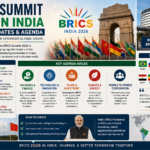
Modi repeated India’s position that conflicts should be resolved through dialogue and diplomacy. He also invited Putin to attend the BRICS Summit in India on September 12–13, 2026.
The meeting reinforced the India–Russia strategic partnership, but no major new defence or energy agreement was publicly announced in Bishkek.
Modi’s Message to Iran on West Asia
Modi also met Iranian President Masoud Pezeshkian.
The two discussed the West Asia conflict, freedom of navigation and the protection of civilian shipping and seafarers.
Modi expressed concern about escalating tensions and called for issues to be resolved diplomatically. He also invited Pezeshkian to attend the upcoming BRICS Summit in India, according to the Prime Minister’s Office.
This meeting was important for India because disruptions around the Strait of Hormuz could affect energy supplies, shipping costs and inflation.
Meetings With Kyrgyzstan and Armenia
Modi and Kyrgyz President Sadyr Zhaparov agreed to strengthen economic cooperation, student exchanges and cultural ties.
During a separate meeting with Armenian Prime Minister Nikol Pashinyan, discussions covered defence, pharmaceuticals, mining, education, economic cooperation and the Armenia–Azerbaijan peace process.
These meetings supported India’s effort to expand its presence in Central Asia and the wider Eurasian region.
Was There a Major Modi–Xi Agreement?
Modi and Chinese President Xi Jinping were seen interacting during the summit. However, India did not announce a separate formal bilateral agreement between the two leaders in Bishkek.
Similarly, no bilateral meeting between Modi and Pakistan’s prime minister was announced.
Photographs and brief interactions should therefore not be confused with negotiated diplomatic agreements.
Was the SCO Visit Successful for India?
The visit produced several useful outcomes.
India secured recognition for its positions on terrorism, sovereign connectivity, English-language access, youth engagement and cultural cooperation. It also participated in new frameworks covering AI, energy, climate action, disaster relief and narcotics control.
The summit additionally allowed Modi to hold direct talks with Russia, Iran, Kyrgyzstan and Armenia during a period of major geopolitical instability.
However, the SCO remains a complicated organisation. India often disagrees with China and Pakistan over terrorism, connectivity and regional security. Declarations will be meaningful only if member countries implement them consistently.
Therefore, the summit should be viewed as a diplomatic gain and platform-building exercise—not a breakthrough that immediately resolves India’s regional challenges.
Conclusion
PM Modi’s SCO Summit 2026 visit strengthened India’s voice across Eurasia.
The clearest gains were the inclusion of English as an SCO official language, stronger institutional cooperation against security threats and support for India-led youth, science and cultural initiatives.
India also maintained its strategic relationships with Russia and Iran while firmly defending its positions on terrorism and territorial sovereignty.
The Bishkek summit did not produce one dramatic trade or defence deal. Its importance lies in shaping the rules, institutions and diplomatic relationships that will influence regional security and economic cooperation over the coming years.
Frequently Asked Questions
Where was the SCO Summit 2026 held?
The 26th SCO Summit was held in Bishkek, Kyrgyzstan, from August 31 to September 1, 2026.
What was the main outcome of the summit?
The summit adopted the Bishkek Declaration, four MoUs and more than 20 decisions and statements covering security, AI, energy, climate, narcotics and disaster response.
Did English become an official SCO language?
Yes. The summit supported the inclusion of English within the SCO’s official framework.
Did Modi meet Vladimir Putin?
Yes. They discussed trade, defence, energy, space, mobility and regional conflicts. No major new bilateral agreement was announced.
Did Modi meet Xi Jinping separately?
The leaders interacted at the summit, but India did not announce a formal bilateral meeting or new agreement in Bishkek.
Did Modi meet Pakistan’s prime minister?
No formal bilateral meeting between Modi and Shehbaz Sharif was announced.
Disclaimer: This article is based on official Indian government releases and credible public reporting available as of September 2, 2026. SCO declarations and MoUs establish political commitments and cooperation frameworks; they should not be interpreted as completed projects or guaranteed operational results. Diplomatic positions and implementation details may evolve. This content is intended for news, education and public-interest analysis.
