












































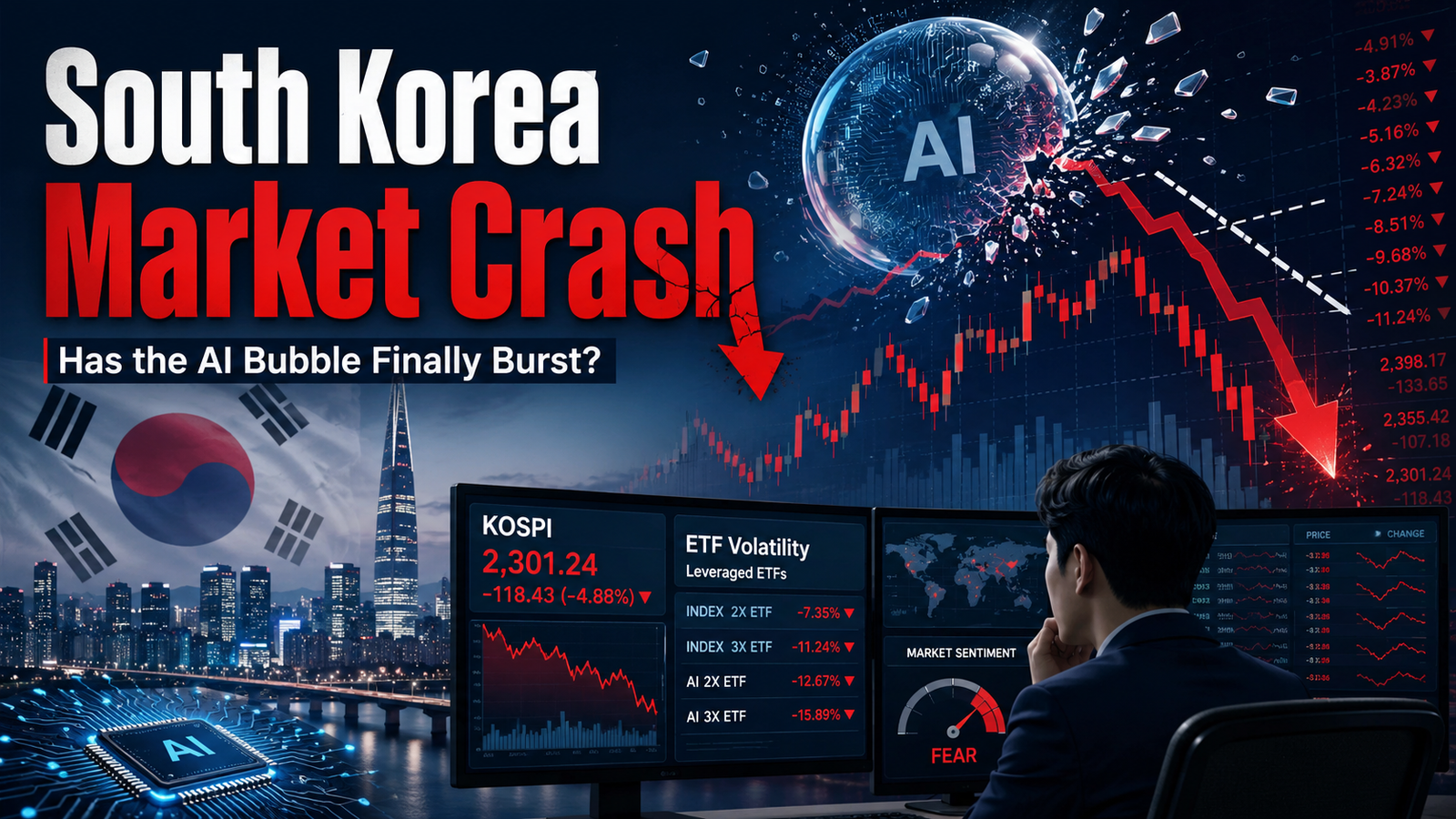
South Korea Market Crash: Has the AI Bubble Finally Burst?

South Korea’s AI Boom Turns Into a Market Shock
South Korea, once the world’s hottest stock market of 2026, is now facing a brutal correction.
The country’s benchmark KOSPI index surged earlier this year on the back of artificial intelligence excitement, especially around semiconductor giants Samsung Electronics and SK Hynix. But that rally has suddenly turned into a sharp market crash.
Reuters reported that the KOSPI lost about 20% in July, even though it was still up around 62% for 2026. The report also said billions of dollars in leveraged bets on South Korea’s AI-linked chip stocks had turned the market into a high-volatility casino.
This is why investors are asking one big question: has the AI bubble burst in South Korea?
What Caused the Crash?
The crash was not caused by one single event. It was a mix of AI hype, leverage, retail speculation and extreme dependence on two major chipmakers.
Samsung and SK Hynix are central to the global AI supply chain because they produce memory chips used in data centers and AI hardware. But Reuters reported that the two companies now account for more than half of the KOSPI, meaning sharp moves in either stock can pull the entire market up or down.
That concentration became dangerous when retail investors piled into single-stock leveraged ETFs linked to these companies. These products can multiply gains when stocks rise, but they can also multiply losses when stocks fall.
In simple words, Korea’s AI boom became too crowded, too fast and too leveraged.
The AI Bubble Did Not Disappear — It Cracked
It would be wrong to say that artificial intelligence is finished. AI demand is still real. Data centers, chips, memory, cloud infrastructure and AI software remain major growth areas.
But the Korean market shows what happens when investors price a future dream too aggressively.
Reuters reported that the KOSPI had fallen about 25% from its record high after blasting through 8,000 points in an AI-fuelled rally. It also said the crash exposed the risk of a market driven by margin debt, two dominant stocks and a rally disconnected from the broader economy.
That is the real story. The AI industry may still grow, but the AI stock bubble in South Korea has clearly suffered a major reality check.
Retail Investors Got Trapped
The most painful part of the crash is the impact on retail investors.
During the rally, many small investors believed Samsung and SK Hynix could only go higher because of the AI boom. Leveraged ETFs made the excitement even stronger by promising amplified exposure to these stocks.
But leverage is a double-edged sword.
Reuters reported that SK Hynix saw extreme volatility, including a 14% fall in Seoul, while a twice-leveraged ETF tracking the stock plunged more than 30% in Hong Kong. The selling fed on itself and helped drag the KOSPI sharply lower.
This is how bubbles break: first slowly, then suddenly.
Regulators Step In
South Korean authorities have now moved to cool the speculative fever.
The Financial Services Commission said it would raise the minimum deposit requirement for retail investors trading single-stock leveraged products from KRW 10 million to KRW 30 million, and the new requirement will apply from July 31, 2026. The regulator also said the amount must be held in cash, not substitute securities.
The FSC also announced that new listings of single-stock leveraged products, including inverse and covered-call products, would be temporarily suspended, while securities firms and asset managers would be banned from advertising and marketing these products.
This shows the government is worried that speculative trading could damage investor confidence and market stability.
Why the Crash Matters Globally
South Korea is not just a local market story. It is one of the world’s most important semiconductor economies.
Fortune reported that Korea’s AI-heavy market has become more closely linked with global tech sentiment. The correlation between the KOSPI and Nasdaq 100 has risen sharply, and weakness in Korean AI stocks has started affecting Wall Street’s view of semiconductor risk.
That means South Korea has become a global warning signal.
If Korean chip stocks fall, investors may start questioning the valuations of other AI-related companies in the United States, Taiwan and Japan.
Is This Like the Dot-Com Bubble?
There are similarities, but also differences.
Like the dot-com era, investors are excited about a revolutionary technology. Like the dot-com era, some stock prices moved faster than profits could justify. Like the dot-com era, retail investors chased momentum.
But unlike many dot-com companies, Samsung and SK Hynix are real businesses with real products, real factories and real earnings. Reuters noted that explosive earnings growth at these semiconductor giants still supports the investment case, even though leverage and concentration have made the market extremely unstable.
So this is not necessarily the end of AI. It is the end of blind AI euphoria.
What Investors Should Learn
The South Korea crash teaches a simple lesson: even the best theme can become dangerous at the wrong price.
AI may be the future, but that does not mean every AI stock is safe. A strong company can still become overvalued. A good sector can still form a bubble. A winning trade can still destroy investors when leverage is involved.
Retail investors should be careful with leveraged ETFs, margin loans and hype-driven investing. These tools can look exciting during rallies but become brutal during corrections.
India’s Lesson From Korea
India should watch South Korea closely.
India is also building its semiconductor, AI and data-center ecosystem. As these sectors grow, Indian investors may also chase “AI theme” stocks aggressively.
The lesson is clear: India should support AI and semiconductor growth, but investors must avoid turning every technology story into a speculative casino.
Healthy markets need innovation, but they also need valuation discipline.
Final Thoughts
South Korea’s market crash is one of the biggest warnings of 2026.
The AI boom is real, but the AI stock bubble in Korea has cracked because of excessive leverage, retail speculation and overdependence on Samsung and SK Hynix.
This does not mean AI is dead. It means investors are finally learning that even powerful technologies can create dangerous bubbles when greed outruns fundamentals.
For global markets, South Korea has become the first major stress test of the AI supercycle.
And the message is clear: AI may change the world, but leverage can still destroy portfolios.
FAQs
Why did the South Korean market crash?
The crash was driven by a sharp correction in AI-linked semiconductor stocks, heavy retail speculation, margin debt and leveraged ETFs tied to Samsung and SK Hynix.
Has the AI bubble burst in South Korea?
The AI stock bubble has clearly cracked, but AI demand itself has not disappeared. The crash is more about valuation, leverage and speculation.
Which stocks caused the biggest impact?
Samsung Electronics and SK Hynix had the biggest influence because together they make up more than half of the KOSPI index.
What are single-stock leveraged ETFs?
They are investment products that multiply the daily movement of one stock. They can increase gains but also multiply losses.
What should Indian investors learn?
Indian investors should be careful with hype-driven themes, avoid excessive leverage and focus on fundamentals instead of chasing every AI-related stock.
Disclaimer: This article is for informational and educational purposes only. It is not financial advice. Stock markets are risky, and readers should consult a qualified financial advisor before making investment decisions.