












































India’s Medical Mafia Problem: How Healthcare Became Expensive and How It Can Be Fixed

The Problem Nobody Wants to Discuss Honestly
Healthcare should be about healing. But for many Indian families, a serious illness can become a financial shock.
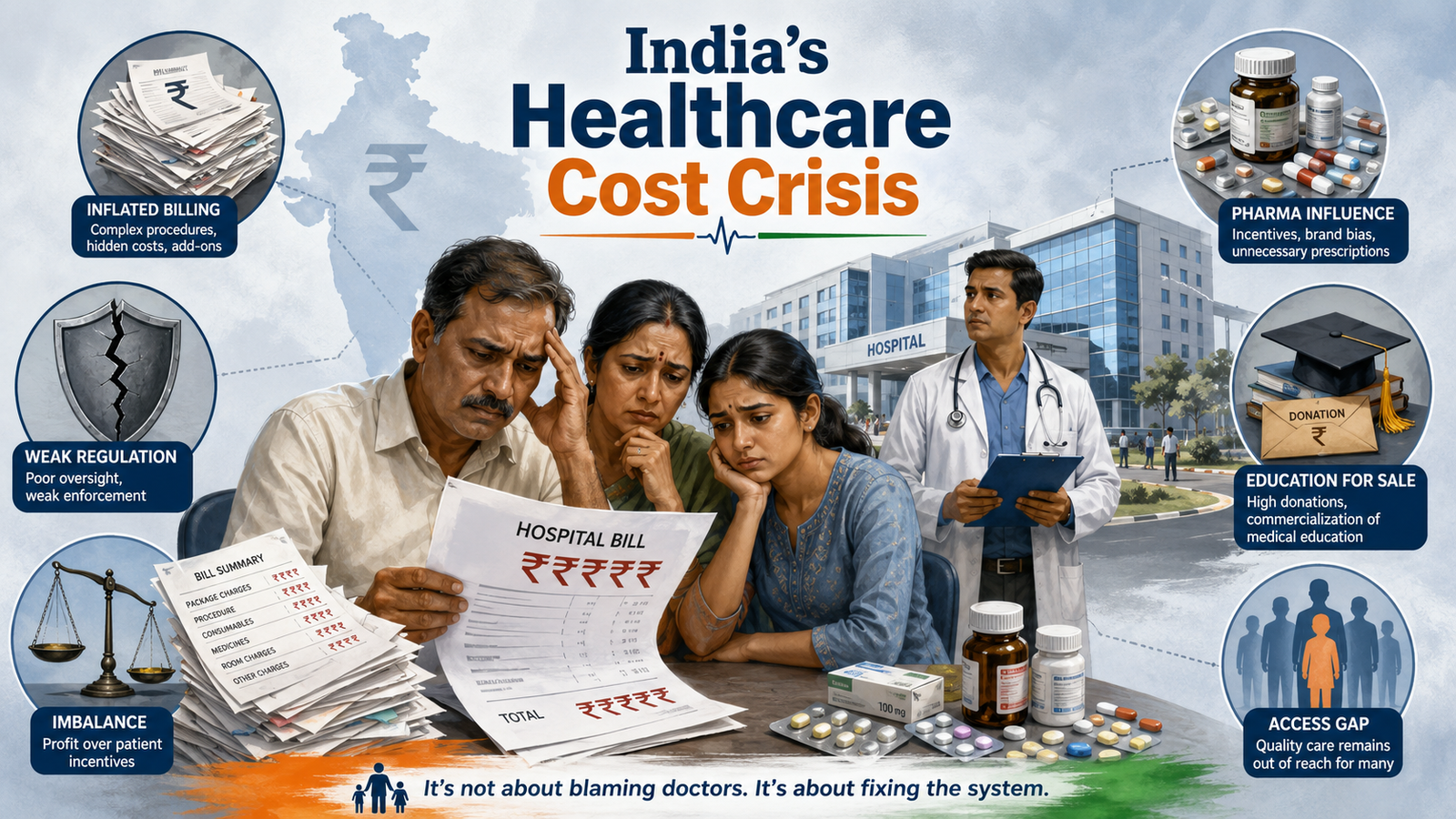
Patients often complain about unclear hospital bills, unnecessary tests, expensive branded medicines, commission-based referrals, inflated procedure costs, insurance misuse and aggressive private hospital packages. This is what people commonly call the “medical mafia.”
But the issue must be understood carefully.
India does not have a shortage of good doctors. Many doctors work honestly under extreme pressure, long hours and limited resources. The real problem is a structural healthcare model where weak public capacity, expensive private care, poor price transparency and profit-driven incentives can hurt patients.
How Did This System Start?
India’s healthcare problem did not appear overnight. It developed over decades.
After independence, India built strong public institutions in some areas, but public healthcare investment remained limited compared with the scale of the population. When government hospitals became overcrowded and under-resourced, private hospitals, private clinics, nursing homes and diagnostic centres filled the gap.
The National Health Policy 2017 itself recognized the need to raise public health expenditure to 2.5% of GDP by 2025, expand primary healthcare and improve access without financial hardship. It also recommended patient-centric systems, including empowered medical tribunals for complaints related to standards of care, prices, negligence and unfair practices.
That shows the government has long known the core issue: healthcare must become more affordable, regulated and patient-friendly.
Medical College Donations: Where the Pressure Begins
One major root of India’s healthcare crisis is the cost of becoming a doctor.
In many private medical colleges, families have long complained about high fees, management quota costs, hidden charges and illegal “donation” or capitation fee demands. This matters because when medical education becomes extremely expensive, some graduates enter the profession already carrying huge financial pressure.
That does not justify unethical practice. But it helps explain why the system becomes distorted.
If a student or family spends massive money to secure medical education, the profession can slowly shift from service to recovery of investment. This creates a dangerous chain: expensive medical seats, expensive education, high career pressure, corporate hospital targets, unnecessary tests, overbilling and patient exploitation.
The government already recognizes this problem. The National Medical Commission’s fee guidelines say private medical colleges and deemed universities should not charge capitation fee in any form or manner. They also say the principle of medical education being “not-for-profit” must be followed while determining fees. (nmc.org.in)
PRS Legislative Research also noted that while capitation fee is banned, there have been concerns that difficult-to-enforce fee caps may lead some colleges to continue collecting “under the table” capitation fees or extra charges on different pretexts. (prsindia.org)
This is why healthcare reform cannot focus only on hospitals and doctors. It must begin with medical education.
India needs transparent counselling, strict fee disclosure, strong audits of private medical colleges, punishment for illegal donations, online complaint systems for students and parents, and real-time monitoring of admissions. Medical seats should be earned through merit and lawful fees, not hidden cash pressure.
If India wants ethical doctors, it must first make medical education ethical, transparent and affordable.
Why Patients Feel Trapped
The patient is usually the weakest person in the system.
When someone is seriously ill, the family is emotional, frightened and desperate. They do not have time to compare prices, question every test or negotiate hospital packages. That vulnerability creates room for exploitation.
A family may not know whether a test is medically necessary. They may not know whether a cheaper generic medicine is available. They may not know whether a stent, implant or surgery package is fairly priced. They may not even get a clear estimate before admission.
This is where healthcare becomes dangerous: when information is controlled by the provider and risk is carried by the patient.
The Cost Burden Is Still High
India has improved health financing, but household medical burden remains significant.
The Union Health Ministry’s National Health Accounts 2022-23 showed that out-of-pocket expenditure declined from 64.2% of total health expenditure in 2013-14 to 43.4% in 2022-23. Government health expenditure as a share of GDP increased from 1.15% to 1.43% over the same period.
This is progress. But it also means families are still paying a large share directly from their pockets.
That is why even middle-class families fear hospitalization. One major surgery can destroy savings.
Pharma Influence and Doctor Incentives
Another major issue is the relationship between pharma companies, medical-device companies and healthcare professionals.
India introduced the Uniform Code for Pharmaceutical Marketing Practices 2024 to prevent unethical marketing and regulate interactions between pharmaceutical companies and doctors. The code prohibits gifts, monetary benefits and hospitality to doctors and their family members by pharmaceutical companies.
This is important because when prescriptions are influenced by incentives, patients may end up paying more for branded medicines instead of affordable alternatives.
The same concern exists in medical devices, diagnostics and referrals. If a system rewards volume, commissions or expensive procedures, patient trust suffers.
Hospital Billing and Package Inflation
Private hospitals are essential in India because they provide capacity that the public system alone cannot deliver. But private healthcare cannot be allowed to operate without transparency.
The Clinical Establishments Act, 2010 was created to register and regulate clinical establishments and prescribe minimum standards of facilities and services. It applies to public and private clinical establishments, including diagnostic centres and single-doctor clinics, except those run by the armed forces.
The government also lists standard treatment guidelines for many specialties, including cardiology, critical care, orthopaedics, oncology, laboratory medicine and others.
The problem is implementation. Health is largely a state subject, and enforcement varies across India. Unless standards, prices and billing formats become transparent everywhere, patients will keep feeling cheated.
Ayushman Bharat Fraud Shows the Systemic Risk
Ayushman Bharat PM-JAY is a major welfare scheme and has helped many poor families. But even good schemes can be misused if monitoring is weak.
In August 2025, the Health Ministry said PM-JAY follows a zero-tolerance policy toward fraud. It reported that 3,167 hospitals were found guilty of irregularities or violations since the scheme began, with 1,114 hospitals de-empanelled, ₹122 crore penalties levied on 1,504 hospitals, and 549 hospitals suspended.
This proves two things. First, the government is acting. Second, fraud is real and must be tackled aggressively.
Public money should help patients, not become a billing opportunity for corrupt providers.
India Is Not Alone: The U.S. Has Its Own Healthcare Mafia
India should not blindly copy the Western healthcare model.
The United States is a warning. OECD data shows the U.S. spends $14,885 per person on healthcare, far above the OECD average of $5,967, and health spending equals 17.2% of GDP compared with the OECD average of 9.3%.
Drug prices are also a major issue. A U.S. government-linked RAND comparison found that U.S. prescription drug prices in 2022 were about 2.78 times those in 33 other OECD comparison countries.
So yes, India has problems. But America also shows what happens when healthcare becomes too commercialized, too insurance-driven and too expensive.
India must build its own model: affordable, ethical, transparent and patient-first.
How Can India Control the Medical Mafia?
India needs long-term reform, not emotional slogans.
First, the government must increase public healthcare spending and strengthen primary care. If government hospitals become reliable, private hospitals will face natural competition.
Second, every hospital should be required to give a transparent cost estimate before admission, except in emergencies. Final bills should use a standard format that patients can understand.
Third, standard treatment guidelines must be enforced. Doctors should retain clinical freedom, but unnecessary tests, overbilling and irrational procedures must be auditable.
Fourth, medicine and device pricing should remain under strong monitoring. NPPA has already capped prices for important medical devices such as coronary stents and knee implants under price-control rules, showing that government intervention can reduce excessive pricing.
Fifth, pharma and device companies should disclose all payments, sponsorships and benefits given to doctors, hospitals and medical associations. India needs a strong “sunshine law” style disclosure system.
Sixth, insurance fraud detection must use AI, real-time dashboards and strict hospital audits. Suspicious claim patterns should trigger automatic investigation.
Seventh, patient rights must be enforceable. Every district should have a fast medical grievance tribunal for overbilling, negligence, denial of records and unethical conduct.
Eighth, prescriptions should include generic names clearly, and hospitals should not force patients to buy medicines only from in-house pharmacies unless medically justified.
Ninth, the government must attack illegal donation and capitation fees in medical education. Private medical colleges should publish full fee structures before counselling, all payments should be digital, and any college demanding hidden money should face strict penalties, loss of seats or suspension of recognition. Medical education reform is healthcare reform.
Doctors Also Need Protection
Reform should not become anti-doctor.
Many doctors are overworked, underpaid in early careers, exposed to violence and trapped in corporate targets. The system must punish corruption, but also protect honest doctors from mob violence, false allegations and unrealistic workloads.
A better healthcare system must protect both patients and ethical healthcare workers.
Final Thoughts
India’s medical mafia problem is not one villain. It is a network of bad incentives.
It includes weak public healthcare, poor billing transparency, pharma influence, hospital overcharging, insurance fraud, medical education costs, lack of audits and slow patient grievance systems.
This will not be fixed in one year. It may take decades.
But the direction is clear. India needs stronger public hospitals, transparent private billing, strict action against fraud, affordable medicines, ethical pharma rules, digital audits and enforceable patient rights.
Healthcare should not become a business of fear. It should remain a service of trust.
India can build a better model than the West — but only if it refuses to let illness become a profit machine.
FAQs
What does “medical mafia” mean in India?
It is a public phrase used to describe corrupt or exploitative practices in healthcare, such as overbilling, unnecessary tests, commission-based referrals, insurance fraud and unethical pharma influence.
Are all doctors part of this problem?
No. Many doctors are honest and hardworking. The issue is structural and involves bad incentives across hospitals, pharma, insurance and regulation.
Why is healthcare expensive in India?
Healthcare becomes expensive due to high out-of-pocket spending, weak public capacity, private hospital billing, branded medicines, diagnostics and lack of price transparency.
What can the government do?
The government can increase public health spending, enforce standard treatment guidelines, regulate hospital billing, strengthen audits, control medicine/device prices and create fast patient grievance tribunals.
Is the U.S. healthcare system better?
Not always. The U.S. spends far more on healthcare than most OECD countries, and drug prices are much higher. India should avoid copying a highly expensive model.
Disclaimer: This article is for informational and public-policy discussion only. It does not accuse all doctors, hospitals, pharma companies or healthcare workers of wrongdoing. Patients should consult qualified medical professionals for treatment decisions and use official grievance channels for complaints.