















































Project Kusha: India’s Own S-400 Passes Major Test, Marking a New Era in Air Defence

India Takes a Big Leap in Air Defence
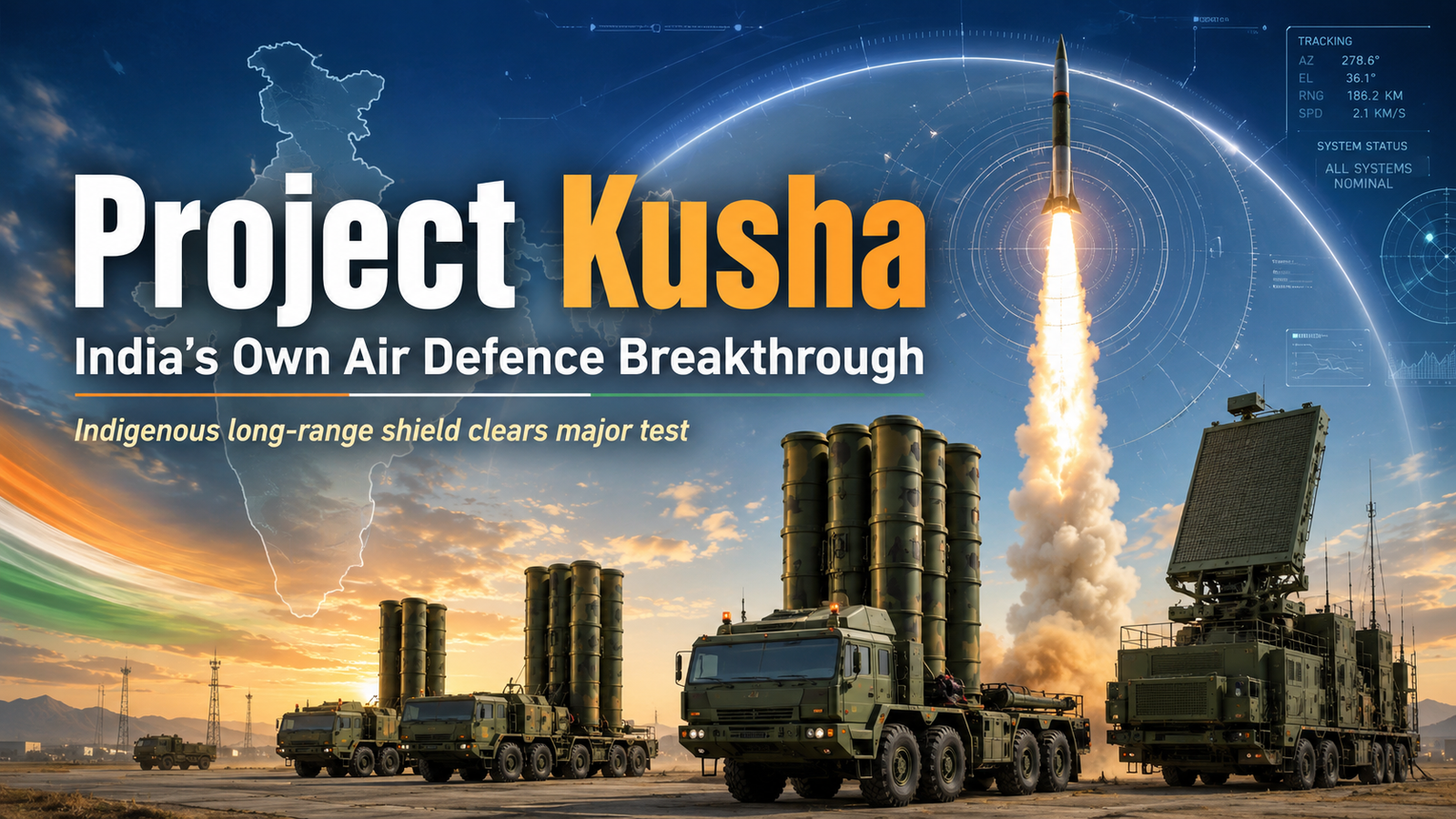
India has taken a major step toward building its own advanced air defence shield after the Defence Research and Development Organisation successfully conducted the maiden flight test of the Kusha Long-Range Surface-to-Air Missile from APJ Abdul Kalam Island off the Odisha coast on July 23, 2026. The Ministry of Defence said the missile successfully intercepted an electronic target simulating a high-speed and high-altitude aerial threat.
This is why defence watchers are calling Kusha India’s own answer to the Russian S-400.
But the real story is bigger than comparison. Kusha is about reducing import dependence, strengthening India’s strategic autonomy and building a layered air defence system for the future.
What Is Project Kusha?
Project Kusha is India’s indigenous long-range surface-to-air missile system. It is being developed to neutralise aerial threats such as fighter jets, missiles, drones, unmanned aerial vehicles and large enemy aircraft across a wide range and altitude envelope. According to the Ministry of Defence, the missiles, radars, command-and-control centre and other weapon-system elements have been developed by DRDO laboratories and Indian industry partners.
In simple words, Kusha is not just a missile. It is a complete air defence ecosystem.
A modern air defence system needs sensors, radars, command centres, interceptor missiles and real-time coordination. Kusha aims to bring these elements together under an indigenous framework.
Why Is It Being Compared With S-400?
India already operates the Russian S-400 Triumf, one of the world’s most powerful long-range air defence systems. The Indian Express noted that the S-400 is understood to be capable of hitting targets up to 400 km away.
Kusha is being compared with S-400 because it is expected to fill India’s long-range air defence gap with a domestic system. ThePrint reported that Kusha is planned in three interceptor variants: M1 with around 150 km range, M2 with around 250 km range, and M3 with around 350–400 km range.
That does not mean Kusha will immediately replace S-400. ThePrint reported that Kusha is expected to complement the S-400 rather than replace it in the near term.
This is important because India needs multiple layers of protection, not dependence on one imported system.
What Happened in the Test?
The maiden test was conducted against an electronic target designed to simulate a high-speed, high-altitude aerial threat. The missile system successfully intercepted the target, proving a key technological milestone for India’s long-range air defence ambitions.
Defence Minister Rajnath Singh said the test marked an important milestone in Indian defence research and showed India’s capability in developing long-range surface-to-air missile systems, a capability possessed by only a handful of nations. He also said it would help eliminate import dependency for such systems.
For India, this is not just a test. It is a signal.
It tells the world that India is no longer satisfied with only buying advanced defence technology. India wants to design, test and manufacture it at home.
Why Kusha Matters for India
Kusha matters because modern warfare has changed.
Today’s threats are not limited to fighter aircraft. Countries now face cruise missiles, drones, swarm attacks, loitering munitions, electronic warfare and high-speed aerial platforms. A single-layer defence system is no longer enough.
The Indian Express reported that Kusha and the Integrated Air Defence Weapon System are seen as major steps toward India’s home-grown nationwide security shield under Mission Sudarshan Chakra over the next decade.
This is the real significance of Kusha. It is part of a larger air defence vision where India can protect strategic military bases, cities, industrial hubs, energy infrastructure and critical national assets.
Is Kusha a Ballistic Missile Defence System?
This point needs clarity.
Kusha is a long-range surface-to-air missile system designed mainly for aerial threats such as aircraft, drones, cruise missiles and similar targets. The Times of India reported that Kusha is not primarily designed to stop ballistic missiles; India’s ballistic missile defence role will depend on dedicated BMD systems within the wider Sudarshan Chakra architecture.
That makes sense. A serious national shield needs different systems for different threats.
Kusha will be one layer. Ballistic missile defence will be another layer. Short-range systems, lasers, radars and electronic warfare will add more layers.
The Make in India Defence Message
The biggest message from Kusha is Atmanirbhar Bharat in defence.
ThePrint reported that the project was cleared for development by the Cabinet Committee on Security in May 2022, and the Defence Ministry gave procurement approval in September 2023 for five squadrons worth around ₹21,700 crore.
This shows India is not treating Kusha as a symbolic project. It is part of a serious long-term defence plan.
If successful, Kusha can reduce India’s dependence on foreign air defence suppliers, create high-value defence manufacturing jobs, strengthen Indian private industry and give the armed forces greater operational flexibility.
Why China and Pakistan Will Watch Closely
India faces a difficult security environment. China has advanced missiles, aircraft and drones. Pakistan has long relied on missile and drone tactics, often backed by external defence suppliers.
In this environment, a strong Indian air defence shield is not optional. It is necessary.
Kusha gives India the ability to build a more independent layered defence network. It also strengthens deterrence because hostile actors will know that India is developing the ability to detect, track and destroy aerial threats across long distances.
That is why this test matters beyond Odisha. It matters from the Himalayas to the western border, from naval bases to major cities, and from military installations to critical infrastructure.
Final Thoughts
Project Kusha’s successful maiden flight test is a proud moment for India’s defence ecosystem.
It does not mean India has already deployed a full S-400 replacement. But it does mean India has crossed an important milestone toward building its own long-range air defence shield.
Kusha represents three things: technological confidence, strategic autonomy and the future of Indian air defence.
If DRDO and industry partners continue to deliver, Kusha could become one of India’s most important defence projects of this decade.
India imported the S-400 because it needed urgent protection. But with Kusha, India is building the capability to protect its skies with its own technology.
That is the real victory.
FAQs
What is Project Kusha?
Project Kusha is India’s indigenous long-range surface-to-air missile system being developed by DRDO and industry partners.
Did Kusha pass a major test?
Yes. DRDO successfully conducted the maiden flight test of the Kusha Long-Range Surface-to-Air Missile on July 23, 2026.
Is Kusha India’s own S-400?
Kusha is often compared with the S-400 because it is a long-range air defence system, but it is expected to complement the S-400 rather than immediately replace it.
What threats can Kusha target?
Kusha is designed to neutralise threats such as fighter jets, missiles, UAVs, drones and large enemy aircraft.
Can Kusha stop ballistic missiles?
Kusha is mainly a long-range air defence system for aerial threats. Ballistic missile defence will depend on dedicated BMD systems within India’s wider defence shield.
Disclaimer: This article is for informational and educational purposes only. It does not disclose classified military information and is based on publicly available reports and official statements.