

































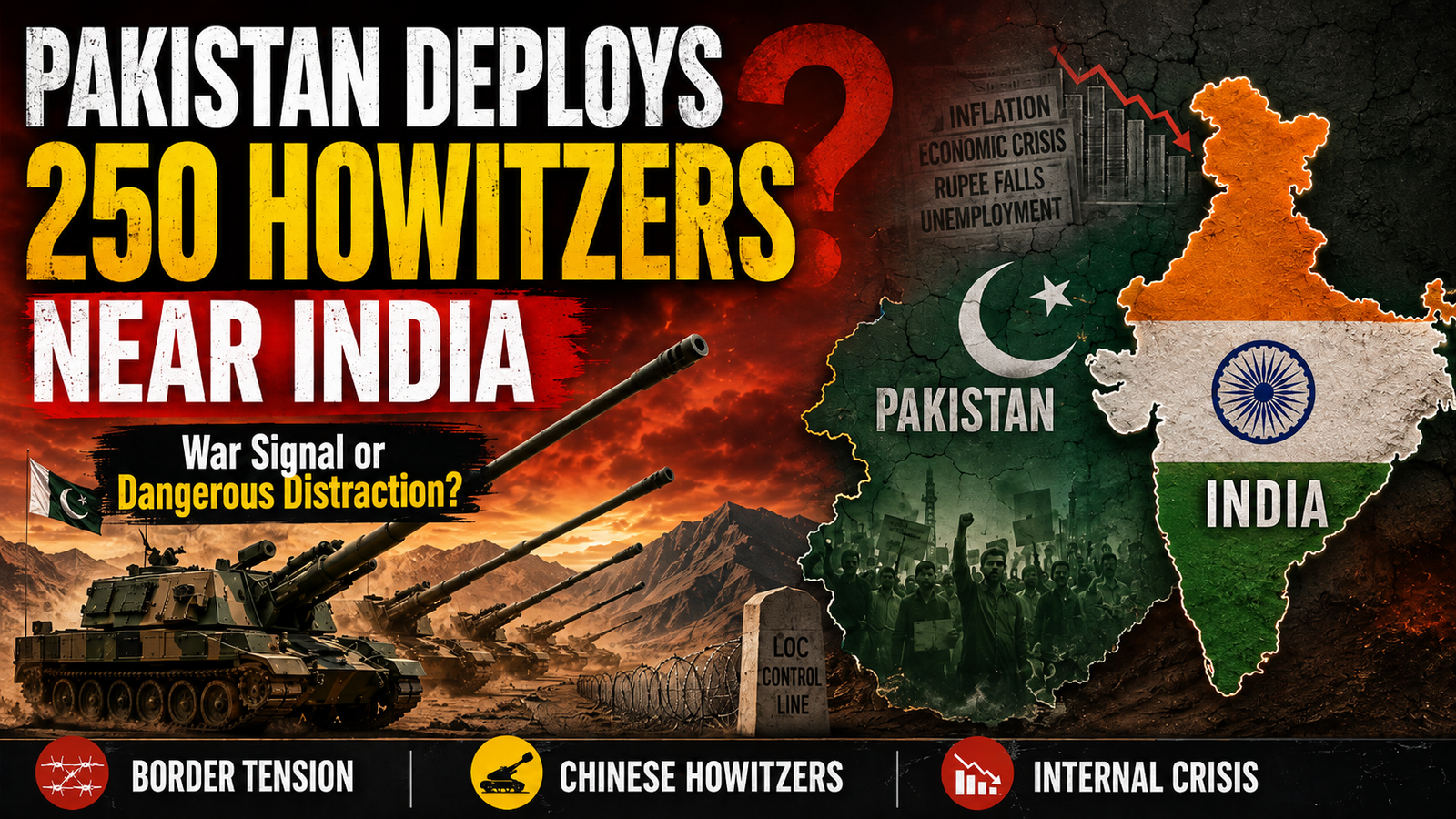
Pakistan Deploys 250 Howitzers Near India: War Signal or Dangerous Distraction?

Reports that Pakistan has positioned approximately 250 Chinese-made SH-15 howitzers along its border with India have raised an alarming question: Is Islamabad preparing for war, strengthening deterrence—or creating an external crisis to divert attention from domestic instability?
According to India Today, unnamed intelligence sources say the mobile 155mm artillery systems have been deployed across several sectors of Pakistan’s eastern frontier. However, Pakistan has not publicly confirmed the deployment, and no independent official verification has yet been released.
What Makes the SH-15 Dangerous?
The truck-mounted SH-15 is designed to fire rapidly and relocate before counter-battery systems can respond. Standard ammunition reportedly has a range of 30–40 kilometres, while specialized projectiles may reach up to 72 kilometres.
Deploying these weapons near India is therefore a serious military signal—but deployment alone does not prove that an attack is planned. It may also represent defensive positioning or long-term artillery modernization.
Is Pakistan Trying to Distract Its Population?
The timing naturally invites suspicion.
Pakistan is confronting widening insurgencies in Balochistan and Khyber Pakhtunkhwa, deadly political unrest in Pakistan-administered Kashmir and continuing economic pressure. The World Bank projected only 3% growth for FY2026, with public debt remaining close to 76% of GDP. World Bank
Creating tension with India could temporarily unite public opinion and shift headlines away from these problems. Nevertheless, there is currently no verified evidence that domestic distraction is the purpose of the reported deployment.
India Is No Longer the India of 1971
Pakistan’s military leadership must recognize that India’s defence capabilities have fundamentally changed.
India is no longer overwhelmingly dependent on imported equipment. Domestic defence production reached a record ₹1.78 lakh crore in FY2025–26, nearly four times its 2013–14 level. Defence exports also climbed to ₹38,424 crore, reflecting India’s expanding military-industrial capacity. Press Information Bureau
A new conflict would therefore be extraordinarily costly for Pakistan. Memories of **1971—not 1972—**remain powerful: that war ended with East Pakistan becoming Bangladesh. Today’s circumstances are different, and Pakistan’s breakup cannot be responsibly predicted. However, war could place enormous pressure on its already fragile economy and internal cohesion.
Final Verdict
Pakistan may intend the howitzer deployment as deterrence rather than preparation for invasion. Yet military signalling between two nuclear-armed neighbours can quickly produce miscalculation.
India should remain alert, technologically prepared and diplomatically calm. Pakistan’s generals, meanwhile, should understand that manufacturing an external confrontation cannot permanently solve internal failures. Another war would not rescue Pakistan—it could become its most disastrous strategic mistake.
Editorial Note: This analysis is based on media reports citing unnamed intelligence sources. The deployment and its purpose have not been independently confirmed.