














































India Names 27 Arunachal Sites: A Direct Message to China’s Map War

India Sends a Strong Border Message
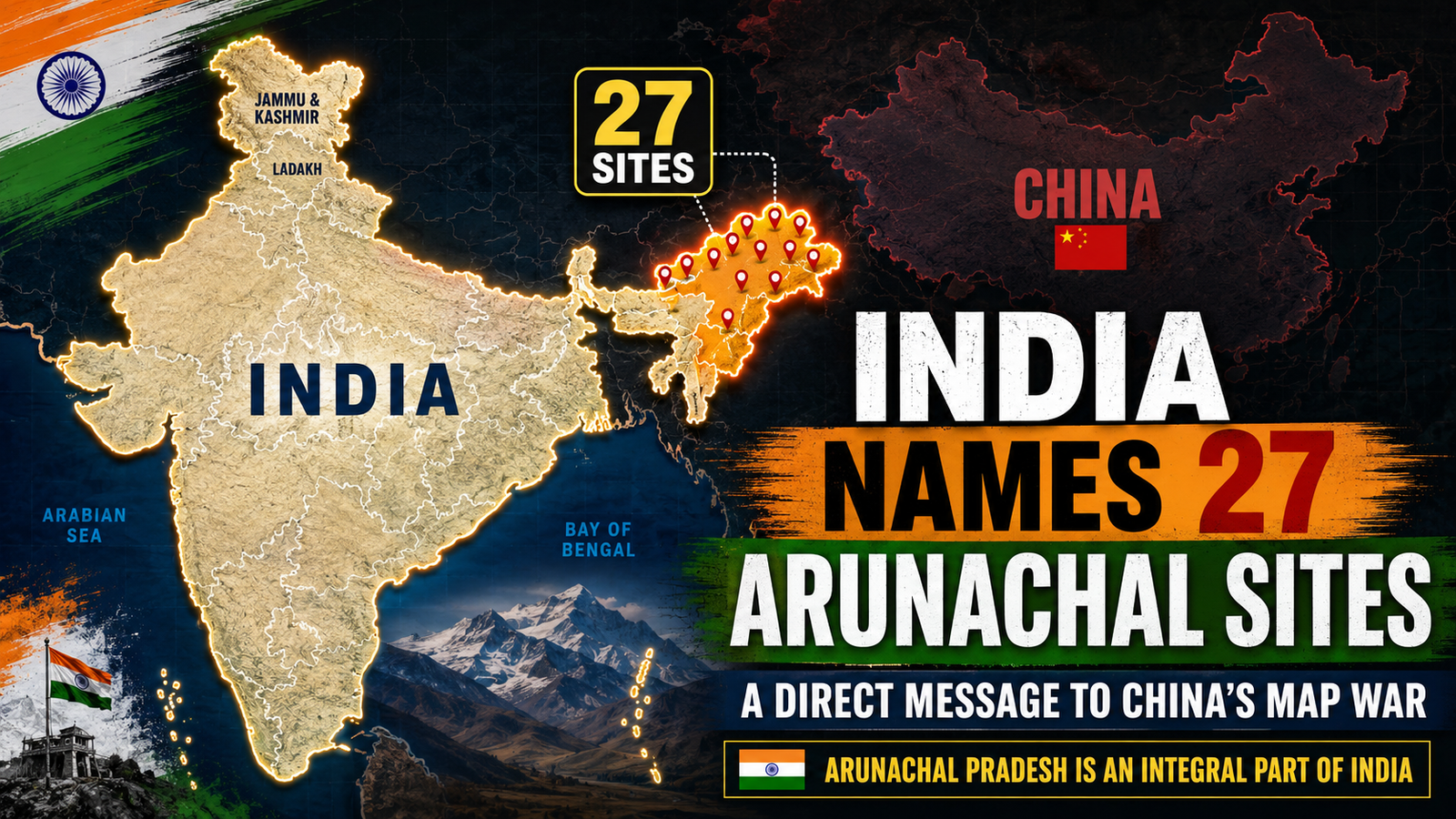
India has made a powerful cartographic move by formally identifying 27 locations in Arunachal Pradesh with standard names on the official Survey of India map.
This is not just a mapping update. It is a clear strategic message to China.
The updated Survey of India map assigns official standard names to key Arunachal Pradesh sites, including mountain passes, border villages, memorials and a high-altitude lake. Reports say the move is part of India’s effort to remove ambiguity around frontier locations and counter China’s repeated attempts to rename places in Arunachal Pradesh.
For India, the message is simple: Arunachal Pradesh is, was and will always remain an integral and inalienable part of India.
Why This Move Matters
China has repeatedly tried to assign Chinese names to places in Arunachal Pradesh, which Beijing refers to as “South Tibet.” India has strongly rejected these attempts, calling them fictitious and unacceptable.
In April 2026, India again rejected China’s attempt to give new names to places that are part of Indian territory. The Ministry of External Affairs said such actions cannot change the undeniable reality that Arunachal Pradesh is an integral part of India.
That is why India’s latest mapping move is significant. It is not only about names. It is about sovereignty, history, identity and territorial clarity.
Maps are not neutral in geopolitics. They shape claims, public understanding and international perception. When China uses maps as a political tool, India must respond with official clarity.
What Places Have Been Named?
The 27 locations include important border villages such as Longju, Maja and Bisa in Upper Subansiri district. The map also includes strategic mountain passes such as Dzo La, Riza La, Pukur La and Thag La. Thag La is historically important because it was linked to the opening phase of the 1962 India-China war.
The list also includes Sambho Sarovar, a high-altitude glacial lake, along with important memorials such as Jaswant Garh and Sher-e-Thapa Memorial, which honour Indian soldiers connected to the 1962 war.
This gives the move emotional as well as strategic weight. India is not only marking land. It is also remembering sacrifice.
A Response to China’s “Name Game”
China has used renaming as a pressure tactic for years. According to reports, China issued lists of Chinese names for places in Arunachal Pradesh in 2017, 2021, 2023 and again later. India has consistently rejected these moves.
But India’s latest step changes the tone.
Instead of only rejecting China’s claims, India is now strengthening its own official record. By placing standard Indian names on Survey of India maps, New Delhi is creating stronger public, administrative and strategic documentation.
This is important because border disputes are fought not only with soldiers, but also with maps, names, roads, villages, records and narratives.
Arunachal Is Not a Bargaining Chip
Arunachal Pradesh is home to Indian citizens, Indian institutions, Indian elections, Indian culture and Indian security infrastructure. The people of Arunachal are part of India’s democratic system.
China’s attempt to rename Indian territory does not change the reality on the ground.
India’s stand has been consistent: assigning invented or foreign names cannot alter sovereignty. News On Air quoted the Ministry of External Affairs saying China should avoid actions that inject negativity into relations and undermine efforts to stabilize India-China ties.
This is the correct approach. India can support peace with China, but peace cannot mean silence on territorial integrity.
Why Border Mapping Is National Security
India’s mapping move must be seen along with its broader border development strategy.
The government has also pushed border infrastructure through programmes such as the Vibrant Villages Programme, which focuses on development in villages along India’s northern border, including Arunachal Pradesh. The Ministry of Home Affairs said VVP-I covers select villages in 46 blocks along the northern border and includes projects related to livelihood, village infrastructure, health, roads, tourism, renewable energy and more.
This is important because border security is not only about military deployment. It is also about population, roads, connectivity, tourism, livelihoods and national integration.
A developed border village is also a strategic asset.
Message to China: India Will Not Accept Narrative Warfare
China’s strategy is not limited to soldiers at the border. It also uses maps, names, diplomatic statements, infrastructure and media narratives to slowly normalize its claims.
India’s response must be equally firm.
By naming these locations officially, India is telling China that it will not accept narrative warfare. Arunachal Pradesh cannot be turned into a diplomatic question mark through repeated renaming exercises.
The world should understand this clearly: changing names on paper does not change territory on the ground.
What This Means for India’s Future
This move also has a long-term impact.
Students, researchers, journalists, map users, administrators, travellers and defence analysts will now have clearer official references for these locations. Local history and military memory will also become more visible to the public.
India should continue this approach by improving maps, roads, telecom, tourism, local-language documentation and public awareness in Arunachal Pradesh.
A nation protects its territory not only by guarding it, but by knowing it, naming it, developing it and honouring its people.
Final Thoughts
India’s decision to formally name 27 Arunachal Pradesh sites is a strong and necessary response to China’s repeated map politics.
It shows that India will not allow Beijing to create confusion over Indian territory through artificial names and manufactured narratives.
Arunachal Pradesh is not “South Tibet.”
It is not disputed in India’s national consciousness.
It is an integral part of India.
The message from New Delhi is clear: India wants peace, but it will not compromise on sovereignty.
In the age of geopolitical map wars, names matter. Maps matter. Memory matters.
And India has now made its position visible on the map.
FAQs
What did India do in Arunachal Pradesh?
India formally identified 27 locations in Arunachal Pradesh by their standard names on the official Survey of India map.
Why is this important?
The move counters China’s repeated attempts to rename places in Arunachal Pradesh and strengthens India’s official territorial documentation.
Is Arunachal Pradesh part of India?
Yes. India’s official position is that Arunachal Pradesh is an integral and inalienable part of India.
Why does China rename places in Arunachal Pradesh?
China uses renaming as a political and diplomatic tactic to support its territorial claims, which India strongly rejects.
What message does India’s move send?
It sends a clear message that India will protect its sovereignty, official maps, historical memory and territorial identity.
Disclaimer: This article is for informational and editorial commentary only. It is based on publicly available reports and official statements. It does not promote hostility toward any country or community.