





























PoK Protests 2026: Killings, Blockade and Revolt

PoK Protests 2026: Killings, Blockade and a Revolt Pakistan Can No Longer Hide
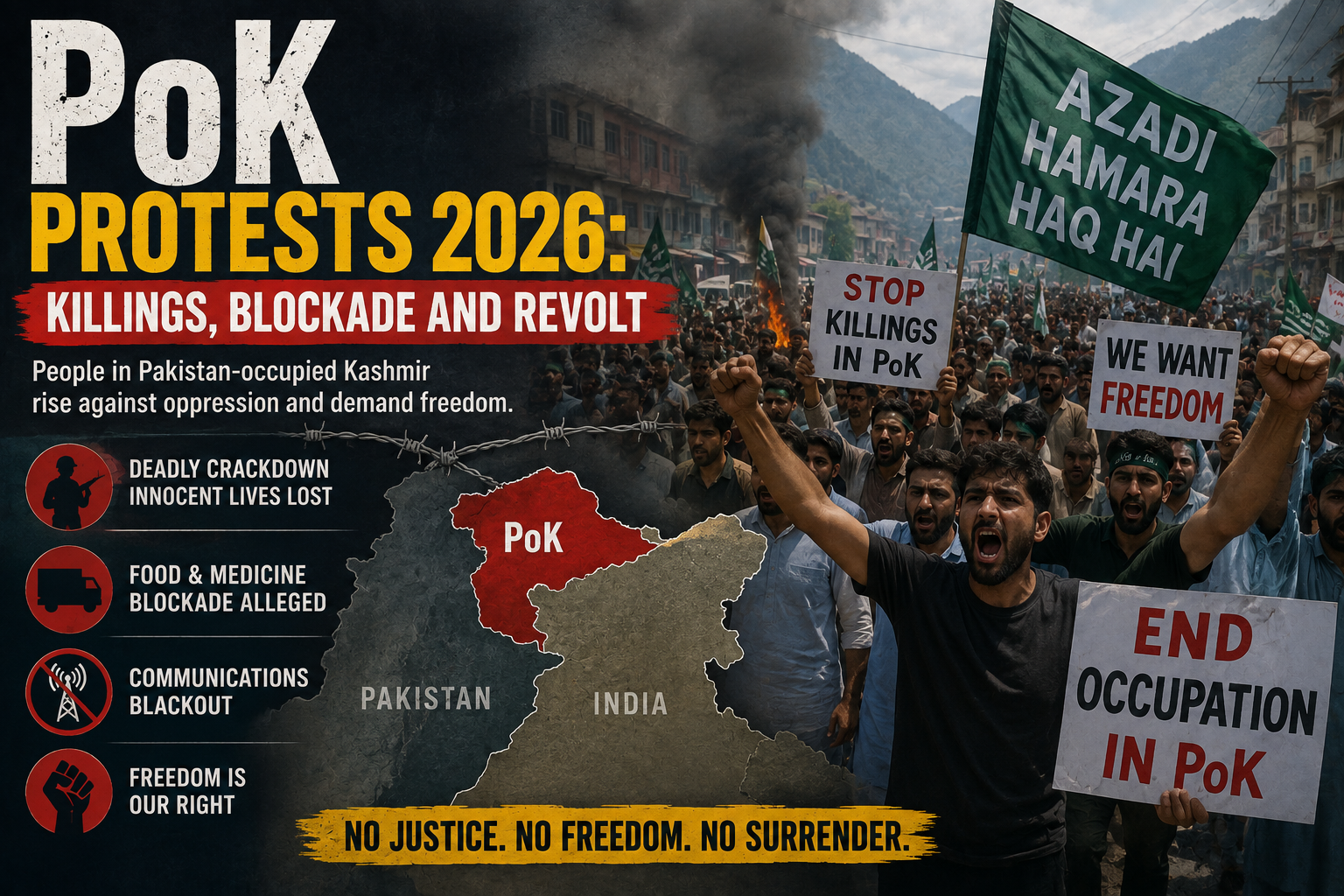
Pakistan-occupied Kashmir is witnessing far more than an ordinary protest. What began as a civil-rights movement over expensive electricity, food shortages and political representation has developed into a direct challenge to Pakistani control.
Videos and testimonies shared by local journalists, residents and Kashmiri activists show enormous demonstrations, funerals, armed deployments and desperate appeals for outside attention. A prolonged internet blackout has made independent verification difficult—but it has not prevented disturbing information from reaching the world.
The central question is no longer whether PoK is experiencing unrest. It is whether this movement is becoming an open revolt against Pakistan.
Security Forces Accused of Killing Protesters
Amnesty International has documented a “violent and sweeping crackdown” involving an internet shutdown, mass arbitrary arrests and deadly force. It confirmed that protesters and police personnel were killed during the June violence and demanded independent investigations into possible unlawful killings.
Amnesty also reported that journalist Sohrab Barkat was arrested after allegedly supporting the movement through his YouTube channel. The arrest demonstrates why citizen videos and diaspora networks have become so important: traditional reporting from inside the region has been severely restricted. Amnesty International
In late July, the Joint Awami Action Committee alleged that security forces killed dozens of unarmed protesters. Witnesses accused the authorities of removing bodies and restricting access to hospitals. Pakistan rejected allegations of responsibility, and the communications blackout prevented complete independent verification. The Guardian
The exact death toll remains disputed, but the existence of deadly violence is not. Reuters reported multiple protesters and security personnel killed in July, while Amnesty said media reports had placed the pre-election death toll at approximately 40, including protesters and members of law enforcement.
Food, Medicine, Electricity and Communications Under Pressure
The crisis is not limited to shootings and arrests.
PoK protest leader Sardar Aman Khan alleged that Pakistani authorities blocked food and medicine supplies for approximately three weeks. He appealed to India and people across the Line of Control for assistance. Protesters also accused authorities of restricting flour, food grains and other daily essentials to weaken the movement. India Today
International reporting confirms that road closures, security operations, protest blockades and transport disruption created serious shortages of food, fuel and medicine. Therefore, the humanitarian crisis cannot be blamed on only one factor. However, shutting communications, sealing access points and restricting independent media made the suffering worse and accountability far more difficult.
This is especially painful for residents who argue that PoK generates significant hydropower while local households face high electricity prices, shortages and unreliable services.
A Protest Turning Into a Freedom Movement
The JAAC movement initially presented a 38-point charter addressing:
- Subsidised flour and affordable electricity
- Unemployment and inflation
- Better healthcare and education
- An end to political privileges
- Greater local control over resources
- Abolition of 12 legislative seats representing refugees living elsewhere in Pakistan
The reserved seats have become a symbol of Islamabad’s political influence over PoK. Protesters argue that people who do not live in the territory can help determine its government.
The movement has since adopted a more openly political tone. At a major gathering, crowds reportedly raised the slogan “Hum lekar rahenge Azadi”—we will secure freedom. Aman Khan declared that PoK was not part of Pakistan and asked whether demonstrators should march towards the Line of Control. The crowd responded in support.
These statements show that the movement is moving beyond economic reforms. Some participants are demanding freedom from Pakistani control, while appeals to India and talk of marching towards the Line of Control suggest a growing willingness to explore alternatives.
However, accession to India has not yet been adopted as an official, universal JAAC demand. The movement contains different voices—from economic reformers and autonomy supporters to advocates of complete independence and those looking towards India.
The Diaspora Is Taking the Protest Worldwide
Pakistan’s communications blackout has failed to silence Kashmiri families living abroad.
Demonstrations have taken place in London, Bradford, Birmingham and Manchester. Hundreds of diaspora members gathered outside Pakistani diplomatic premises, demanding an end to the crackdown and restoration of basic rights.
More than 50 British parliamentarians reportedly supported a letter raising concerns about arrests, blocked communications and the inability of British Kashmiris to contact relatives. The Week
The crisis has also reached Brussels. A briefing hosted by the Press Club Brussels Europe highlighted reports of civilian deaths, disappearances, detentions, humanitarian deprivation and families in Belgium being unable to contact relatives. Press Club Brussels Europe
This international mobilisation matters. Diaspora communities can preserve evidence and draw attention to events that authorities may prefer to keep hidden.
Is This Genocide Against Kashmiris?
The scale of the allegations is extremely serious. They include unlawful killings, mass arrests, disappearances, communications censorship, restricted supplies and possible collective punishment.
Nevertheless, “genocide” has a specific legal meaning: it requires evidence of an intention to destroy a national, ethnic, racial or religious group, wholly or partly. No international court or independent UN investigation has yet established that legal conclusion in PoK.
An immediate international investigation is necessary to determine the complete scale of the violations.
Ajit Doval’s Warning and Pakistan’s Fault Lines
Ajit Doval did not specifically predict in 2014 that PoK would soon join India. His actual warning was broader and potentially more significant.
Doval argued that India could respond to Pakistani aggression by applying pressure to Pakistan’s internal vulnerabilities. His most widely reported statement warned that another Mumbai-style terrorist attack could result in Pakistan losing Balochistan.
Today, those vulnerabilities are visible:
- A sustained uprising in PoK
- A violent separatist conflict in Balochistan
- Tensions with Afghanistan across the disputed Durand Line
- Sindhi nationalist grievances
- Economic dependence on external financial assistance
- Declining public confidence in political and military institutions
These crises do not automatically mean that Pakistan will disintegrate. But they show that military power cannot permanently suppress every regional grievance.
Could Pakistan’s Map Change by 2028?
My prediction is that Pakistan could face a map-changing constitutional or territorial crisis by 2028 if unrest in PoK, Balochistan and the Afghan border region intensifies simultaneously.
This is an analytical prediction—not an established certainty. Pakistan still has a powerful military, nuclear weapons, international partners and functioning state institutions.
Yet every crackdown creates more anger. Every internet blackout increases distrust. Every civilian death makes reconciliation harder. If Islamabad continues treating demands for food, electricity, representation and dignity as terrorism, it could push reform movements towards separatism.
Final Word
PoK is no longer suffering in silence. Local journalists are documenting events, residents are sending videos despite the blackout, protesters are demanding freedom and diaspora communities are taking their concerns to Britain and Europe.
Whether the movement leads to reform, independence or a closer relationship with India will ultimately depend on the people of PoK.
One reality is already clear: bullets, blockades and censorship cannot provide Pakistan with permanent control or political legitimacy.
Frequently Asked Questions
Why are people protesting in PoK?
Protesters are demanding affordable food and electricity, political representation, employment, local control over resources and protection of their civil rights.
Has Pakistan blocked food and medicine?
Protest leaders allege that authorities deliberately restricted essential supplies. Independent reporting confirms serious shortages resulting from road closures, transport disruption, security measures and protest blockades.
Are PoK protesters demanding independence?
Freedom slogans and statements rejecting Pakistani control have become increasingly visible. However, the movement contains different political positions.
Are protesters demanding to join India?
Some protesters have appealed to India and supported moving towards the Line of Control, but accession to India is not yet the movement’s official universal demand.
Is Pakistan committing genocide in PoK?
Deadly repression and grave human-rights violations have been alleged, but genocide has not been legally established. An independent international investigation is urgently required.
Editorial Disclosure: This analysis draws upon international news reports, human-rights organisations and statements from protest leaders. Some casualty and blockade claims remain difficult to verify because of restrictions on communications and media access.