















































DRDO PGB-500 Bunker-Buster: Is Operation Sindoor 2.0 Coming?

DRDO’s 500 Kg Bunker-Buster Bomb: Is India Preparing for Operation Sindoor 2.0?
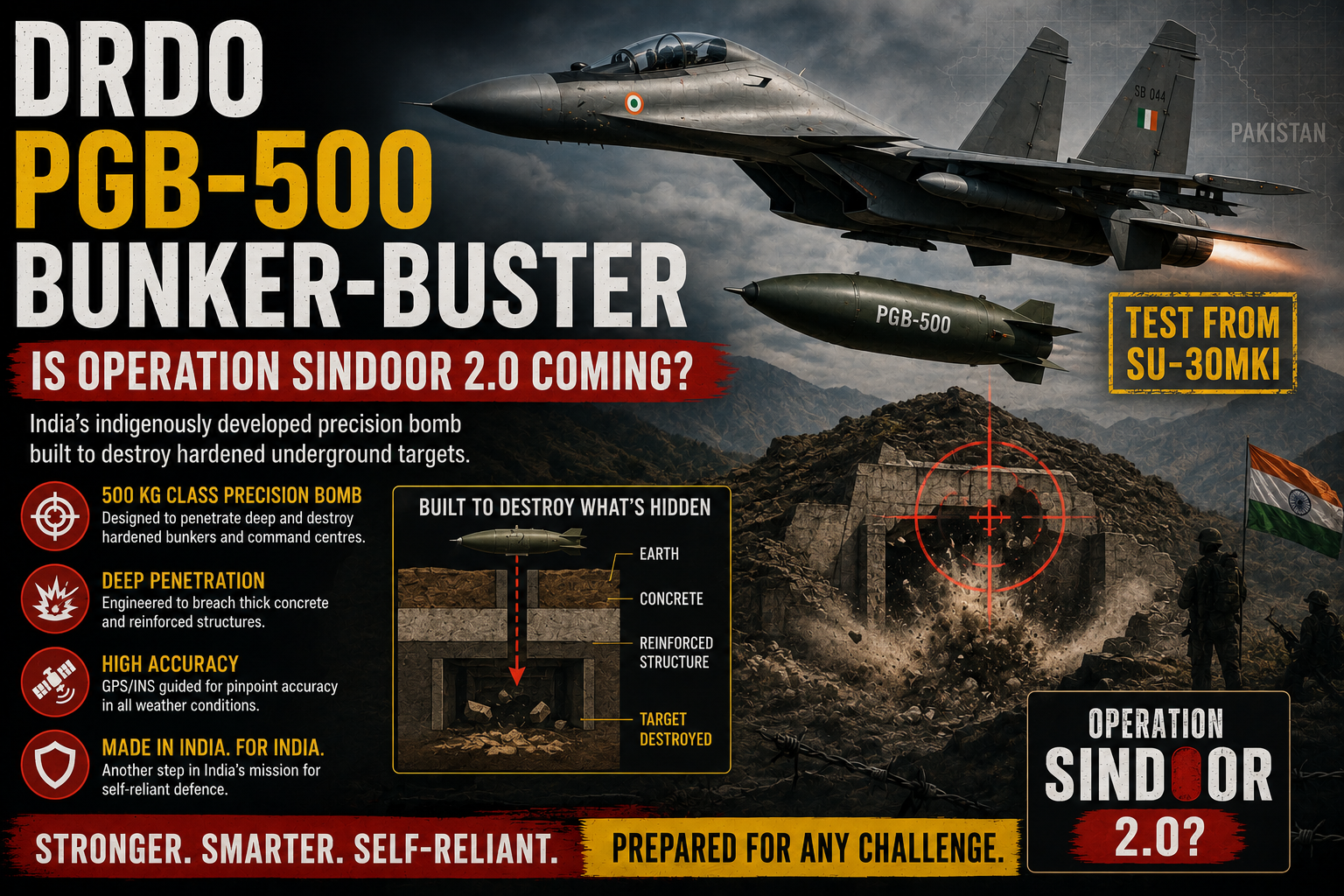
India is preparing to test its indigenous PGB-500 precision-guided bomb from the Su-30MKI fighter aircraft. The development has quickly sparked speculation: Is India strengthening its arsenal for an Operation Sindoor 2.0?
The weapon could significantly improve India’s ability to strike fortified bunkers and other high-value targets. However, there is currently no official announcement of a new military operation.
The PGB-500 trials confirm growing precision-strike capabilities—not an immediate decision to attack.
What Has DRDO Officially Confirmed?
An official government procurement document confirms that carriage and release flight trials of the PGB-500 are planned for September and October 2026.
According to the official trial-support specification, the bomb will be tested from a Su-30MKI aircraft. The trials are expected to involve DRDO, the Directorate General of Aeronautical Quality Assurance and other development partners.
Testing is likely to take place at Air Force Station Jodhpur and the Chandan range near Jaisalmer.
This document is important because it confirms that the PGB-500 programme has progressed beyond general discussion and is moving toward aircraft-integration trials.
Is the PGB-500 Really a Bunker-Buster?
Several defence reports describe the PGB-500 as a 500 kg-class precision weapon intended for fortified targets. Such weapons generally combine an impact-resistant casing, accurate guidance and a delayed fuze, allowing detonation after penetrating a structure.
Potential targets could include:
- Reinforced military bunkers
- Command-and-control centres
- Aircraft shelters
- Ammunition-storage facilities
- Hardened terrorist infrastructure
However, the official trial document calls it a “PGB 500 Bomb.” It does not publicly reveal its penetration depth, explosive filling, guidance system or confirmed operational range.
The planned events are carriage and release trials. They will primarily examine whether the Su-30MKI can safely carry and release the weapon under flight conditions. They should not be confused with a confirmed destructive test against a deep underground bunker.
Therefore, calling it a bunker-buster may describe its expected role, but its complete capabilities remain classified or unconfirmed.
Why the Su-30MKI Matters
The Su-30MKI is one of the Indian Air Force’s most capable strike aircraft. It already carries weapons such as the BrahMos cruise missile and Astra air-to-air missile.
Integrating the PGB-500 could give it another option for attacking hardened targets with greater accuracy. Precision is especially important when military objectives are located near civilian areas, as it can reduce unintended damage when combined with reliable intelligence and careful targeting.
An indigenous bomb would also offer India several advantages:
- Reduced dependence on imported weapons
- Faster domestic production during emergencies
- Lower long-term procurement costs
- Greater control over upgrades and configurations
- Improved supply-chain security during a conflict
These benefits make the programme strategically important even if no immediate operation is planned.
Is India Preparing for Operation Sindoor 2.0?
The short answer is: India is preparing the capability, but there is no evidence that Operation Sindoor 2.0 has been authorised.
Operation Sindoor was launched in May 2025 following the Pahalgam terrorist attack. India described it as a precise and calibrated response against terrorist infrastructure in Pakistan and Pakistan-occupied Jammu and Kashmir.
The government has repeatedly maintained that India will respond decisively to future cross-border terrorism. Defence Minister Rajnath Singh said in April 2026 that India executed and halted Operation Sindoor on its own terms.
That policy means India wants credible military options ready before another crisis occurs. The PGB-500 could eventually become one of those options.
But testing a new weapon is not proof that a strike is imminent. Defence systems often require years of design work, aircraft integration, evaluation and user trials before operational induction.
Why This Weapon Still Sends a Strong Message
Even without a new operation, the PGB-500 carries an important message of deterrence.
Militant organisations and their supporters have traditionally relied on fortified shelters, underground facilities and locations believed to be protected from conventional attack. A precision bunker-busting capability could make such protection less reliable.
It also signals that India is studying lessons from Operation Sindoor. Future confrontations may require weapons that can accurately strike fortified targets while allowing aircraft to operate from safer distances.
The real value of the PGB-500 may therefore be psychological as well as military: adversaries must consider that hardened infrastructure could become vulnerable during a future crisis.
What Must Happen Before Induction?
The upcoming trials are only one stage in the weapon’s development. Before operational deployment, the PGB-500 would likely need to complete:
- Aircraft-carriage and aerodynamic testing
- Safe-separation and release trials
- Guidance and accuracy evaluation
- Warhead and fuze validation
- Indian Air Force user trials
- Production and quality-clearance procedures
Only after successful evaluation could the bomb be cleared for wider service.
Conclusion
The DRDO PGB-500 programme represents a major step in India’s effort to build an indigenous precision-strike arsenal. Its planned trials from the Su-30MKI are real and officially documented.
However, reports that the test proves Operation Sindoor 2.0 is about to begin go beyond the available evidence.
India is clearly preparing for future security challenges and strengthening its ability to strike fortified targets if required. Whether that capability is ever used will depend on intelligence, political decisions and the actions of India’s adversaries.
The strongest conclusion is simple: Operation Sindoor 2.0 has not been announced, but India wants to ensure that it has more powerful options if another major terrorist attack demands a response.
Frequently Asked Questions
What is the PGB-500?
The PGB-500 is an indigenous precision-guided bomb being developed for the Indian Air Force. Its complete operational specifications have not been publicly released.
When will the PGB-500 be tested?
Official documents indicate that carriage and release trials from a Su-30MKI are planned for September and October 2026.
Can the PGB-500 destroy underground bunkers?
Defence reports describe it as suitable for hardened targets, but its officially verified penetration capability has not been disclosed.
Has India announced Operation Sindoor 2.0?
No. India has not officially announced an operation under that name. The PGB-500 trials demonstrate military preparedness, not confirmation of an imminent strike.
Disclaimer: This article is based on publicly available government documents, credible media reports and defence analysis available at the time of publication. While official documents confirm planned PGB-500 carriage and release trials, its description as a “bunker-buster” and any connection to a possible “Operation Sindoor 2.0” remain analytical interpretations, not officially confirmed facts. The article is intended solely for news, education and public-interest discussion. Readers should consult official DRDO, Ministry of Defence and government announcements for verified updates.