








































AfD Wins German State Election: Is Europe Moving Towards the Far Right?
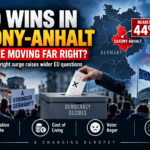
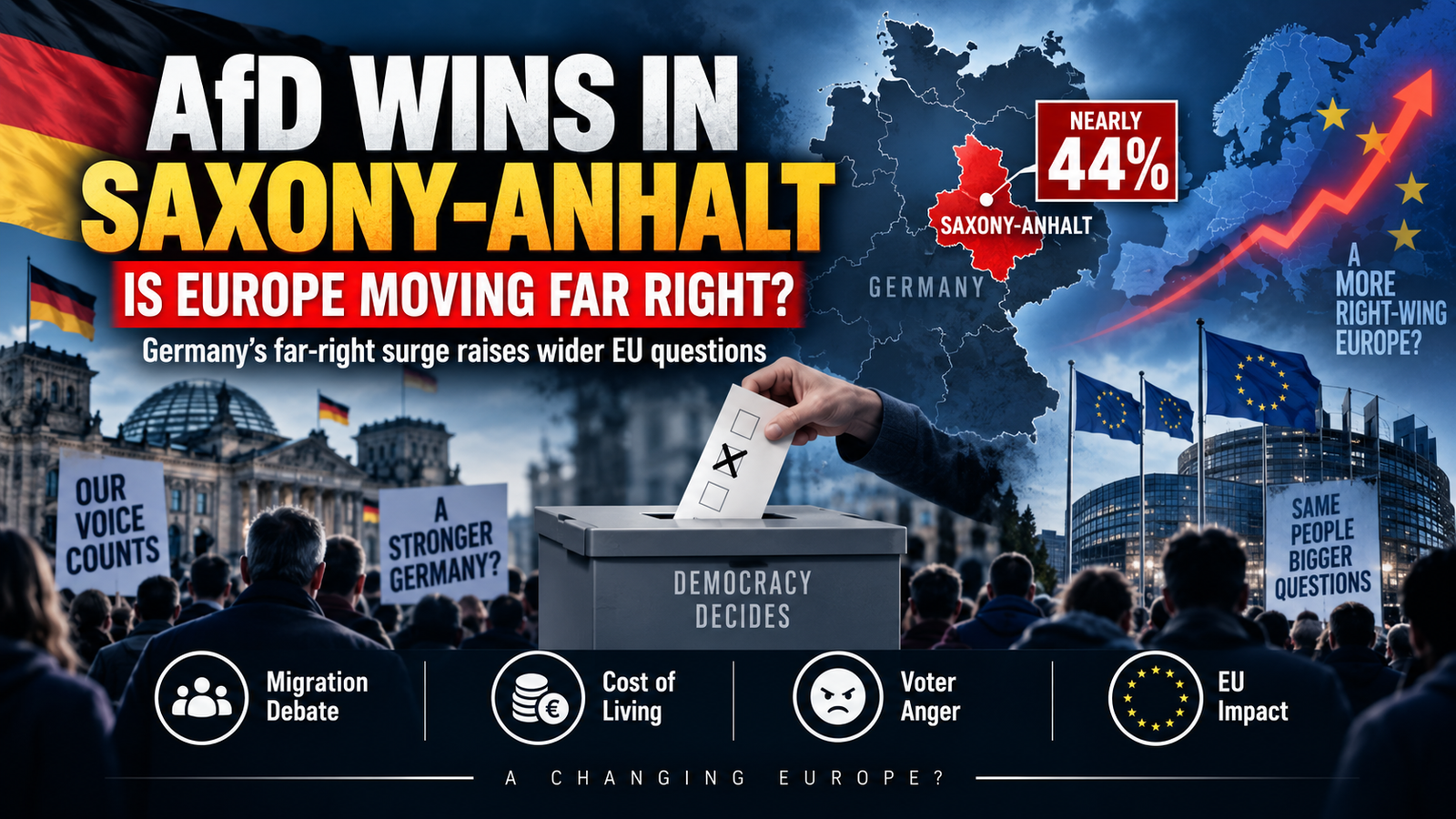
Germany has witnessed a historic political shock. The far-right Alternative for Germany, or AfD, won nearly 44% of the vote in the eastern state of Saxony-Anhalt—more than double its performance in the previous state election.
The result is the AfD’s strongest showing in any German state election. It also reflects a much wider European trend: nationalist and anti-establishment parties are gaining support as voters become frustrated with immigration, living costs, economic stagnation and traditional political institutions.
However, winning the most votes does not automatically mean the AfD will control Saxony-Anhalt’s government.
What Happened in the Saxony-Anhalt Election?
According to preliminary final results from the September 6 election, the AfD received approximately 43.8% of the vote and secured 39 of the state parliament’s 83 seats.
The centre-right Christian Democratic Union, or CDU, suffered a devastating defeat, falling to approximately 17.2%.
The AfD’s vote share rose dramatically from 20.8% in the 2021 state election. Voter turnout also climbed to around 76.5%, suggesting that the result was driven by unusually strong political engagement rather than public apathy.
AfD candidate Ulrich Siegmund described the outcome as a mandate to govern. Nevertheless, his party remains three seats short of the 42 needed for an absolute majority, according to Reuters’ coverage of the election.
Can the AfD Form a Government?
That remains uncertain.
Germany’s established parties have traditionally maintained a political “firewall” against cooperating with the AfD. Chancellor Friedrich Merz has again ruled out an alliance between his CDU and the far-right party.
Without a majority, the AfD would need support from another party or individual lawmakers to elect Siegmund as state premier and pass legislation.
The left-populist Sahra Wagenknecht Alliance, known as BSW, won enough seats to potentially become influential in the negotiations. Despite major economic differences, BSW and the AfD share some positions involving immigration, sanctions on Russia and opposition to parts of Germany’s foreign policy.
No final governing arrangement had been confirmed at the time of publication. The AfD has therefore won the election, but it has not yet secured control of the state government.
Why Did So Many Voters Support the AfD?
There is no single explanation. The result reflects several overlapping political and economic concerns.
Economic Frustration
Germany has struggled with weak growth, high energy costs, industrial pressure and concerns about jobs. These problems have been particularly sensitive in eastern regions that still feel economically disadvantaged decades after reunification.
Many voters believe the established parties have failed to protect German manufacturing, control public spending or improve living standards.
According to Reuters’ election analysis, cost-of-living pressures, pensions and energy prices were among the issues driving dissatisfaction with the government.
Immigration and Border Control
The AfD has made immigration its most powerful political issue. It promises stronger borders, faster deportations and major restrictions on asylum.
Germany accepted a large number of refugees during and after the 2015 migration crisis. More recently, pressure on housing, public services and local government budgets has kept migration at the centre of political debate.
Some voters support the AfD because they believe mainstream parties ignored these concerns or dismissed legitimate questions about integration and public resources.
Distrust of Mainstream Parties
For many supporters, voting for the AfD is also a protest against the entire political establishment.
Complicated coalition governments can create the impression that elections change party combinations without producing meaningful policy changes. The AfD has successfully presented itself as the only party willing to challenge that system.
Opposition to Germany’s Russia Policy
The AfD has criticised Germany’s military support for Ukraine and called for improved economic relations with Russia.
These positions have found support in parts of eastern Germany, where some voters oppose higher defence spending and blame sanctions or the breakdown in Russian energy ties for rising costs.
Critics argue that the AfD’s approach could weaken Germany’s commitments to Ukraine and benefit Moscow.
Why Is the AfD Called Far Right?
The AfD describes itself as a democratic, conservative and patriotic party. It rejects accusations that it is racist or opposed to Germany’s constitutional system.
However, political researchers and major international news organisations generally classify it as far right because of its nationalist, anti-immigration and Eurosceptic positions.
The Saxony-Anhalt branch has been classified as a confirmed right-wing extremist organisation by the state’s domestic intelligence authority since 2023. The agency says elements of the party promote ideas that conflict with human dignity and constitutional equality. The AfD disputes the assessment and says intelligence agencies are being used politically against the opposition.
The classification is explained on the official Saxony-Anhalt Interior Ministry website.
This dispute is one reason Germany’s traditional parties remain reluctant to cooperate with the AfD, even after its major electoral gains.
Is This Part of a Wider European Shift?
Yes—but Europe’s right-wing parties are not identical.
The continent has experienced a clear movement towards nationalist, anti-immigration and Eurosceptic politics:
- Giorgia Meloni’s Brothers of Italy leads the Italian government.
- Austria’s Freedom Party finished first in the 2024 national election.
- France’s National Rally has become one of the country’s most powerful parties.
- Geert Wilders’ Party for Freedom won the Netherlands’ 2023 election.
- Hungary’s Viktor Orbán has promoted nationalist and socially conservative policies for years.
- Spain’s Vox and Portugal’s Chega have expanded their electoral support.
Right-wing parties also made substantial gains in the 2024 European Parliament election, particularly in France, Germany, Austria and the Netherlands. The official European Parliament results showed a weaker liberal and green centre alongside stronger right-wing blocs.
Still, these parties differ on economics, NATO, Russia, the European Union and social policy. Calling them a single unified movement would be misleading.
Why Is the Far Right Rising Across Europe?
Several common factors are driving the shift.
Migration Has Become a Defining Issue
Voters across Europe are demanding more control over borders, asylum rules and integration. Mainstream parties have gradually adopted tougher migration policies, demonstrating how strongly the issue has changed public debate.
Cost-of-Living Pressure
Inflation, housing shortages, expensive energy and stagnant wages have created widespread frustration. Far-right parties often connect these economic problems to immigration, globalisation or European Union policies.
Decline of Traditional Parties
Centre-left and centre-right parties once dominated European politics. Their support has weakened as voters move towards parties offering clearer—although sometimes more confrontational—positions.
Cultural and National Identity
Some Europeans believe rapid demographic and social change has weakened national identity. Right-wing parties use this concern to campaign against multiculturalism and greater EU integration.
Social Media and Political Polarisation
Digital platforms allow political movements to communicate directly with voters without depending on traditional media. Short, emotional messages about crime, migration and national decline can spread particularly quickly.
Is Europe Becoming Far Right?
Europe is moving politically to the right, especially on immigration, national sovereignty, security and climate policy. However, that does not mean every European country is about to elect a far-right government.
In several countries, far-right parties have won the most votes but remained outside government because they could not find coalition partners. Mainstream parties, courts, independent institutions and coalition systems continue to limit their ability to exercise power.
The deeper change is that far-right parties are influencing policy even when they do not govern. Traditional parties increasingly adopt stricter positions on migration, border enforcement and national security to prevent further losses.
What Could the German Result Mean for Europe?
A stronger AfD could pressure Germany to change its policies on:
- Immigration and asylum
- Military support for Ukraine
- Relations with Russia
- EU climate regulations
- Defence spending
- European political integration
Germany is the European Union’s largest economy and one of its most influential members. A major political shift there would therefore affect decisions across the continent.
The immediate question is whether Germany’s political firewall can survive when the AfD approaches or exceeds 40% in parts of the country. Continually excluding the largest party can become politically difficult, but cooperation could also normalise positions that Germany’s institutions consider extremist.
Conclusion
The AfD’s victory in Saxony-Anhalt is more than a regional protest vote. Winning approximately 43.8% shows that the party has built a large and committed electoral base in eastern Germany.
Yet the AfD has not automatically gained power. It still needs enough parliamentary support to form a government, while mainstream parties continue to reject cooperation.
The broader European message is unmistakable. Voters are demanding greater border control, economic security and political accountability. When established parties appear unable or unwilling to respond, nationalist and far-right movements gain ground.
Europe is not uniformly becoming far right, but its political centre is clearly shifting. The Saxony-Anhalt result shows that this transformation is no longer happening at the edges of European politics—it is moving increasingly close to government.
Frequently Asked Questions
Which election did the AfD win?
The AfD finished first in the September 6, 2026 state election in Saxony-Anhalt, eastern Germany.
How much of the vote did the AfD receive?
Preliminary final results gave the party approximately 43.8% and 39 of the state parliament’s 83 seats.
Will the AfD form the government?
Not necessarily. The party lacks an absolute majority and requires support from other lawmakers. Coalition negotiations remain unresolved.
Is this a national German election result?
No. It was a state election in Saxony-Anhalt. However, the scale of the victory has important national implications.
Why is the far right rising in Europe?
Major factors include immigration concerns, rising living costs, weak economic growth, distrust of traditional parties, cultural anxiety and opposition to some EU policies.
Does every European right-wing party support the same policies?
No. These parties differ significantly on economics, Russia, NATO, the European Union and the role of government.
Disclaimer: This article is based on preliminary election results, official public information and credible media reporting available as of September 7, 2026. Government-formation negotiations remain ongoing, and the final political outcome may change. The terms “far right,” “nationalist” and “populist” reflect classifications commonly used by political researchers, public institutions and international news organisations; individual parties may reject those descriptions. This article is intended for news, education and public-interest analysis.
