











































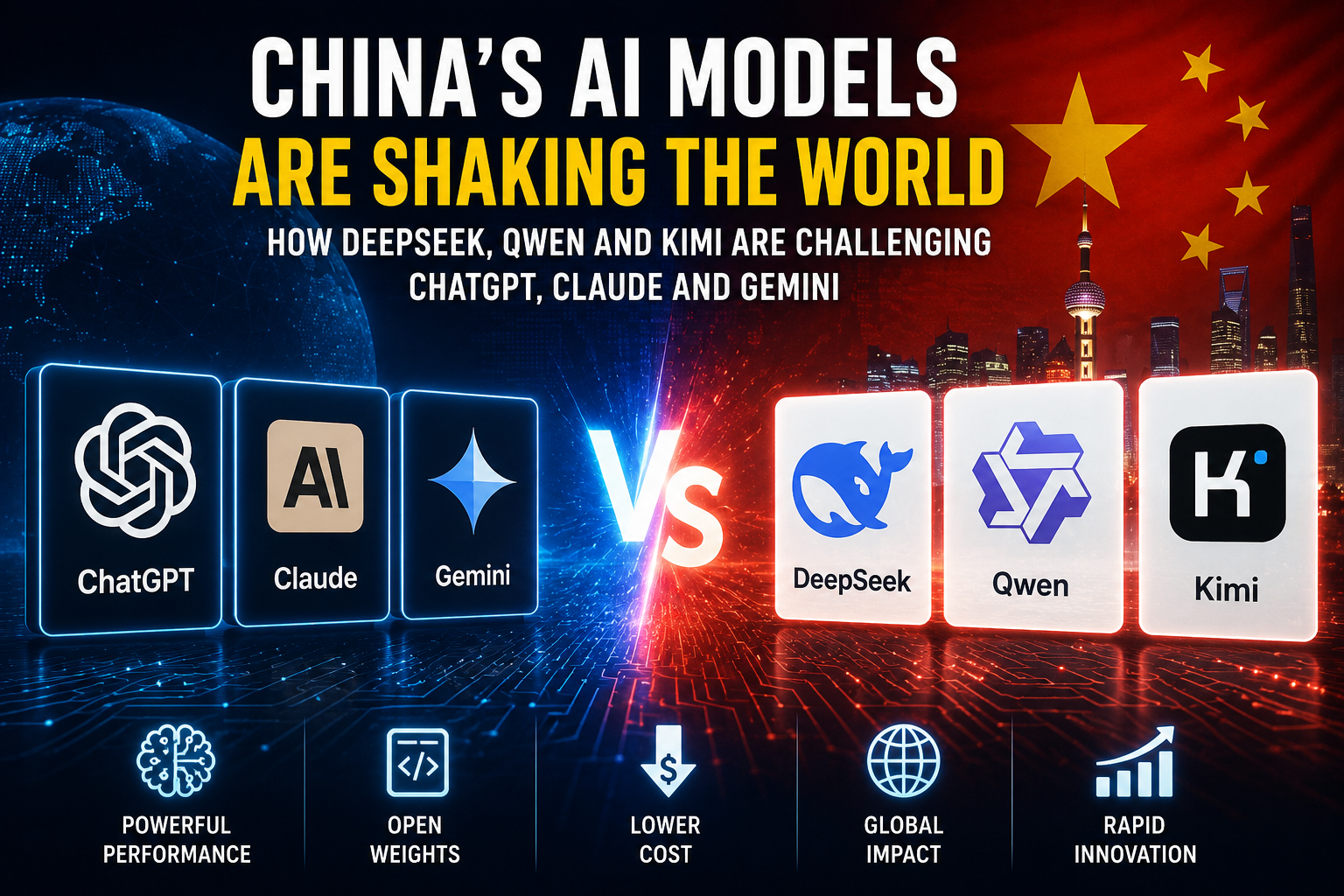
China’s AI Models Are Shaking the World: How DeepSeek, Qwen and Kimi Are Challenging ChatGPT, Claude and Gemini

China Is No Longer Just Catching Up in AI
For years, the artificial intelligence race looked simple: the United States had OpenAI’s ChatGPT, Anthropic’s Claude and Google’s Gemini at the top, while China was seen as catching up.
That picture is changing fast.
Chinese AI models such as DeepSeek, Alibaba’s Qwen and Moonshot AI’s Kimi are now competing aggressively on performance, price and open-weight availability. The biggest shift is not only intelligence. It is value for money.
For businesses, developers, students and startups, cost matters. If a model gives 80–95% of premium performance at a fraction of the price, the market starts paying attention.
Kimi K3: China’s New AI Shockwave
Moonshot AI’s Kimi K3 has become one of the biggest AI stories of 2026 because it is not just cheap — it is beating top Western models in important real-world categories.
The biggest headline is that Kimi K3 ranked #1 on Arena.ai’s Frontend Code leaderboard, placing ahead of leading U.S. models such as Claude Fable 5 and GPT-5.6 Sol in blind front-end coding evaluations. That is a major breakthrough because front-end coding is one of the most practical AI use cases for startups, developers and businesses.
This means China is no longer competing only on low cost. It is now competing on real capability.
At the same time, broader benchmarks need careful wording. On the Artificial Analysis Intelligence Index, Kimi K3 ranked near the frontier but was not #1 overall. Artificial Analysis reported it at #3, comparable to Claude Opus 4.8 and GPT-5.5, while behind Claude Fable 5 and GPT-5.6 Sol.
So the correct conclusion is stronger and more accurate: Kimi K3 is already #1 in front-end coding value and near the top in broader intelligence benchmarks.
That combination is exactly why Silicon Valley is worried. If a Chinese open-weight model can beat premium Western models in coding while offering strong overall intelligence at lower cost, the AI race has entered a new phase.
The Cost Advantage Is the Real Weapon
The AI war is becoming a pricing war.
DeepSeek’s official API pricing shows how aggressive Chinese model economics have become. DeepSeek lists deepseek-v4-pro at $0.435 per 1 million input tokens and $0.87 per 1 million output tokens, while its cheaper deepseek-v4-flash is listed at $0.14 input and $0.28 output per 1 million tokens.
Compare that with Western premium models. OpenAI’s pricing page lists gpt-5.5 at $5 input and $30 output per 1 million tokens, while gpt-5.5-pro goes much higher. Anthropic lists Claude Sonnet 5 at a promotional $2 input and $4 output per million tokens through August 31, 2026, rising to $3 input and $6 output after that, while Claude Opus 4.5 is listed at $5 input and $25 output.
Google Gemini is also strong on price in some models. Gemini 2.5 Flash is listed at $0.30 input and $2.50 output per million tokens, while Gemini 3.1 Pro Preview is much higher at $2 input and $12 output for prompts up to 200k tokens.
The message is clear: China is forcing the whole AI industry to cut prices.
DeepSeek Changed the Psychology of AI
DeepSeek was the model family that made the world take China’s AI efficiency seriously.
Academic reviews of DeepSeek noted that its V3 and R1 models gained global attention because of low cost, strong performance and open-source advantages, using techniques such as Mixture-of-Experts, Multi-head Latent Attention and reinforcement learning optimization.
Another review said DeepSeek-V3 and DeepSeek-R1 achieved performance comparable to top closed-source models from companies like OpenAI and Anthropic while requiring only a fraction of the training cost.
This changed the AI narrative. Before DeepSeek, many believed only companies spending tens of billions on chips and data centers could build frontier AI. DeepSeek showed that engineering efficiency can sometimes beat brute-force spending.
Alibaba’s Qwen: China’s Enterprise AI Weapon
Alibaba’s Qwen family is another major force.
Alibaba Cloud’s model pricing shows Qwen3.7-Max international pricing at $2.50 input and $7.50 output per 1 million tokens, while Qwen3-Max starts at $1.20 input and $6 output for shorter contexts. In China mainland deployment, Qwen3-Max is listed far cheaper at $0.359 input and $1.434 output for up to 32k tokens.
This matters because Alibaba is not just a lab. It is a cloud company with enterprise customers, e-commerce data, developer platforms and large-scale infrastructure.
If Qwen becomes the low-cost AI layer for Asian businesses, China can build a huge AI ecosystem around cloud, apps, agents, search, coding and automation.
Are Chinese Models Better Than ChatGPT, Claude and Gemini?
The honest answer is: not in every area.
OpenAI, Anthropic and Google still lead in many premium tasks, especially safety tooling, enterprise reliability, product ecosystem, multimodal polish, coding agents, long-context workflows and regulated enterprise deployment.
But Chinese models are becoming extremely competitive in the value segment.
Artificial Analysis reported that Kimi K3’s overall Intelligence Index score is comparable to Opus 4.8 and GPT-5.5, while its cost per Intelligence Index task was around $0.94, similar to GPT-5.6 Sol and about half the cost of Opus 4.8.
On another Artificial Analysis benchmark for long-horizon knowledge work, Kimi K3 ranked second only to Claude Fable 5, although it was slower and more expensive to run on that specific task set.
So the fair conclusion is this: Western models still compete strongly at the top, but China is attacking the market with cheaper, powerful, open or semi-open alternatives.
Why Developers Love Cheaper AI
For a normal user, a few dollars difference may not matter. For a company processing millions or billions of tokens, it matters a lot.
Cheaper AI means lower customer-support costs, cheaper coding assistants, more affordable AI tutors, better automation for small businesses, lower-cost chatbots and faster adoption in developing countries.
This is why Chinese models are dangerous for Western AI companies. If premium models remain expensive, many businesses may shift routine workloads to cheaper Chinese or open models and use expensive Western models only for the hardest tasks.
That could reduce the pricing power of OpenAI, Anthropic and Google.
The Security and Trust Question
There is another side to the story.
U.S. officials and AI companies have raised concerns about Chinese models, data security, censorship, geopolitical risk and alleged model distillation. Business Insider reported that a top White House official accused Moonshot AI of using Anthropic’s model to build Kimi K3, while also acknowledging that legitimate distillation is a normal part of AI development.
These allegations are serious, but they are also part of a larger U.S.-China technology conflict.
For users and companies, the practical lesson is simple: use AI tools carefully. Check data policies, hosting location, compliance rules, privacy risks and whether the model is suitable for sensitive work.
What This Means for India
India should watch this AI price war very closely.
The rise of cheaper Chinese models is good for Indian developers in the short term because it reduces AI costs. Indian startups can build products faster and cheaper.
But there is also a strategic risk. If India becomes dependent on foreign AI models — whether American or Chinese — the country may lose control over data, language models, digital infrastructure and future AI value creation.
India needs its own AI ecosystem: Indian language models, sovereign compute, open datasets, AI chips, cloud infrastructure and domain-specific models for healthcare, agriculture, law, education and governance.
The lesson from China is clear: policy support, engineering talent and cost discipline can create global AI power.
Final Thoughts
China is not simply copying the West anymore. It is competing through efficiency, open-weight strategy and aggressive pricing.
DeepSeek changed the cost debate. Alibaba’s Qwen is pushing enterprise AI. Moonshot’s Kimi K3 is challenging the idea that only closed U.S. models can be near the frontier.
ChatGPT, Claude and Gemini remain powerful. But the AI market is no longer only about who has the smartest model. It is about who can deliver the most intelligence at the lowest usable cost.
That is where China is becoming extremely dangerous.
For India, this is both an opportunity and a warning. Cheap AI can help Indian startups grow, but long-term digital sovereignty will require India to build its own AI foundation.
The future AI race will not be won only by the country with the biggest model. It will be won by the country that makes intelligence affordable, scalable and sovereign.
FAQs
Are Chinese AI models better than ChatGPT, Claude and Gemini?
Not in every area. But Chinese models like DeepSeek, Qwen and Kimi are becoming highly competitive on cost and value for money.
Why is DeepSeek important?
DeepSeek showed that strong AI performance can be achieved with efficient engineering and lower costs, challenging the idea that only massive spending can produce advanced models.
What is Kimi K3?
Kimi K3 is Moonshot AI’s advanced model that has scored strongly on independent AI benchmarks and is expected to become a major open-weight competitor.
Why are Chinese AI models cheaper?
They use efficiency-focused architectures, aggressive pricing, open-weight strategies and strong domestic competition to reduce cost.
What should India learn from China’s AI rise?
India should build its own AI models, sovereign compute, Indian-language AI systems and affordable AI infrastructure instead of depending only on foreign platforms.
Disclaimer: This article is for informational and educational purposes only. It does not recommend using any particular AI model for sensitive data, national security, medical, legal or financial decisions. Pricing and benchmark rankings can change quickly, so readers should verify latest details before choosing an AI provider.