


















Rubio in India: Taj Mahal, Trade Tensions and a Quad Meeting That Has China Watching

Photo Credit: Ministry of External Affairs/ @meaindia (Instagram)
US Secretary of State Marco Rubio landed in India on May 23 on his first-ever official visit — four cities, four days, and a packed diplomatic agenda. Here’s what happened, what was agreed, and what it means for India-US ties at their most complicated moment in two decades.
| On Saturday morning, May 23, 2026, a US Air Force plane touched down at Netaji Subhash Chandra Bose International Airport in Kolkata. Out stepped Marco Rubio — the first US Secretary of State to visit India in years, and the first top diplomat from the Trump administration to make the journey. His itinerary: Kolkata, Agra, Jaipur, New Delhi. His mission: repair a relationship that has quietly frayed since Trump returned to the White House. |
🗓️ Four Days, Four Cities: The Full Rubio India Tour
| Day / City | What Happened |
| May 23 Kolkata | Arrival + Mother House visit Rubio landed at NSCBI Airport, Kolkata — becoming the highest-profile US official to land in the city in years. He visited Mother House, headquarters of the Missionaries of Charity founded by Mother Teresa. Later called on PM Modi in New Delhi. |
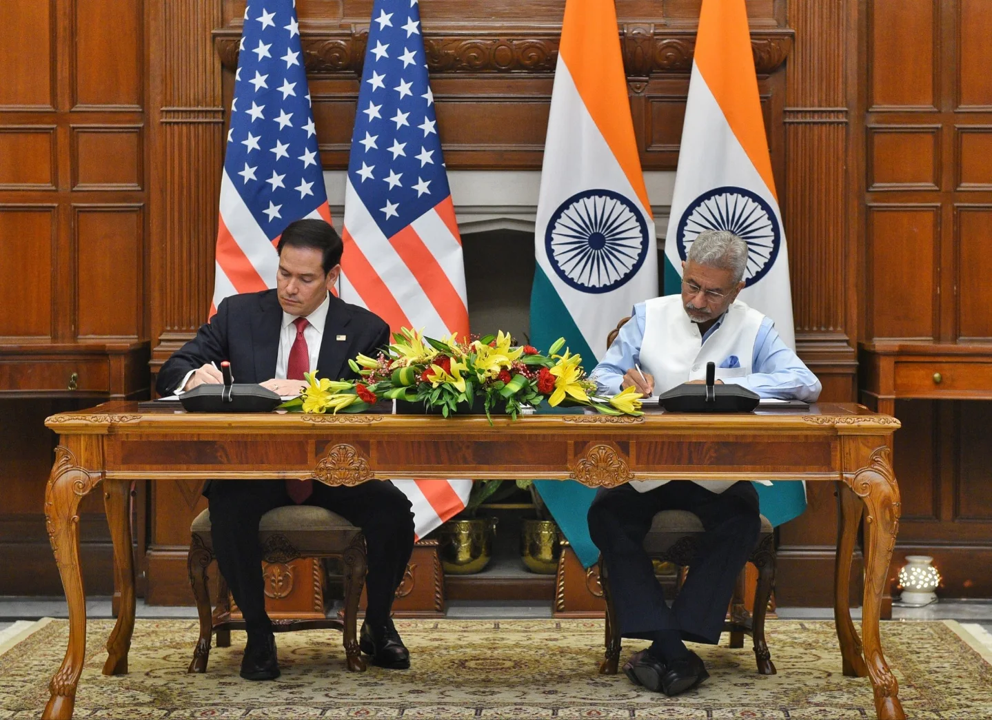
| May 24 New Delhi | Bilateral talks: Jaishankar Joint press conference at Hyderabad House. Rubio called India “one of Washington’s most important strategic partners.” Jaishankar said both nations are driven by their own national interests. Talk of trade deal optimism. |
| May 25 Agra & Jaipur | Taj Mahal + Amber Fort Rubio and wife Jeanette toured the Taj Mahal in Agra and Amber Fort in Jaipur accompanied by Indian artists performing for the delegation. Cultural diplomacy at its most photogenic. |
| May 26 New Delhi | Quad Foreign Ministers’ Meeting Rubio chairs the Quad ministerial with India’s Jaishankar, Japan’s FM Takeshi Iwaya, and Australia’s FM Penny Wong. South China Sea, supply chains, maritime security, AI, and clean energy on the agenda. |
⚠️ Why India-US Ties Hit Their Lowest Point in Two Decades
To understand why Rubio’s visit matters, you need to understand why it was necessary. India-US relations — which were at a high point during Modi’s visits to Washington in 2023 — have cooled sharply since Trump’s return to the White House in January 2025.
Three specific issues drove the friction:
| Issue | Status | What Happened |
| Trump Tariffs | Partially resolved | Trump imposed steep tariffs on Indian exports. India and US reached an interim arrangement reducing tariffs to 18%, but a full trade deal remains unsigned. |
| Russian Oil purchases | Ongoing tension | Trump pressured India to stop buying discounted Russian oil. India refused, citing energy sovereignty. Trump imposed tariffs partly because of this. Relations strained. |
| Ceasefire controversy | Political sensitivity | Trump publicly claimed credit for brokering the India-Pakistan ceasefire after Operation Sindoor (May 2025). India refused to acknowledge US mediation. This cooled Trump-Modi personal rapport. |
| Trump-China re-engagement | Strategic concern | Trump’s high-profile visit to China in early 2026 raised anxiety in New Delhi. If Washington was “resetting” with Beijing, what did that mean for India’s strategic value? |
| “Relations between India and the US have fallen to their lowest point in over two decades,” — PBS NewsHour, citing diplomatic analysts, May 24, 2026 |
🤝 What Was Said, and What It Means
Rubio’s message to India
Rubio’s framing throughout the four days was consistent: America still values India, and the strategic partnership is intact. In his joint press conference with Jaishankar, he described India as “one of Washington’s most important strategic partners” and said he was “optimistic the two countries would finalise a bilateral trade deal soon.”
He also delivered a personal message: Rubio conveyed a formal invitation from President Trump for PM Modi to visit Washington later in 2026. The invitation signals that Trump wants to reset the personal warmth that once characterised the Modi-Trump relationship.
Jaishankar’s message back
India’s External Affairs Minister was characteristically direct. He acknowledged that both countries are driven by national interests, not sentiment.
| “Trump administration has been very forthright in putting forward its foreign policy outlook as America first. We have a view of India first. So both of us are obviously driven by our respective national interests.” — S. Jaishankar, Joint Press Conference, Hyderabad House, New Delhi, May 24, 2026 |
The subtext of Jaishankar’s remarks was clear to every observer: India is not going to adjust its foreign policy choices — including energy purchases or its engagement with BRICS — simply because Washington is uncomfortable. The partnership is real, but India will not be a junior partner.
🗺️ The Quad Foreign Ministers’ Meeting: What It Is and Why It Matters
The diplomatic centerpiece of Rubio’s India trip was the Quad Foreign Ministers’ Meeting on Tuesday, May 26, in New Delhi. Here is the essential context:
| Country | Foreign Minister | Strategic Priority |
| 🇺🇸 United States | Marco Rubio | Indo-Pacific stability, China containment, tech supply chains |
| 🇮🇳 India | S. Jaishankar (Host) | Maritime security, IMEC, energy, balanced approach to China |
| 🇦🇺 Australia | Penny Wong | South Pacific stability, rare earth supply chains, defence |
| 🇯🇵 Japan | Takeshi Iwaya | East China Sea tensions, chip supply chains, defence tech |
What the Quad discussed
- China’s military activity in the South China Sea — the Quad’s defining concern, with China accused of militarising disputed islands and aggressively contesting maritime boundaries
- Indo-Pacific supply chain resilience — reducing dependence on China for semiconductors, rare earths, and critical minerals
- Maritime security and freedom of navigation — including the Strait of Hormuz, where the Iran war has raised energy transit risks for India
- Artificial Intelligence governance and digital infrastructure — building shared standards for trustworthy AI in the Indo-Pacific
- Clean energy and green hydrogen cooperation — linking climate goals with energy security
- Vaccine and health security — advancing the QUAD Vaccine Partnership that was launched at the 2021 leaders’ summit
| Why China is watching closely: Beijing consistently characterises the Quad as an ‘Asian NATO’ designed to contain China. The meeting in New Delhi — coming just weeks after Trump’s high-profile China visit — sends a pointed message: regardless of any US-China bilateral warming, the Quad framework remains intact. For India, which has historically been the most cautious Quad member about antagonising Beijing, the decision to host the ministerial is itself a signal. |
💰 The India-US Trade Deal: Close, But Not Signed Yet
One of the clearest outcomes of Rubio’s visit was renewed optimism around the India-US bilateral trade deal — a comprehensive agreement that has been under negotiation since early 2025 and remains the single most consequential economic deliverable in the bilateral relationship.
The background: In February 2026, Trump reduced tariffs on Indian goods from 50% to 18% as part of an interim arrangement that also saw India increase purchases of US energy products. But this was a temporary fix, not a final deal. A full trade agreement would cover goods, services, intellectual property, digital trade, and investment protection.
Rubio said he was “optimistic” a deal could be finalised soon. India’s side was more measured — Jaishankar said the talks are progressing but emphasised India’s own national interest framework. Analysts say the deal could be announced before Modi’s expected Washington visit later in 2026.
| What a full India-US trade deal would mean: The US is already India’s largest trading partner, with bilateral trade exceeding $130 billion annually. A full FTA could double this within a decade, open US markets for Indian IT services and pharmaceuticals, and bring American investment into India’s manufacturing sector. For Indian exporters — textiles, gems, auto parts, chemicals — reduced US tariffs would be transformative. |
🏛️ The Taj Mahal Moment: Why Rubio’s Tourism Matters
Rubio’s four-day itinerary included extensive cultural tourism — the Taj Mahal in Agra, Amber Fort in Jaipur, and Mother House in Kolkata. This was not accidental.
In American diplomatic tradition, a Secretary of State’s willingness to spend time outside capital cities, visiting cultural sites and meeting ordinary people, sends a message to the host country: we see your whole nation, not just your government. Rubio touring the Taj Mahal with Indian artists performing for his delegation was photographed extensively and shared worldwide.
It also served a domestic purpose. The images of a senior Trump official being warmly received in India — at the world’s most photographed monument — are useful optics for an administration keen to show its foreign policy is producing goodwill, not just confrontation. US Ambassador Sergio Gor’s enthusiastic social media posts underlined the message: “This is what partnership looks like.”
🧠 The Bigger Picture: What Rubio’s Visit Tells Us
Three things stand out from the totality of Rubio’s India visit:
- India-US ties are durable but not unconditional. Despite tariff friction, ceasefire controversy, and Trump’s China re-engagement, both sides came to the table. The strategic logic — India as a counterweight to China — is strong enough to survive political turbulence. But India made clear it will not compromise its strategic autonomy to repair that relationship.
- The Quad is still alive and purposeful. The meeting in New Delhi demonstrates that despite all the noise about Trump’s China pivot, the four-nation Indo-Pacific framework continues to function. India hosting the ministerial is a meaningful signal that New Delhi remains committed to the Quad architecture it helped revive in 2021.
- A Modi-Trump summit is coming. Rubio’s formal delivery of Trump’s White House invitation to Modi is the clearest signal yet that a leaders’ level meeting is being planned for late 2026. That summit, if it happens, will be the real test of whether the India-US relationship can return to the warmth of 2023.
❓ Frequently Asked Questions
What was the purpose of Marco Rubio’s India visit?
Rubio’s four-day visit (May 23–26, 2026) had three main purposes: bilateral meetings with PM Modi and EAM Jaishankar to stabilise India-US ties strained by Trump’s tariff policies; attending the Quad Foreign Ministers’ Meeting on May 26; and participating in events marking the 250th anniversary of US independence. It was Rubio’s first official visit to India as Secretary of State.
What is the Quad and why is it important?
The Quad (Quadrilateral Security Dialogue) is an informal strategic alliance between the United States, India, Australia, and Japan. It focuses on maintaining a free, open, and stable Indo-Pacific region — which in practice means countering China’s growing military and economic influence in the region. The Quad was revived at leaders’ level in 2021 and has since held regular summits and ministerial meetings.
Why have India-US relations been strained?
Relations soured after Trump returned to the White House in January 2025 and imposed steep tariffs on Indian exports — partly over India’s continued purchases of Russian oil. Trump’s public claim of credit for brokering the India-Pakistan ceasefire after Operation Sindoor also irritated New Delhi. An interim trade arrangement reduced tariffs to 18%, but a full trade deal remains unsigned.
Did Rubio and Jaishankar reach any agreements?
No formal agreements were signed during the bilateral meeting. Both sides stressed their commitment to the strategic partnership and expressed optimism about a trade deal. Rubio conveyed Trump’s invitation to Modi to visit Washington. The joint press conference affirmed both countries are driven by national interests and seek to deepen cooperation in trade, energy, defence and maritime security.
When will India and the US sign a trade deal?
No date has been set. Rubio expressed optimism a deal could be finalised “soon” during his New Delhi visit. Analysts expect a deal could be announced before or during a Modi-Trump summit expected later in 2026. The full trade deal would go significantly beyond the February 2026 interim tariff arrangement.