








































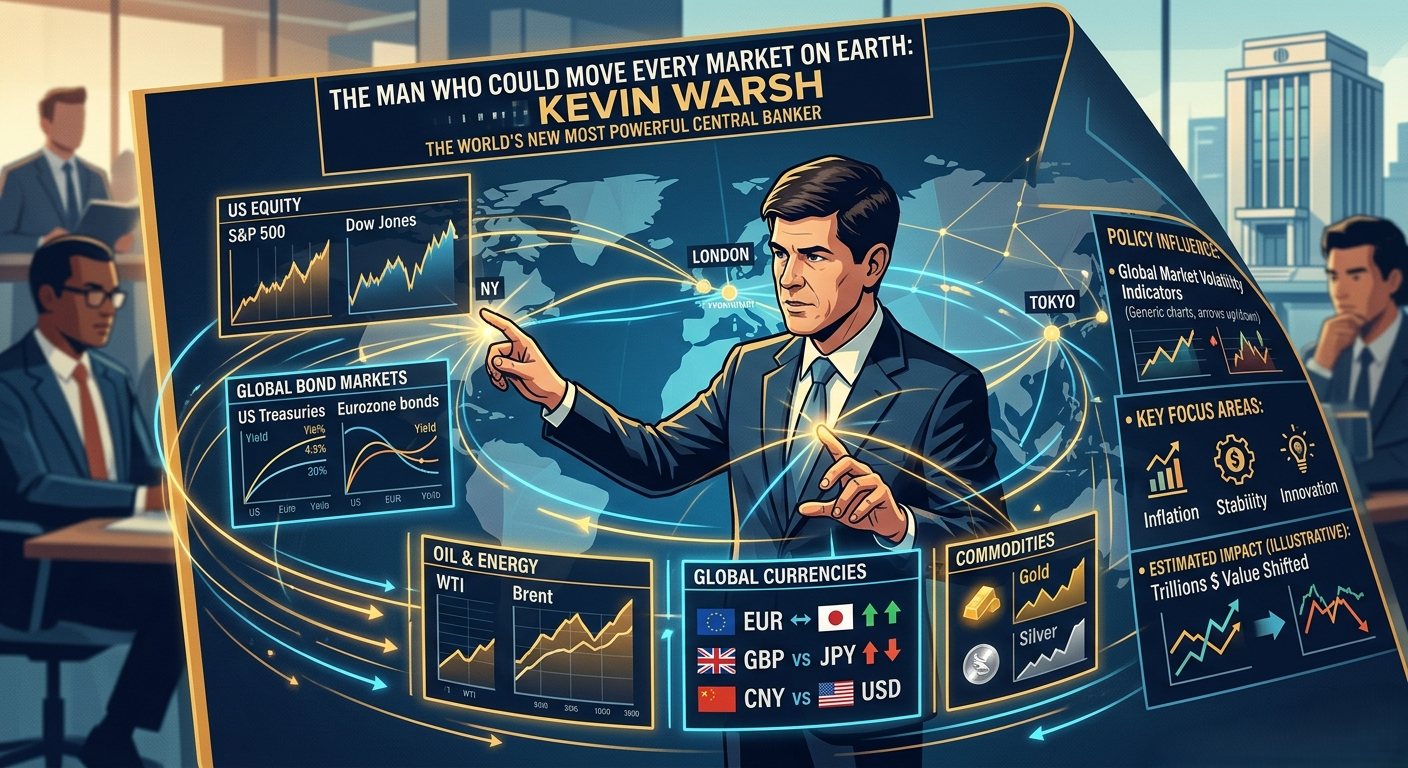
The Man Who Could Move Every Market on Earth: Meet Kevin Warsh, the World’s New Most Powerful Central Banker

Powell is out. Warsh is in. The Federal Reserve has a new chair for the first time in eight years — and every investor, government, and central bank on the planet is recalibrating. Here is what changed, who Kevin Warsh is, what he believes, and what it means for interest rates, bond markets, and the Indian economy.
| On May 15, 2026, Jerome Powell handed over the keys of the world’s most powerful central bank to Kevin Warsh. The handover was confirmed by a 54-45 Senate vote — the most divisive confirmation of a Fed chair in history. Warsh inherits, as one analyst put it, “the most challenging bond market environment in decades”: sticky inflation near 3–4%, elevated bond yields, a White House openly demanding rate cuts, and an AI-fuelled economy that refuses to slow down on cue. Here is the full story. |
🏛️ The End of the Powell Era: What He Leaves Behind
Jerome Powell served as Federal Reserve Chair from 2018 to 2026 — eight years across two very different crises. Trump appointed him in his first term, then spent years publicly demanding he cut rates. In his second term, Trump appointed him again — and then tried to fire him, eventually triggering a Department of Justice investigation into the Fed’s headquarters renovation project.
Despite all of that, Powell’s legacy is broadly positive by conventional measures. He navigated the COVID-19 collapse of 2020 without a financial crisis. He led the most aggressive rate-hiking cycle in 40 years (2022–2023) to tame post-pandemic inflation — and largely succeeded, without tipping the US into recession. His final words to his successor were a call for patience and data-dependence.
Powell’s parting gift: he handed Warsh an economy with a 4.1% unemployment rate, inflation at approximately 3.2%, and a federal funds rate sitting at 3.50–3.75%. Not perfect — but far from broken.
| 🏦 | 3.50–3.75% | Current US Federal Funds Rate (target range, April 2026) |
| 💹 | 3.2% | US Inflation (PCE measure) — above the Fed’s 2% target |
| 📊 | 4.1% | US Unemployment Rate — historically low |
| 📅 | 54-45 | Senate vote confirming Warsh — most divisive in Fed history |
| 💵 | 4.44% | US 10-year Treasury yield (end of March 2026) — elevated |
| 💰 | 4.9% | US 30-year Treasury yield — near decade high |
🧠 Who Is Kevin Warsh? The Man Behind the Most Important Job on Earth
Kevin Warsh, 56, is a Yale Law graduate, former investment banker at Morgan Stanley, and a former Federal Reserve Governor from 2006 to 2011 — making him one of the youngest people ever to serve on the Fed’s board. He was in the room during the 2008 financial crisis, worked alongside Ben Bernanke through the bank bailouts, and came away with strong views about what central banks should and should not do.
After leaving the Fed in 2011, he became a prominent critic of quantitative easing — the policy of buying bonds to flood the system with money. He argued for years that QE was distorting markets, creating asset price bubbles, and ultimately making the Fed’s job harder. He was right about some of it, and critics say he was wrong about other parts.
Trump selected him with one clear priority in mind: lower interest rates. Trump has been loudly impatient with what he sees as an overly restrictive Fed for years. Warsh was chosen partly because he was seen as someone who would ease monetary conditions. But the inflation data — sticky at 3.2% and rising with oil prices from the Iran conflict — may be about to complicate that plan significantly.
⚖️ Warsh’s Monetary Policy: ‘Hawkish Easing’ Explained Simply
Understanding Warsh’s approach requires understanding two concepts: the ‘Fed funds rate’ (the short-term rate the Fed controls) and ‘quantitative tightening’ or QT (reducing the Fed’s massive $7 trillion balance sheet of bonds it bought to support the economy).
Warsh’s framework is best described as: “Lower the short-term rate slightly — but shrink the balance sheet aggressively.” Markets have called this ‘hawkish easing.’ It means:
- Short-term borrowing costs (mortgages, car loans, credit cards) may ease slightly if the Fed cuts rates
- But long-term bond yields may stay high or rise because Warsh plans to actively sell bonds from the Fed’s balance sheet, increasing supply in the market
- This creates an unusual situation: cheaper short-term money but potentially tighter long-term financial conditions
| The simple analogy: Imagine a tap (short-term rates) and a reservoir (the Fed’s bond holdings). Warsh wants to open the tap slightly (cut rates) while draining the reservoir (selling bonds). The result is that while day-to-day borrowing gets a little cheaper, the big money — long-term loans, mortgages, corporate bonds — stays expensive. It is a tightrope walk, and nobody has attempted it quite this way before. |
📊 Powell vs Warsh: The Key Policy Differences
| Policy Area | 🔹 Jerome Powell (2018–2026) | 🔵 Kevin Warsh (2026–) |
| Core doctrine | Data-dependent; patient; cautious | Productivity-led growth; balance sheet discipline |
| Interest rates | Held high to beat inflation; slow cutter | Open to cuts — if data justifies; not a blank cheque |
| QE / Balance sheet | Passive runoff (let bonds expire naturally) | Active sales — aggressive reduction of $7T balance sheet |
| Fed independence | Defended vigorously against Trump pressure | More aligned with White House; independent-but-cooperative |
| Inflation view | 2% target is non-negotiable; cautious | AI will be disinflationary; may allow slightly higher inflation temporarily |
| Communication style | Press conferences, careful language | More direct; willing to signal earlier |
| Bond market impact | Stable; predictable; markets liked him | Uncertainty; ‘hawkish easing’ creates unpredictable yield moves |
📈 The Bond Market Bind: The Problem Warsh Walked Into
The US bond market — the world’s largest financial market at over $27 trillion — is telling a worrying story as Warsh takes charge. Long-term Treasury yields have risen sharply in 2026, driven by three forces:
- Sticky inflation: At 3.2%, US inflation is above the Fed’s 2% target and creeping higher, driven partly by the Iran war’s impact on oil prices through the Strait of Hormuz
- Fiscal deficits: The US government is running a deficit of over $1.7 trillion, meaning it must issue enormous quantities of new bonds — flooding the market with supply and pushing yields up
- AI capex boom: The trillion-dollar investment wave in AI data centres and infrastructure is keeping demand — and growth — resilient, giving the Fed less reason to cut
The result: 10-year Treasury yields hit 4.44% by end of March 2026, and 30-year yields reached 4.9% — near decade highs. This matters for everyone: higher US bond yields pull capital away from emerging markets, including India, and push up borrowing costs globally.
| The paradox Warsh faces: Sometimes the only way to bring long-term yields down is to raise short-term rates — signalling that inflation will be crushed. If Warsh cuts rates prematurely, long-term yields could spike further as markets fear inflation is returning. This is the “$1.7 trillion policy trap”. Even a Fed chair chosen to cut rates may be forced by the data to raise them. |
🌍 What This Means for the World Economy: Country by Country
| Region / Country | Outlook | Why It Matters |
| 🇮🇳 India | Watchful | High US yields pull foreign capital out of Indian equities and bonds. A stronger dollar (from tight Fed policy) makes India’s oil imports costlier. RBI must balance domestic growth with currency stability. |
| 🇨🇳 China | Mixed | China is already in deflation; a tighter US Fed paradoxically gives Beijing more room to ease its own monetary policy. But a strong dollar hurts Chinese exports priced in yuan. |
| 🇪🇺 Eurozone | Cautious | ECB already cutting rates. If Warsh keeps US rates high, divergence widens, weakening the euro vs dollar. Makes European exports competitive but imports expensive. |
| 🇬🇧 UK | Challenged | Bank of England also cutting. Same dynamic as Eurozone: sterling under pressure, inflation import risk. |
| 🇯🇵 Japan | Complex | Bank of Japan finally normalising rates. If Fed stays high, yen stays weak. Japan’s carry trade unwinding could create market volatility globally. |
| 🌍 Emerging Markets | Most at risk | Countries with dollar-denominated debt face higher repayment costs as the dollar strengthens. Capital flows back to the US seeking higher yields, creating pressure on EM currencies. |
🇮🇳 What It Means Specifically for India
India is one of the world’s most exposed large economies to Fed policy shifts. Here is why this Warsh era matters directly to Indian investors, businesses, and consumers:
- The rupee under pressure: When US yields are high, global investors pull money out of India and park it in US Treasuries for safer returns. This puts downward pressure on the rupee, making imports — especially oil — more expensive.
- RBI’s tightrope: India’s Reserve Bank of India has been cutting rates in 2026 to stimulate growth. But if the Fed stays high, the RBI cannot cut too aggressively without risking rupee depreciation and imported inflation.
- FII outflows: Foreign Institutional Investors watch the dollar yield closely. Every time US yields rise meaningfully, FIIs pull money out of Indian equities and bonds. Indian stock markets feel this immediately.
- Your home loan and EMI: The RBI’s rate decisions ultimately flow into bank lending rates. If the RBI is constrained by Fed policy from cutting further, borrowers in India will feel it.
- Gold prices: Higher US yields typically strengthen the dollar and pressure gold prices globally — which means the spectacular gold rally of 2025–26 could face its first serious headwind.
| The silver lining for India: India’s economy is structurally strong heading into the Warsh era — 7%+ GDP growth, record foreign exchange reserves of over $680 billion (a buffer against currency pressure), and the India-EU FTA creating new export markets. A US economy that stays strong under Warsh is also good for Indian IT exports and remittances. The risks are real but manageable. |
❓ Frequently Asked Questions
Who is Kevin Warsh and why is he important?
Kevin Warsh, 56, is the newly confirmed 17th Chair of the US Federal Reserve — the world’s most powerful central bank. The Fed sets US interest rates, which influence borrowing costs, currency values, and capital flows globally. Warsh was confirmed by the US Senate 54-45 on May 13, 2026, and took over from Jerome Powell on May 15.
What is the Federal Reserve and why does it matter to India?
The Federal Reserve (the ‘Fed’) is the central bank of the United States. It controls US interest rates and the supply of dollars in the global financial system. When the Fed raises rates, the dollar strengthens and capital flows out of emerging markets like India. When it cuts rates, the reverse happens. Fed policy affects the Indian rupee, RBI rate decisions, FII flows into Indian markets, and even gold and oil prices.
Will Kevin Warsh cut interest rates?
Warsh is ‘open’ to cuts if data justifies them — but he is not unconditionally dovish. He plans to simultaneously cut short-term rates while shrinking the Fed’s $7 trillion balance sheet aggressively. With US inflation still at 3.2% and bond yields elevated by the Iran war’s oil price shock, the rate-cut timeline is highly uncertain. Some analysts believe Warsh may be forced to raise rates rather than cut them if inflation accelerates.
What is ‘hawkish easing’ in simple terms?
It means: slightly looser short-term interest rates, but tighter overall financial conditions due to aggressive reduction of the Fed’s bond holdings. Short-term borrowing (car loans, credit cards) may get marginally cheaper, but long-term borrowing (mortgages, corporate bonds) could stay expensive or get costlier as the Fed sells bonds into the market.
What happened to Jerome Powell?
Powell’s term as Fed Chair expired on May 15, 2026. He remains on the Fed’s Board of Governors (his governor term runs until January 2028), meaning he will still vote on interest rate decisions. He has said he will keep a low profile and not overshadow his successor.
Disclaimer: This article is for informational and educational purposes only. It is based on publicly available reports and policy updates. It should not be considered financial, investment, legal or business advice.