




























Is America Still the World’s Sole Superpower? An Honest Assessment After 90 Days of Iran, Ukraine, and a Fracturing World Order

Trump promised to end the Iran war in ‘three to four weeks.’ Ninety-plus days later, the Strait of Hormuz has still not fully reopened, Ukraine is no closer to peace, and US bases have been hit across the Middle East. Meanwhile, India, China, and a resurgent Europe are writing their own rules. Here is the clearest, most honest assessment of American power in 2026.
| The promise vs reality: On March 4, 2026, when announcing US military strikes on Iranian nuclear infrastructure, President Trump told reporters the conflict would “be over in three to four weeks.” Today is June 4, 2026. Day 92. The war continues. The Strait of Hormuz has not fully reopened. A peace deal is ‘largely negotiated’ but unsigned. Iran has struck US bases at least 217 times. Oil prices remain elevated. US inflation is at multi-year highs. The gap between that promise and this reality is the starting point for an honest conversation about American power in 2026. |
🚫 What the US Set Out to Achieve — and Where It Stands
Before judging outcomes, it is essential to be precise about what the United States actually set out to achieve. There were four stated objectives at the start of the Iran conflict. The honest scorecard looks like this:
Objective 1: Eliminate Iran’s Nuclear Programme
US strikes destroyed significant portions of Iran’s nuclear infrastructure, including the Natanz and Fordow facilities. RAND’s April 2026 analysis confirmed the operation ‘succeeded in setting the Iranian threat back.’ This is a genuine US achievement. However, Iran still possesses enriched uranium and has not agreed to fully surrender its stockpile. The gap between ‘damage inflicted’ and ‘programme eliminated’ remains wide.
Objective 2: Open the Strait of Hormuz
The Strait was blockaded by Iran beginning in February 2026. After 90+ days, Phase 1 of a framework deal commits Iran to reopening the Strait — but the MoU has not been signed as of this writing. VP Vance said the US is ‘very close but not there yet.’ Iran’s own negotiator publicly declared that Iran obtains concessions ‘through missiles, not talks.’ The Strait remains only partially open, with global oil markets still pricing in supply disruption risk.
Objective 3: Change Iran’s Political Direction
The Trump administration hoped military pressure would either topple the Islamic Republic or force a fundamental change in its behaviour. Neither has happened. Iran’s supreme leader Khamenei remains in place. The revolutionary government has not collapsed. If anything, the foreign threat has historically strengthened nationalist sentiment inside Iran. An investigation by the Washington Post found Iran damaged 217 structures at 15 US military sites across the Middle East in response to the conflict.
Objective 4: End the War Within Weeks
Trump said ‘three to four weeks.’ It is Day 92. The war is not over. A deal is being negotiated, but its Phase 2 — covering the nuclear programme, frozen assets, and Lebanon — represents 30 to 60 more days of talks, with no guarantee of success. By any objective standard, this timeline failed spectacularly
| The Ukraine dimension: The Iran conflict has consumed Washington’s foreign policy bandwidth so completely that Ukraine—Trump’s first major foreign policy project—has been sidelined. Peace talks between Kyiv and Moscow lost what little momentum they had, as the Iran war preoccupied Washington. Russia has been providing Iran with drone tactics and intelligence, effectively using the Middle East conflict as a proxy to weaken US capacity in Europe. The two-front foreign policy challenge has proved more than the administration bargained for. |
📊 But America Is Not Finished. Here Is What the Critics Miss.
Declaring the end of American supremacy based on one difficult conflict would be as mistaken as denying the evidence of strain. Here is what the ‘American decline’ narrative consistently underestimates:
- Military power remains unrivalled. No country on earth can project force at the scale the US can. The Anna Maria Dyner of Poland’s Institute of International Affairs put it precisely: “We know that in military terms there is no equal to the United States.” This has not changed.
- The dollar remains the world’s reserve currency. Despite $36 trillion in debt, foreign governments still buy US treasuries. The dollar still settles most global trade. This structural advantage is eroding — but slowly, not overnight.
- American technology still leads. The AI revolution is being driven by US companies — Nvidia, OpenAI, Anthropic, Google, Microsoft. Semiconductor manufacturing is being rebuilt on US soil. The knowledge economy is still centred in Silicon Valley and Boston.
- Alliance structures hold. Despite tension over Iran, NATO has not collapsed. AUKUS is active. The Quad (with India) is deepening. The US still has more formal allies than any other power on Earth.
🌏 The Real Shift: From Unipolar to Multipolar
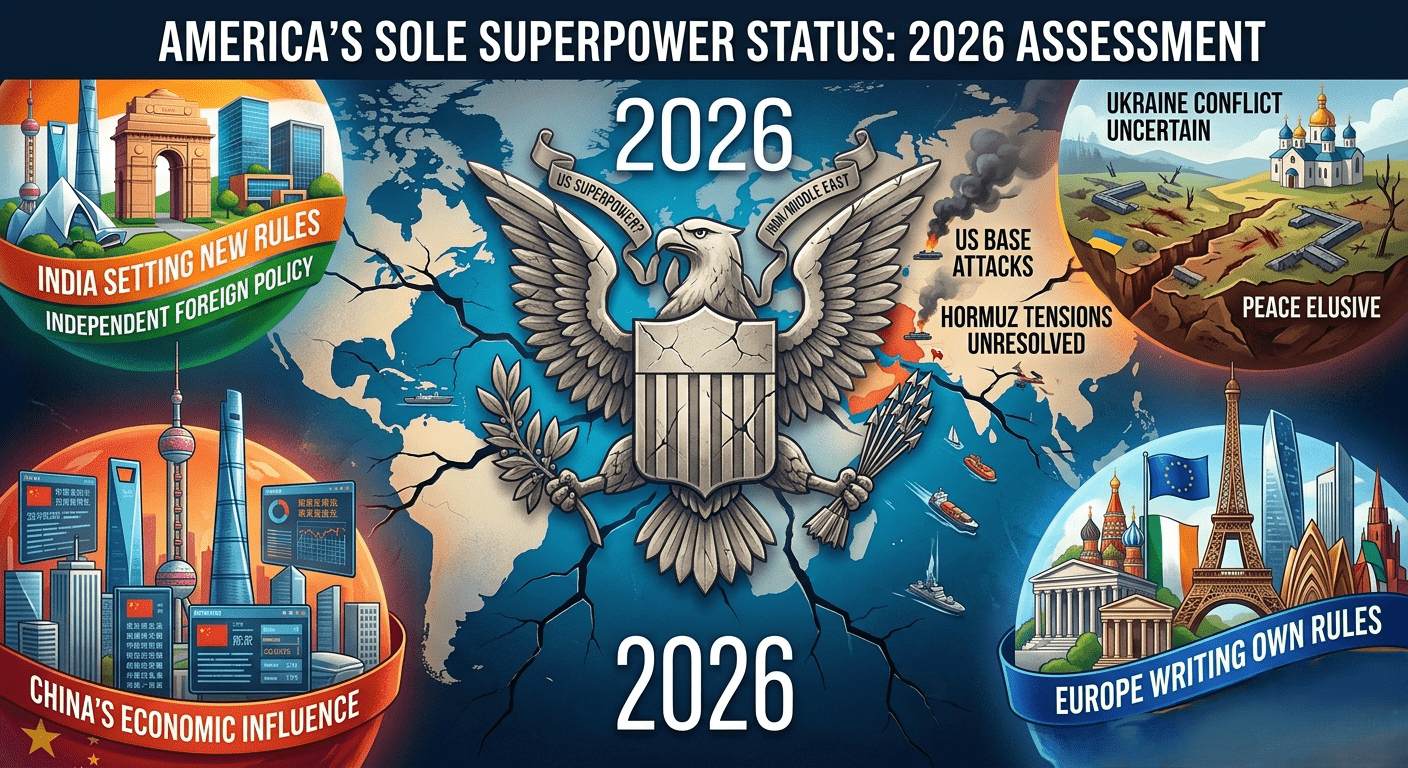
The honest answer to ‘is America still the sole superpower?’ is this: it never truly was, and the gap between American power and the next tier is narrowing faster than at any point since 1991. What has changed is not that the US has become weak. What has changed is that several other actors have become credible
China has the world’s largest navy by number of ships, the second-largest economy, and a technology sector increasingly competitive with the US. Russia, despite its own economic constraints, has demonstrated that a determined regional power can sustain a multi-year war against the combined economic pressure of the West. India has validated its own advanced military technology in combat, emerged as a top-five global defence spender, and is signing its own strategic partnerships across Asia, Europe, and the Americas. The European Union, long accused of strategic passivity, is building its own defence industrial base for the first time.
The Iran war has accelerated this shift in one specific way that matters enormously: it has confirmed that the US can no longer manage multiple major conflicts simultaneously without visible strain. A superpower that is visibly stretched — moving THAAD systems from South Korea to the Middle East, delaying Ukraine peace efforts, struggling to close a deal it promised to close in four weeks — is a superpower that other nations are now willing to route around rather than simply defer to.
| The India reading: For India, this shift is an opportunity. A world where the US is the indispensable but not unchallenged leader — where India can buy Russian oil and American technology, sign defence deals with France and trade agreements with Europe, and mediate between Iran and the US through Pakistan while simultaneously deepening the Quad — is a world built for Indian strategic autonomy. The multipolar world is not India’s enemy. It is the world India has been preparing for since 1947. |
❓ Quick FAQs
Did the US achieve its objectives in the Iran war?
Partially. US and Israeli strikes significantly damaged Iran’s nuclear infrastructure — a genuine strategic achievement. However, the timeline failed completely (promised ‘three to four weeks,’ still ongoing at Day 92), the Strait of Hormuz has not fully reopened, the Islamic Republic has not fallen, and Iran damaged 217 structures at US military sites. The honest answer is: mixed results at high cost.
Is the USA still the world’s most powerful country?
Yes, by most conventional measures. No other country has comparable military reach, financial depth, or technological advantage. But the gap between the US and the next tier of powers — China, India, Russia, the EU — has narrowed, and the US’s willingness to use its power is increasingly constrained by its $36 trillion debt, domestic political divisions, and the demonstrated limits of military force in achieving political outcomes.
Why couldn’t the US end the Iran war in four weeks?
Three reasons: Iran’s strategic depth (the country is large, mountainous, and its infrastructure is dispersed and hardened); Iran’s asymmetric response capability (drones, Hormuz blockade, proxy forces across Lebanon, Iraq, and Yemen); and political constraints (the US needed to avoid civilian casualties, manage allied concerns, and maintain a framework for a negotiated settlement rather than pure destruction). The combination made a fast political resolution impossible despite US military dominance.
Disclaimer: This article is for informational and educational purposes only. It is based on publicly available reports and policy updates. It should not be considered financial, investment, legal or business advice.