
















































India’s Semiconductor Revolution: The Dholera Fab Explained Simply

| In December 2026, a factory in the middle of a Gujarat desert is expected to produce India’s first-ever commercially manufactured microchip. That event — a small silicon wafer rolling off a production line in Dholera — will mark one of the most significant industrial milestones in India’s history. This article explains, in plain language, what microchips are, why India doesn’t make them yet, what is being built in Dholera, who is building it, what the Tata-ASML deal means, and why it matters to every Indian — whether you work in tech or not. |
Let’s Start From the Beginning: What Is a Semiconductor Chip?
Before we talk about factories and billion-dollar deals, let’s make sure we understand what a semiconductor chip actually is — because ‘chip’ is one of those words everyone uses and almost nobody explains.
A semiconductor chip — also called a microchip or integrated circuit — is a tiny piece of silicon, usually smaller than your thumbnail, that contains billions of microscopic switches called transistors. These switches turn on and off billions of times per second to process, store, and transmit information. Every digital device you use — your smartphone, your laptop, your car, your TV, your ATM — runs on chips.
When people talk about ‘chips’ being in short supply, or one country trying to block another from getting chips, this is what they mean: the tiny components without which modern life — as we know it — simply does not function.
| The simple analogy: Think of a semiconductor fab (fabrication plant) like a printing press. But instead of printing words on paper, it prints circuits on silicon. And instead of ink, it uses light, chemicals, and extraordinary precision to etch patterns so small they are measured in nanometres — a nanometre being one-billionth of a metre. |
India Has a Trillion-Dollar Tech Economy. So Why Does It Have No Chip Factory?
This is the question that surprises most people. India has some of the world’s best software engineers. Indian-origin CEOs run companies like Google, Microsoft, IBM, and Adobe. India’s IT services industry is a global giant. And yet, until 2026, India had zero commercial front-end semiconductor fabrication capacity. None. Not a single chip factory that could produce the chips used in everyday devices.
The reasons are layered, but the main ones are:
- Fab economics are brutal. A single modern chip factory costs between $10 billion and $20 billion to build, takes 4–5 years to construct, requires extremely stable power and millions of litres of ultra-pure water daily, and needs thousands of highly specialised engineers. The return on investment takes a decade. Very few countries or companies have the capital, the patience, and the technical base to attempt this.
- India missed the first wave. Taiwan, South Korea, Japan, and the United States built their semiconductor industries in the 1970s–1990s, when land, labour, and capital were structured differently. India was focused on software services — a path that was faster, cheaper, and very successful, but left hardware manufacturing behind.
- Design talent without manufacturing. India currently has nearly one-fifth of the world’s semiconductor design talent — the engineers who design chips on computers. But design and manufacturing are different skills. India excelled at design and neglected manufacturing, creating a gap that is only now being addressed.
- Geopolitical risk was low — until it wasn’t. For decades, global supply chains worked fine. Chips were made in Taiwan and South Korea, assembled elsewhere, and shipped worldwide. The COVID-19 pandemic and the US-China tech war changed that equation permanently. Suddenly, countries realised they had zero control over their access to the components powering their economies.
The Wake-Up Call: COVID, the Chip Shortage, and the New World Order
In 2020–2021, the world ran out of chips. Not because factories blew up — but because COVID disrupted supply chains at exactly the same moment that demand for electronics (laptops, phones, game consoles) exploded as billions of people worked and learned from home.
The consequences were staggering. Car manufacturers halted production lines because they couldn’t get microcontrollers for $2 a piece. Hospital equipment was delayed. Consumer electronics went on backorder for months. Economists estimated the chip shortage cost the global economy hundreds of billions of dollars.
For India, the lesson was stark: a country that cannot make its own chips can be brought to its knees by a supply chain it has no control over. The government began taking semiconductor manufacturing seriously in a way it never had before.
| The geopolitical dimension: The US government, alarmed by its own dependence on Taiwanese chip makers, passed the CHIPS Act in 2022, committing $52 billion to rebuild American semiconductor manufacturing. The EU launched its own European Chips Act. Japan, India, and others followed. The message was the same everywhere: chips are strategic national infrastructure, not just another product. Countries that cannot make them are vulnerable. |
India’s Response: The India Semiconductor Mission
In December 2021, the Indian government launched the India Semiconductor Mission (ISM) with an initial outlay of ₹10 lakh crore (approximately $10 billion) in incentives — offering to fund up to 50% of the capital cost for companies willing to set up fabs in India. In the 2026-27 Union Budget, the government launched ISM 2.0, building on the first phase and strengthening capabilities in equipment, materials, design, supply chains, and skills.
The pitch to global chip companies was straightforward: India offers a democratic, geopolitically stable alternative to Taiwan and China, a massive domestic market, an enormous engineering talent pool, and significant government subsidies. Come build here.
Several companies responded. But the centrepiece of the entire mission — the project that would make everything else credible — was the Tata Electronics fab in Dholera.
India’s Semiconductor Journey: Key Milestones
| Dec 2021 | India Semiconductor Mission launched Government announces ₹10 lakh crore incentive scheme for chip manufacturing |
| Feb 2024 | Cabinet approves Dholera fab Tata Electronics–PSMC Dholera project gets Cabinet approval with ₹91,000 crore investment |
| Feb 2026 | Micron Sanand facility inaugurated PM Modi opens India’s first operational semiconductor ATMP facility in Sanand, Gujarat |
| Apr 2026 | Dholera declared Special Economic Zone Dholera fab site formally gets SEZ status; construction reaches 50% completion |
| May 5, 2026 | Two more projects approved Cabinet approves GaN display fab and a packaging unit in Gujarat (₹3,936 crore combined) |
| May 16, 2026 | Tata-ASML MoU signed in The Hague Landmark agreement signed during Modi’s Netherlands visit; ASML to provide lithography tools |
| Dec 2026 | First silicon expected Initial chip production at Dholera targeted for December 2026 — India’s historic first |
What and Where Is Dholera? Understanding the Site
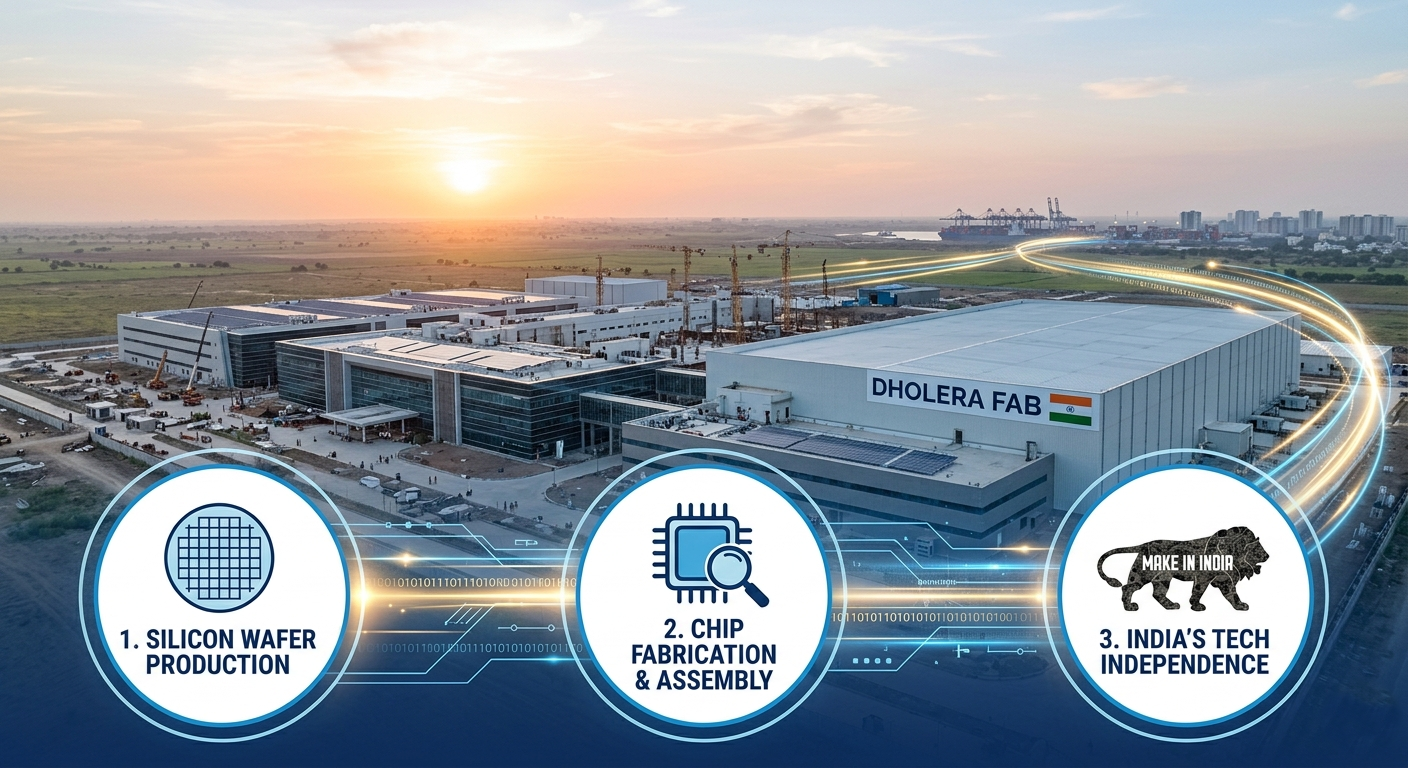
Dholera is a greenfield Special Investment Region (SIR) located approximately 100 kilometres south of Ahmedabad in Gujarat. It was conceived over a decade ago as a planned industrial city built from scratch — the kind of infrastructure-first project that India rarely attempts at scale.
For semiconductor manufacturing, Dholera has some critical advantages:
- It is a greenfield site — no legacy infrastructure to work around. The fab was designed into the location, not retrofitted onto it.
- The Dholera SIR has its own dedicated power infrastructure, including provisions for solar energy to power the facility.
- It has an integrated water management system, critical because semiconductor fabs consume approximately 2 million litres of ultra-pure water per day.
- The site spans 66.2 hectares — roughly the size of 90 football fields — giving room for future expansion.
- SEZ status was formalised in April 2026, along with an on-site inland container depot for efficient logistics.
As of April 2026, construction at the Dholera site had reached 50% completion. Foundation work is finished and the project has moved into cleanroom installation — the ultra-sterile environment where chip manufacturing takes place.
The Dholera Fab: What Will It Actually Make?
The Technical Specs, Made Simple
The Dholera fab is being built by Tata Electronics in partnership with Taiwan’s Powerchip Semiconductor Manufacturing Corporation (PSMC). PSMC is providing the process technology — the recipes and know-how for actually making chips. Think of it as a franchise arrangement: Tata builds and operates the factory; PSMC provides the manufacturing playbook.
The fab will produce chips at the following process nodes: 28nm, 40nm, 55nm, 90nm, and 110nm. If those numbers mean nothing to you, here is what they actually mean:
| What is a “nanometre node” and why does it matter? A nanometre (nm) node refers to how small the transistors on a chip are. Smaller = more transistors per chip = more powerful and efficient. The cutting edge today is 3nm (used in Apple’s latest chips). Dholera will produce 28nm to 110nm chips, which are called ‘mature nodes.’ These are not the chips in your latest iPhone. They are the chips that run your car’s engine management system, your home’s smart meter, your city’s traffic lights, industrial sensors, IoT devices, 5G base stations, and power management in electric vehicles. The global shortage of these ‘unglamorous’ chips caused much of the 2020-21 supply crisis. They are the backbone of the modern economy. |
Scale and Capacity
The Dholera fab is designed to produce 50,000 wafers per month at full capacity. A single 300mm silicon wafer can yield hundreds of individual chips depending on the design. At full ramp, this facility will be producing millions of chips every month for customers in automotive, mobile, AI and industrial sectors globally.
Total investment: $11 billion (₹91,000 crore) — making it one of the largest manufacturing investments in India’s history.
The ASML Deal: Why It Changes Everything
The most significant single development of 2026 for the Dholera project was the MoU signed between Tata Electronics and ASML during PM Modi’s visit to the Netherlands on May 16, 2026.
Who Is ASML?
ASML is a Dutch company and the most strategically critical technology company most people have never heard of. It holds a complete monopoly on one specific but essential category of semiconductor manufacturing equipment: extreme ultraviolet (EUV) and deep ultraviolet (DUV) lithography machines.
Lithography is the process of using light to ‘print’ circuit patterns onto silicon wafers. Without ASML’s machines, you cannot make modern chips at scale. There is no alternative supplier. A single ASML machine can cost between $60 million and $380 million. The United States has spent years pressuring the Netherlands to restrict ASML’s exports to China precisely because of this monopoly.
| Why the ASML-India deal is geopolitically significant: China has been denied access to ASML’s most advanced machines. India is getting ASML’s technology, talent development support, and supply chain infrastructure for Dholera. This positions India as the ‘trusted alternative’ in global chip supply chains — a role that Western governments, desperately trying to reduce dependence on China and Taiwan, are actively encouraging. |
What the Deal Covers
The Tata-ASML MoU is not just an equipment purchase agreement. It covers:
- Supply of DUV ArF immersion lithography systems for the Dholera fab (the specific machines used for 28nm–110nm chips)
- Metrology and process control tools to ensure chip quality and yield from day one
- Workforce training and talent development programmes for Indian engineers
- Supply chain resilience and local service capability — so India is not dependent on flying in Dutch engineers every time a machine needs servicing
- R&D infrastructure development for long-term semiconductor innovation in India
ASML CEO Christophe Fouquet described India’s semiconductor sector as presenting “many compelling opportunities” and said ASML looks forward to contributing technological expertise and helping “nurture talent in India.”
The Bigger Picture: India’s Full Semiconductor Ecosystem
Dholera is the centrepiece, but it is not the whole story. A broader ecosystem of chip-related facilities is emerging across India:
| Company | Type | Location | Investment | Status (2026) |
| Tata Electronics–PSMC | 300mm Fab | Dholera, Gujarat | $11 billion | 50% built; First silicon Dec 2026 |
| Micron Technology | ATMP / Packaging | Sanand, Gujarat | $2.75 billion | Operational — 6.3M chips/day |
| Kaynes Semicon | OSAT / Packaging | Sanand, Gujarat | ₹3,300 crore | Operational since Mar 2026 |
| Crystal Matrix Ltd | GaN / Compound Semi | Dholera, Gujarat | ₹3,936 crore (combined) | Cabinet approved May 2026 |
| HCL–Foxconn | ATMP Unit | Jewar, UP | ₹3,706 crore | Under development |
| ISMC–Tower Semi | Analog Fab | Karnataka | TBD | Proposed |
What Does This Mean for Jobs and the Indian Economy?
This is the question that matters most to most Indians. The answer is significant — and goes well beyond the factory floor.
Direct Job Creation
The Dholera Tata Electronics fab alone is expected to generate over 20,000 direct jobs. These are not ordinary factory jobs: semiconductor fab workers are among the best-paid manufacturing employees in any economy, typically earning 3–5 times the average manufacturing wage. Categories include:
- Process engineers: Specialists who manage the chip-making process
- Equipment engineers: Technicians who maintain and operate the lithography and etching machines
- Yield engineers: Analysts who identify and fix defects to maximise the number of working chips per wafer
- Clean-room operators: Technicians who handle wafers in the sterile manufacturing environment
- Quality and metrology: Engineers who measure and verify chip dimensions and performance
The Talent Pipeline: Training 1 Million Engineers
The government’s semiconductor workforce strategy is ambitious. The Chips to Startup (C2S) programme aims to train 85,000 engineers in VLSI (chip design) and embedded systems by FY2027. Beyond that, India’s roadmap targets training approximately 60,000 engineers annually using ‘virtual fab’ digital simulation technology — allowing students to practise chip manufacturing processes without needing access to a physical cleanroom.
The ultimate ambition: one million chip-ready engineers by 2030.
| Already one-fifth of the way there: India currently houses nearly one-fifth of the world’s semiconductor design talent. The country is not starting from zero — it is converting existing design expertise into full-stack manufacturing capability. The gap to close is in process, equipment, and yield engineering, where specialised training is now being scaled up rapidly. |
The Multiplier Effect on the Economy
Every chip factory job creates multiple indirect jobs in logistics, maintenance, chemicals supply, clean-room consumables, food services, housing, and local services. Industry estimates suggest that for every direct fab job, 5–10 indirect jobs are created in the surrounding economy.
More significantly, domestic chip production reduces India’s import bill. India currently imports chips worth tens of billions of dollars annually. As domestic production scales, that outflow reverses — and India begins earning export revenue from chips instead.
For a country trying to shift from a services-led economy to a high-value manufacturing hub — the stated goal of Make in India — semiconductor manufacturing is the highest-value, highest-multiplier sector available.
The Honest Picture: Challenges and Risks
No honest assessment of India’s semiconductor ambitions can ignore the very real challenges:
Water and Power
A semiconductor fab consumes approximately 2 million litres of ultra-pure water per day and requires completely stable, uninterrupted power. Dholera’s greenfield design includes water recycling and dedicated solar power, but executing this reliably at scale is a genuine operational challenge in a water-stressed region.
Talent Migration
India has strong chip design talent, but many of the best-trained engineers migrate to the US, Taiwan, and South Korea for higher salaries and more advanced work environments. Building a domestic industry that retains this talent requires not just factories but competitive salaries, research opportunities, and career pathways — a harder problem than building the fab itself.
Supply Chain Dependence
Despite the ASML deal, India remains heavily dependent on imports for semiconductor equipment, specialty gases, photoresists, and silicon wafers. A single geopolitical shock — export controls, tariff disputes, or conflict — could delay production. Building domestic supply chain depth will take a decade or more.
Execution Risk
Semiconductor fabs are among the most complex construction and operational projects in human history. The tolerance for error is close to zero: a single contamination event in the cleanroom can delay first silicon by months. India has never built or operated a facility of this kind before. The learning curve is steep and the cost of mistakes is high.
| The bottom line on risk: None of these challenges are insurmountable, but none of them are trivial either. India’s semiconductor mission will succeed or fail based on execution, not ambition. The ambition is clear. The funding is committed. The partnerships are signed. What remains is the hardest part: delivery. |
Why Every Indian Should Care — Even If You’re Not in Tech
You do not need to work in technology for India’s semiconductor mission to affect your life. Here is why it matters to everyone:
- Your phone, your car, your electricity meter, your hospital equipment: all run on chips. India making its own means lower costs, more reliable supply, and less vulnerability to global disruptions.
- National security: Military drones, communication systems, satellite technology, and missile guidance all depend on semiconductors. A country that cannot make its own chips is strategically exposed.
- Economic sovereignty: Importing chips costs India tens of billions of dollars a year. Manufacturing them domestically keeps that money in India and creates a new export industry.
- Jobs and wages: Semiconductor manufacturing creates some of the highest-paying factory jobs in any economy. The downstream effect on the middle class is significant.
- India’s global standing: A country that makes chips has a seat at the table in global technology negotiations. A country that only buys them does not.
Frequently Asked Questions
What is a semiconductor fab?
A semiconductor fabrication plant (fab) is a factory that manufactures microchips — the tiny silicon components that power all digital devices. It uses a process called lithography to etch microscopic circuits onto silicon wafers using light and chemicals.
When will the Dholera fab produce its first chip?
Initial chip production at the Dholera fab is targeted for December 2026. This would make it India’s first-ever commercial front-end semiconductor fabrication facility to produce chips domestically.
What chips will Dholera make?
The Dholera fab will produce chips at process nodes ranging from 28nm to 110nm. These are ‘mature node’ chips used in automotive systems, 5G infrastructure, IoT devices, power management, electric vehicles, industrial sensors, and AI applications — not the cutting-edge chips in the latest smartphones.
What is the Tata-ASML deal?
Tata Electronics and ASML (the Dutch company with a global monopoly on advanced lithography machines) signed an MoU on May 16, 2026, during PM Modi’s visit to the Netherlands. Under the agreement, ASML will supply lithography tools and related support for the Dholera fab, and will also help train Indian engineers and build local supply chain capability.
How many jobs will the Dholera fab create?
The Dholera fab is expected to generate over 20,000 direct jobs. With multiplier effects across the supply chain and local economy, the total employment impact is significantly higher. Semiconductor jobs are among the highest-paid in manufacturing.
What is the India Semiconductor Mission?
The India Semiconductor Mission (ISM) is a government programme launched in 2021 that offers to fund up to 50% of the capital cost for companies setting up chip fabs in India. ISM 2.0 was launched in the 2026-27 Budget to build on the first phase and strengthen capabilities in equipment, materials, design, supply chains, and skills.
Disclaimer: This article is for informational and educational purposes only. It is based on publicly available reports and policy updates. It should not be considered financial, investment, legal or business advice.